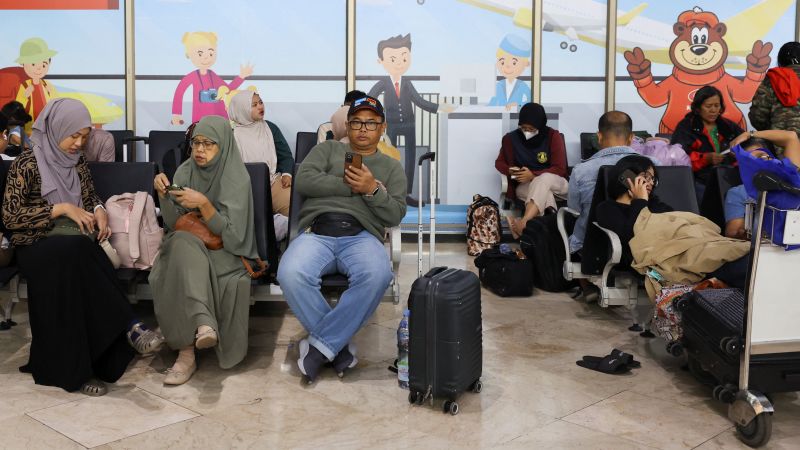
Volcanic ash leaves 170,000 travelers stranded at eight Indonesian airports

Daftar Isi
Ash Cloud from Anak Krakatau Grounds Eight Airports Across Indonesia
Healfromzero.com – Travelers across western Indonesia faced a massive disruption early Monday morning as volcanic ash from Mount Anak Krakatau forced the closure of eight airports, including both facilities serving the capital, Jakarta. The transport ministry confirmed that roughly 170,000 passengers were affected by cascading flight cancellations, making it one of the largest single-event aviation disruptions in the country’s recent history.
The ash plume, generated by eruptions that began late Friday, has blanketed Jakarta and multiple surrounding provinces. Because the volcano sits roughly midway between the islands of Java and Sumatra, its output drifts unpredictably depending on wind patterns, complicating any attempt to set a firm reopening schedule.
Airport Closures and Passenger Impact
Jakarta’s primary international gateway remained shut through at least 6 p.m. local time on Monday, according to statements posted by its operators on social media. Seven additional airports, serving the nearby provinces of Lampung and West Java among others, were ordered closed until no earlier than 08:59 a.m. the following morning.
Transport Minister Dudy Purwagandhi acknowledged the uncertainty surrounding the timeline in a written statement issued Monday:
“We cannot ascertain when this will end due to the dynamic weather.”
The minister’s remark underscored a recurring challenge in Indonesian aviation: volcanic events in the archipelago often produce ash clouds that shift with changing wind directions, making it impossible to guarantee a safe corridor for aircraft on a fixed schedule. Airlines operating out of the affected airports were left to reroute or cancel flights with little advance notice, compounding confusion for connecting passengers.
Scale of the Eruption
Indonesia’s meteorological agency, BMKG, documented ash columns reaching approximately 20,000 feet (6,000 meters) on the Java-facing flank of the volcano and as high as 50,000 feet (15,000 meters) on the Sumatra-facing side. Portions of Banten province on Java also received measurable ashfall, according to data posted on the agency’s website.
The volcano monitoring authority logged the most recent significant eruption at 8:23 p.m. on Sunday and issued a warning on Monday that continued activity was likely:
“The probability of further eruptions in the coming periods remains high.”
By Monday, Anak Krakatau had entered its second consecutive day of major eruptive activity, a pattern that typically signals sustained magma movement beneath the edifice and increases the likelihood of additional ash emissions over subsequent days.
Public Health and Educational Measures
With fine particulate matter drifting over populated areas, the national disaster agency urged residents to wear protective masks whenever traveling outdoors, reducing the risk of inhaling abrasive volcanic particles that can irritate airways and exacerbate respiratory conditions.
In both Jakarta and the Lampung region, schools transitioned to remote-learning arrangements to limit students’ exposure to degraded air quality, according to state news agency Antara. The shift, while temporary, reflects a standard protocol in Indonesian disaster management when airborne ash concentrations exceed recommended thresholds for prolonged outdoor activity.
Geological Background: Anak Krakatau and the Ring of Fire
Indonesia’s position along the Pacific Ring of Fire — a horseshoe-shaped belt of tectonic plate boundaries encircling the Pacific basin — makes the archipelago one of the most volcanically active regions on Earth. Earthquakes, tsunamis, and explosive eruptions occur with a frequency that shapes national infrastructure planning, emergency preparedness, and aviation routing.
Anak Krakatau, whose name translates to “child of Krakatau,” first emerged roughly a century ago from the caldera left behind by its predecessor. The older volcano, historically known as Krakatoa, obliterated itself in a cataclysmic series of eruptions in August 1883. That event generated a chain of tsunamis that killed more than 36,000 people across the Sunda Strait and remains one of the deadliest volcanic disasters in recorded history. The younger cone that grew in its wake has since produced its own succession of eruptions, periodically reshaping the small island on which it sits.
For travelers and residents of western Java and eastern Sumatra, the current episode serves as a reminder that aviation in this corridor is perpetually exposed to volcanic risk. Airlines operating trans-Java and trans-Sunda routes maintain contingency plans for ash-avoidance rerouting, but the sheer number of airports affected simultaneously — eight in this instance — strains those plans and leaves passengers with limited alternatives. Until BMKG downgrades the eruption alert and wind patterns clear the flight corridors, the disruption is expected to persist, with further closures possible if additional ash columns develop.
Related Reading
Frequently Asked Questions
What is Volcanic ash leaves 170 000 travelers?
Volcanic ash leaves 170 000 travelers is the main topic of this guide. The article explains the context, practical details, and next steps readers should understand.
Why does Volcanic ash leaves 170 000 travelers matter?
Volcanic ash leaves 170 000 travelers matters because readers are looking for a useful answer, not just a short summary. Good content should match search intent and help them decide what to do next.