From heated rivalry to frenemies: Inside the cutthroat business of ruling tech in Asia

Daftar Isi
When Rivals Become Partners: How the AI Chip Boom Is Rewriting Asia’s Tech Rivalry
Healfromzero.com – The data centers stretching across Virginia, Germany, and beyond are filling up with hundreds of thousands of AI servers, each one a monument to an industrial interdependence that would have seemed absurd just a few years ago. Inside every single Nvidia AI server sits a computing chip fabricated by Taiwan’s TSMC, memory components sourced from South Korea’s SK Hynix or Samsung, and proprietary assembly techniques that fuse those elements into functioning AI accelerators. Taiwanese manufacturers then integrate those accelerators into server racks fitted with advanced thermal-management systems before the units ship out to power generative-model training runs. The result is a supply chain so tightly braided that neither island economy can operate the other’s absence.
For decades, South Korea and Taiwan waged a grinding, often vicious contest for dominance over the technologies that define the digital age — from flat-panel televisions and mobile phones to the memory chips that store everything in between. That rivalry, rooted in parallel postwar industrial strategies and shared colonial histories under Japan, is now giving way to a form of cooperation neither side could have imagined a generation ago. The driver is simple: the global appetite for AI computing power has grown so vast that no single nation can meet it alone.
The Urgency Written on a Wafer
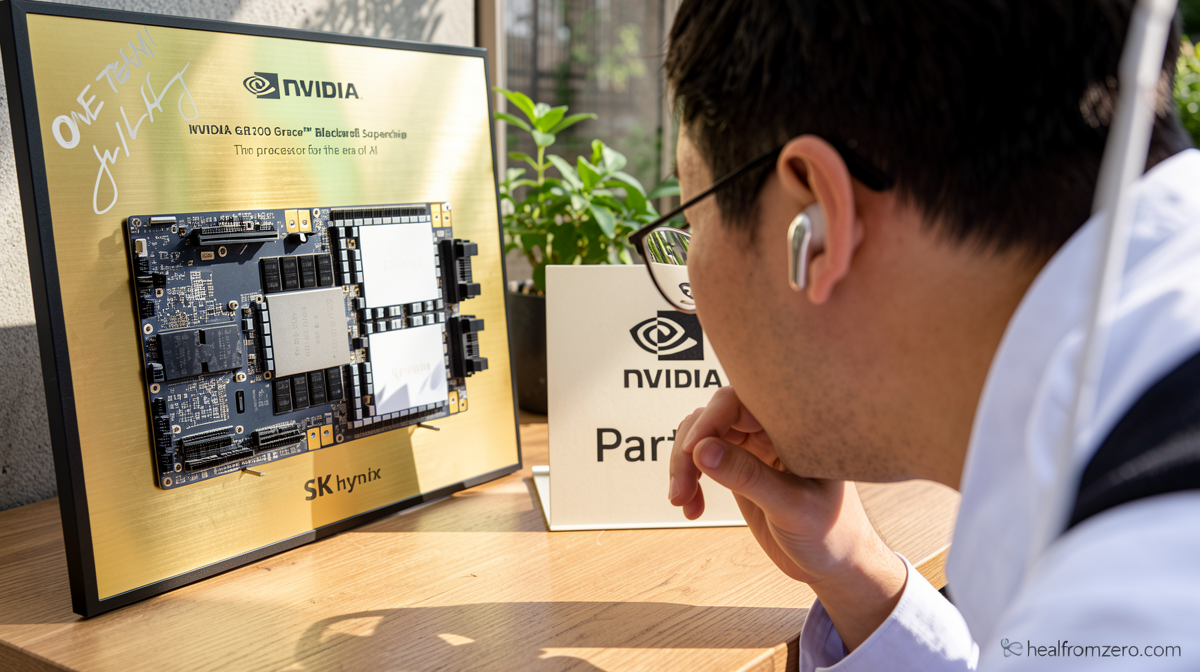
The strain in accelerator supply chains became impossible to ignore in June, when Nvidia chief executive Jensen Huang took a memory wafer produced by South Korean firm SK Hynix at Taipei’s annual computer exhibition and scrawled a note across its surface:
“Please make more.”
The gesture captured a reality that industry executives have been whispering about for months. Tech giants are consuming computing capacity at a pace designed to lock in advantages in frontier-model development, and the expansion of AI infrastructure worldwide has outstripped what any one country’s fabs can deliver. The products of Nvidia and AMD — the two firms that architect the dominant accelerator designs — depend on components flowing across the strait between Taiwan and South Korea in quantities that stretch both sides’ manufacturing capacity to its limits.
“In the AI era, technological competitiveness alone is not enough and the ability to supply the required volume at the exact moment customers need it is the ultimate competitive advantage,” an SK Hynix spokesperson stated, noting the company is accelerating construction of new fabrication plants.
A Rivalry Forged in Parallel
The cooperative posture masks a long history of direct confrontation. Both economies emerged from Japanese colonial rule with similar industrial blueprints: export-led growth beginning with labor-intensive textiles in the 1960s, migrating into consumer electronics and home appliances through the 1970s and ’80s, and eventually into high-value electronic components such as display panels and memory chips. Both also completed the transition from authoritarian governance to functioning democracies, a parallel that deepened the sense of mirrored destinies.
Competition intensified as Asia consolidated its position as the world’s factory for electronic components. On the consumer-brand front, Taiwanese makers Acer and Asus clashed with Samsung and LG in personal computers, while HTC took on Samsung in smartphones. Yet the balance of power tilted steadily toward Seoul. South Korea’s giant conglomerates — Samsung chief among them — integrated multiple stages of the supply chain under one corporate roof, giving them scale advantages that smaller Taiwanese firms struggled to match.
The intensity of that rivalry found an unusual outlet in 2013, when Taiwan’s Business Today magazine ran a piece by veteran technology journalist Owen Lin describing an internal Samsung meeting in 2008 where executives allegedly discussed a “Kill Taiwan” strategy aimed at dominating every industry where Taiwanese firms competed. Samsung rejected the existence of such a strategy at the time and declined further comment when approached again. Lin himself, author of Chip Champion: The Triumph of TSMC and Taiwan, has noted that cooperation between the two economies was historically rare compared with competition.
Necessity Overwrites History
Even in contract chipmaking — the sector TSMC now commands with near-total dominance — Samsung once held the upper hand before the iPhone era reshaped the competitive landscape. The memory-chip market, meanwhile, has long been a two-player game between Samsung and SK Hynix, with Taiwanese firms largely excluded from the highest-value segments.
Yet the economics of AI accelerators have made that old geometry untenable. The specialized hardware that trains generative models must execute trillions of parallel calculations, and the components required to build it span both island economies in ways that no single-country substitution can replicate. The result is a forced alignment of interests that overrides decades of competitive reflex.
“We don’t have time to get into this old-fashioned conflict,” said Sung Soo Eric Kim, distinguished guest professor at Keio University in Tokyo. “There’s so much demand; we have to cooperate and supply first.”
Kim cautioned against over-reading the old rivalry narratives, observing that every major corporation formulates market strategies against competitors across Taiwan, Japan, and the United States simultaneously. “They would, of course, have market strategies competing with not just Taiwan, Japan, and the United States — they’re a global company,” he added.
What Comes Next
The partnership is fragile by nature. It rests on continued demand for accelerators, on the absence of a geopolitical shock that severs cross-strait logistics, and on both governments maintaining open trade corridors. SK Hynix’s accelerated factory-buildout and TSMC’s ongoing capacity expansions are hedges against supply shortfalls, but they also signal that neither side trusts the other’s timeline. The frenemy dynamic — cooperation under pressure, competition the moment the pressure eases — may prove the defining feature of Asia’s next industrial chapter. What is no longer in question is that the two economies are now, whether they like it or not, building the same machine.
Related Reading
Frequently Asked Questions
What is From heated rivalry to frenemies?
From heated rivalry to frenemies is the main topic of this guide. The article explains the context, practical details, and next steps readers should understand.
Why does From heated rivalry to frenemies matter?
From heated rivalry to frenemies matters because readers are looking for a useful answer, not just a short summary. Good content should match search intent and help them decide what to do next.