Why even resilient forests are struggling to regrow after wildfires

Daftar Isi
Hotter Wildfires Are Changing Forests Faster Than They Can Recover
Healfromzero.com – In parts of the United States once defined by dense, fire-adapted woodland, severe wildfires are leaving behind landscapes that may not return to forest for generations. Instead of a familiar cycle of burning and regrowth, researchers are increasingly finding open grasslands, shrub-covered slopes and sparse stands of surviving trees.
The change is especially visible in Yellowstone National Park, where ecologist Monica Turner has spent decades studying the aftermath of fire. Her work has covered recovery from Yellowstone’s historic 1988 fires, but a return visit following the 2016 Maple Fire showed how different the new conditions can be.
A familiar route transformed
Turner first crossed a western Yellowstone hillside in 2013 during a cold, rainy July. The compact forest was so thick that moving through its branches offered little relief from the chill. Four years later, the same route was dramatically altered.
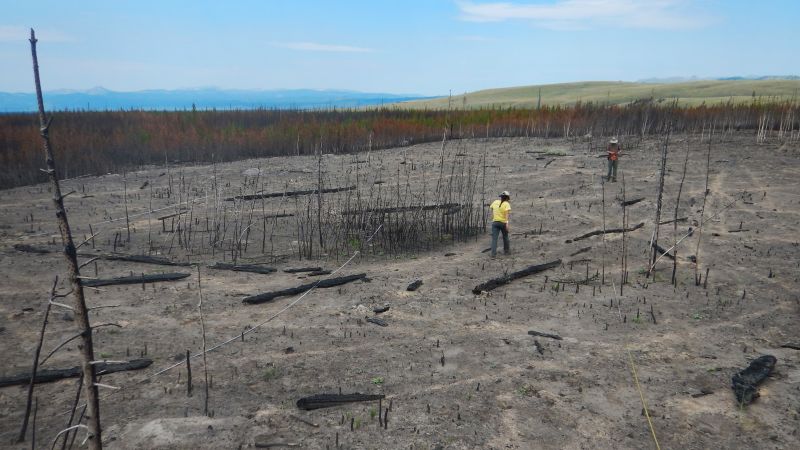
The fire had cleared much of the woodland, exposing a broad, sun-baked opening. A few mature trees remained, while thin young stems pushed up from blackened soil. What had once been a shaded forest had become a hot, exposed field.
Turner, the Eugene P. Odum Professor of Ecology and a Vilas Research Professor at the University of Wisconsin-Madison, had witnessed extensive wildfire damage before. Yet the scale of loss after the Maple Fire was striking because this was a landscape that had burned in the past and had still recovered with dense tree growth.
During the 2017 field trip, the heat was far more intense than what Turner had grown used to during Yellowstone summers. Cool and wet conditions had long been common during her research seasons. At one point, a field assistant was hospitalized for dehydration.
The scene also recalled Turner’s experience during the fires of 1988, when ash coated the ground, her face and her socks. For years, those fires stood as a powerful example of nature’s capacity to rebuild: even after miles of trees were scorched, forests returned in large numbers.
“We could see what we call ghost logs, which is where there had been large logs on the ground, and they were completely combusted,” she said. “And then you can see their shadows where the white ash is left behind from the hot temperatures.”
Those remains point to the extraordinary heat of recent fires. Large fallen logs that might ordinarily persist after a burn had been consumed almost completely, leaving pale ash outlines where wood once lay.
Regrowth is falling behind
Only about 5% of tree seedlings have returned so far in the area affected by the 2016 fire, compared with the area that burned. Grasses now move across the open meadow, joined by wildflowers commonly seen after wildfire. The landscape is not empty, but its recovery is moving in a different direction.
Turner has identified what she calls a gradual yet measurable move toward plant communities better suited to heat and dry weather. Such plants may also be more capable of returning after repeated fires. That resilience, however, does not necessarily mean the old forest will reappear.
Fire itself is not inherently harmful to these ecosystems. Scientists studying fire-prone landscapes emphasize that many forests need periodic burning. Fire can remove accumulated dead vegetation, recycle nutrients and support the conditions in which certain native plants and trees reproduce.
The concern is that a changing climate is contributing to faster-moving, hotter and more destructive fires, while a long history of limiting prescribed burning has allowed fuel to build up in many places. Indigenous communities have long used intentional, carefully managed fire to clear dead plant material and maintain healthy landscapes. Without regular low-intensity burns, vegetation can become more vulnerable when an extreme wildfire arrives.
From forest to meadow
Researchers are now considering what happens when forests that evolved with fire encounter burns that are hotter and more frequent than the ecosystems can absorb. The result may not be a sudden, uniform collapse. Instead, landscapes could gradually shift, with tree-covered terrain becoming scrubland or grassland over time.
That possibility carries consequences beyond the appearance of a park or forest. Trees provide shade that can moderate ground and water temperatures. In Yellowstone, Turner said the loss of shade contributed in part to warm, low-water conditions that placed added stress on fish. At one point, the park temporarily prohibited fishing, including catch-and-release, because fish were already struggling with the conditions.
Visitors may also notice the transition. Forests shape where people seek shade, how they experience trails and what they expect from iconic landscapes. Open areas can support their own plants and wildlife, but they offer a different environment from the tall conifer forests many visitors associate with Yellowstone.
The larger question is whether these ecosystems will reach a point at which tree recovery becomes increasingly difficult. That threshold may vary by location, elevation, rainfall and the severity of future fires. In many places, the shift may be subtle at first: fewer seedlings, more grasses and shrubs, and longer stretches of open ground after each burn.
Yellowstone’s experience shows why past patterns cannot always be treated as a guarantee for the future. The park’s forests have demonstrated remarkable resilience, including after 1988. But warmer, drier conditions and extreme fire behavior are testing that resilience in new ways. The forests are still changing and growing, yet the trees that once defined them may no longer be the dominant feature everywhere they once stood.
Related Reading
Frequently Asked Questions
What is Why even resilient forests are struggling?
Why even resilient forests are struggling is the main topic of this guide. The article explains the context, practical details, and next steps readers should understand.
Why does Why even resilient forests are struggling matter?
Why even resilient forests are struggling matters because readers are looking for a useful answer, not just a short summary. Good content should match search intent and help them decide what to do next.