US Air Force flight to Antarctica turns back after space activity warning

Daftar Isi
Antarctic Logistics Disrupted as US Military Transport Diverts After Russian Space-Activity Alert
Healfromzero.com – A United States Air Force cargo aircraft en route to the Antarctic continent made an unplanned turnaround back to Christchurch, New Zealand, after New Zealand aviation regulators flagged a potential collision risk linked to orbital activity. The incident, which unfolded over roughly two and a half hours on Tuesday morning, underscored how routine polar supply missions can be upended by events occurring far above the atmosphere.
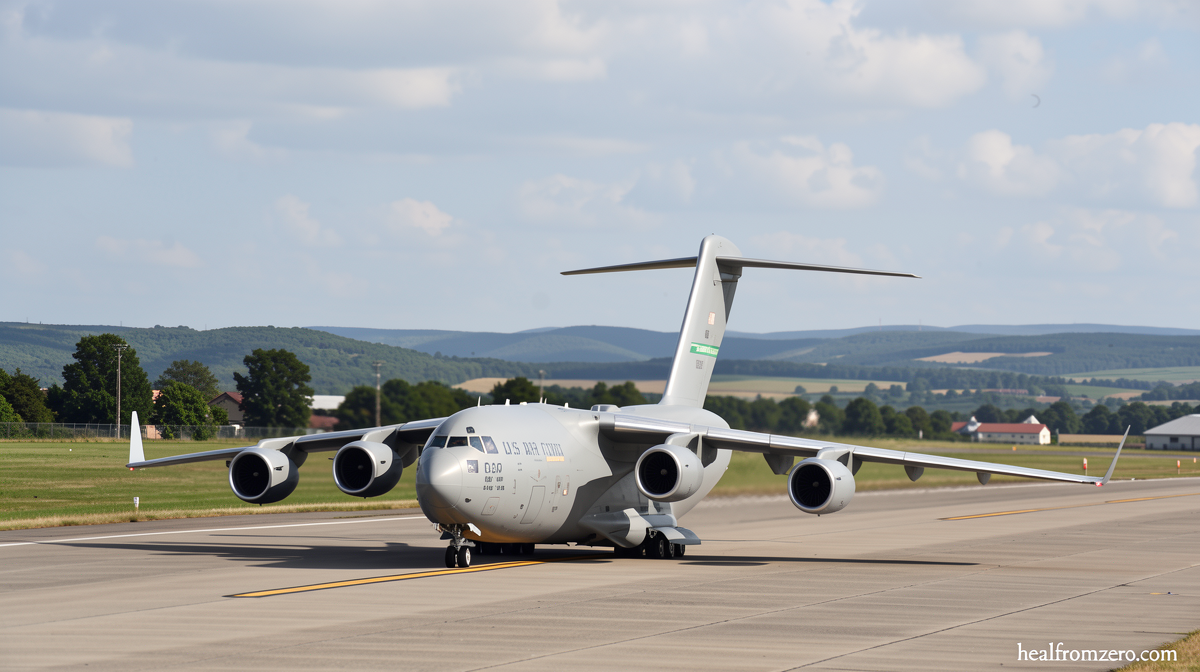
The aircraft in question was a C-17 Globemaster III, a four-engine military transport routinely used to ferry personnel, scientific instruments, and bulk provisions between New Zealand and the research outposts on the Antarctic ice sheet. Flight-tracking data from Flightradar24 recorded the plane lifting off Christchurch Airport at approximately 9:00 a.m. local time under the call sign ICE28, heading south toward the continent. By just before 11:30 a.m., the aircraft had completed a full reversal and touched down again at its departure airfield, having spent roughly 150 minutes airborne before the decision to abort the mission was executed.
The Trigger: A NOTAM Issued on Russia’s Notification
New Zealand’s Civil Aviation Authority (CAA) confirmed that it had issued a NOTAM — a Notice to Airmen, the standard instrument through which air-traffic authorities broadcast time-limited hazards to pilots worldwide. The alert was prompted by information relayed from Russia’s State Air Traffic Management Corporation, which notified the New Zealand agency of a planned missile launch and its associated debris or fragmentation risk to international airspace.
“We put in place a danger area and issued a NOTAM to alert aircraft operators to the potential hazard. This does not prevent aircraft from flying through the area, operators make their decisions based on the information available,” the CAA said in a statement released Wednesday.
The authority stressed that a NOTAM is advisory rather than prohibitive: pilots retain final authority over whether to proceed, reroute, or turn back. In this case, the US Air Force crew opted for the safest course and returned to base.
Why the Oceanic FIR Matters
The airspace in question falls within New Zealand’s Oceanic Flight Information Region, a vast zone spanning approximately 30 million square kilometres of Pacific Ocean and Tasman Sea. It ranks among the largest contiguous airspaces administered by any single national authority. Because much of this region sits over international waters, the CAA acknowledged its jurisdictional limits.
“Much of our Oceanic FIR is over international waters, where we have limited control over activities,” the agency added.
In practical terms, this means that while New Zealand is responsible for providing flight-information services to aircraft transiting certain altitude bands across that oceanic expanse, it cannot dictate what other nations do with their launch vehicles or orbital debris. The responsibility for notifying affected airspace controllers rests with the launching state — in this instance, Russia.
WINFLY: The Narrow Window That Cannot Wait
The disrupted sortie was scheduled during the annual Winter Fly-in, commonly abbreviated WINFLY, a tightly compressed operational window in which regular scheduled flights resume between Christchurch and two Antarctic stations: McMurdo Station, the United States’ primary logistics hub on the Ross Ice Shelf, and Scott Base, New Zealand’s year-round research outpost. During WINFLY, dozens of flights in quick succession move rotating scientific staff, replacement fuel, construction materials, and seasonal equipment onto the ice ahead of the austral summer research season, when the continent becomes accessible by sea and the population swells from a few hundred to several thousand.
A single diverted flight within that compressed schedule creates cascading delays. Crews, cargo manifests, and downstream station operations all depend on predictable arrival times. A two-and-a-half-hour airborne turnaround, followed by the need to re-plan the mission around weather windows and fuel constraints, can push a station’s resupply timeline by days.
Space Activity and Civil Aviation: A Growing Intersection
The episode is not an isolated curiosity. As launch cadence increases globally — driven by commercial satellite constellations, national-space-program milestones, and military test campaigns — the probability of orbital debris or rocket-stage re-entry intersecting high-altitude flight corridors rises correspondingly. International conventions require launching states to notify relevant air-traffic authorities when a mission’s predicted trajectory or debris corridor overlaps populated or heavily trafficked airspace. The NOTAM system, dating to the early decades of commercial aviation, is the mechanism through which that notification reaches pilots in real time.
For polar routes, the geometry is particularly sensitive. Flights from Christchurch to McMurdo or Scott Base traverse long stretches of oceanic FIR at high altitude, precisely the bands where re-entering rocket bodies or upper-stage fragments are most likely to be encountered. A launch scheduled even thousands of kilometres away can project a debris corridor across the southern Pacific, forcing operators to weigh the risk against the operational urgency of the mission.
Aftermath and Outstanding Questions
As of Wednesday, the CAA had not disclosed the specific parameters of the Russian launch — vehicle type, exact launch window, or predicted debris corridor — beyond characterising it as a “planned missile launch” with an “associated potential hazard to international airspace.” The US Air Force, the US Antarctic Program, and Russia’s State Air Traffic Management Corporation had not issued public statements detailing their respective roles in the decision-making chain.
The CAA’s Tuesday statement framed the event in procedural terms: a notification arrived, a NOTAM was issued, and operators made their call. The Wednesday follow-up added the context of the missile launch and the FIR’s international-waters character. Together, the two statements paint a picture of a system functioning as designed — information flowed from one national authority to another, the advisory was broadcast, and the flight crew exercised its prerogative to protect the aircraft and its occupants.
For the scientists and support staff awaiting the next WINFLY rotation, however, the procedural neatness offers little comfort. The supplies that did not arrive on Tuesday will need another window, another weather cycle, and another clearance through an airspace that, for a brief interval, belonged to no single nation’s exclusive control.
Related Reading
Frequently Asked Questions
What is US Air Force flight to Antarctica?
US Air Force flight to Antarctica is the main topic of this guide. The article explains the context, practical details, and next steps readers should understand.
Why does US Air Force flight to Antarctica matter?
US Air Force flight to Antarctica matters because readers are looking for a useful answer, not just a short summary. Good content should match search intent and help them decide what to do next.