US Army grounds all Apache helicopter training missions after deadly crash in Texas

Daftar Isi
Apache Helicopter Fleet Suspended Following Fatal Training Crash at Fort Hood
Healfromzero.com – The United States Army has initiated an immediate suspension of all Apache helicopter training operations after a tragic accident near Fort Hood, Texas, claimed the lives of two service members. This temporary stand-down affects AH-64 Apache flight operations across the installation as military investigators work to determine what caused the fatal incident.
Army leadership announced the operational pause, emphasizing that the restriction will remain active until investigators establish a comprehensive understanding of the accident’s underlying causes. The decision reflects standard military protocol following significant aviation incidents, ensuring thorough examination before resuming normal training schedules.
Victims Identified from 1st Cavalry Division
The fallen soldiers have been identified as Chief Warrant Officer 2 Deontre Huey, age 34, and Warrant Officer Seth Olmstead, age 25. Both aviators served with Bravo Company, 1st Battalion, 227th Aviation Regiment, which operates under the 1st Air Cavalry Brigade within the 1st Cavalry Division at Fort Hood.
Lt. Gen. Kevin Admiral, the commanding general of Fort Hood, expressed the installation’s grief in an official statement. “Our hearts and deepest condolences are with the families of the Soldiers we lost Wednesday,” Admiral said. “The Army is a family, and a tragedy like this is felt throughout our formations and our community.”
Investigation Underway
Specialized investigators from the Army Combat Readiness Center in Fort Rucker, Alabama, arrived at the crash site on Thursday to lead the comprehensive examination. Their team will analyze flight data, weather conditions, maintenance records, and witness accounts to reconstruct the sequence of events leading to the accident.
The investigation process typically involves multiple phases, including on-site examination, technical analysis of the aircraft systems, and interviews with personnel involved in the training mission. Results may take several weeks to months depending on complexity.
The AH-64 Apache: America’s Premier Attack Helicopter
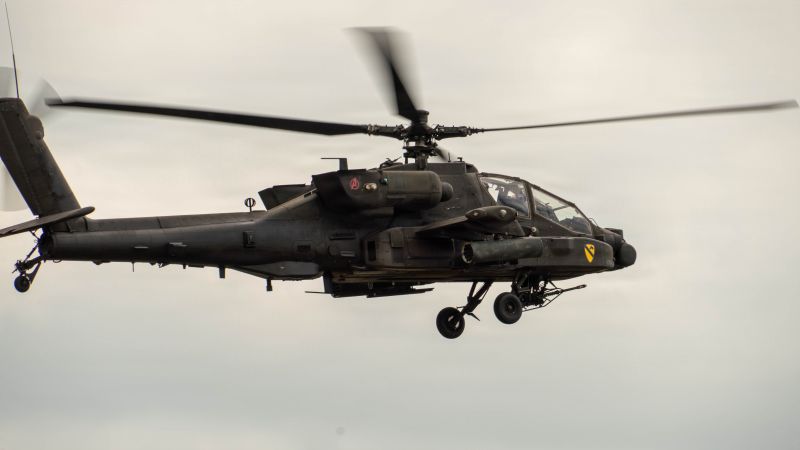
The AH-64 Apache represents one of the most sophisticated rotary-wing aircraft in military aviation history. The four-bladed helicopter accommodates two crew members in a distinctive configuration: the pilot occupies the rear seat while the co-pilot and gunner operate from the front position. This arrangement allows for effective division of navigation and weapons control responsibilities during combat operations.
The Apache’s formidable armament includes 16 Hellfire missiles, 76 aerial rockets, and 1,200 rounds for its integrated 30 mm cannon. These weapons systems enable the helicopter to engage diverse targets across multiple engagement ranges.
“It is highly mobile, lethal, and can destroy armor, personnel, and materiel targets in obscured battlefield conditions at ranges out to 8 kms (5 miles),” the Army stated on its official website.
The modernized AH-64E variant incorporates enhanced situational awareness capabilities, improved flight performance characteristics, and joint interoperability features that position it as the most advanced aerial fighting vehicle globally. These upgrades extend the aircraft’s operational effectiveness across diverse combat environments.
A Legacy of Service
Since its initial introduction in 1984, the Apache helicopter has undergone continuous upgrades and modernization throughout its service life. The aircraft has proven its capability across numerous conflicts and continues to serve as a cornerstone of Army aviation operations. Military planners have scheduled the Apache to remain in active service through 2050, reflecting confidence in its design and adaptability to evolving battlefield requirements.
The grounding of training missions represents a temporary disruption rather than a permanent change to Apache operations. Once investigators complete their examination and determine appropriate corrective actions, training flights will resume with renewed emphasis on safety protocols. The incident serves as a reminder of the risks inherent in military aviation and the dedication of service members who operate these critical platforms daily.
Fort Hood, one of the largest military installations in the United States, houses thousands of personnel and continues to serve as a vital training center for Army aviation units. The base’s Apache fleet supports both domestic training missions and deployment readiness for international operations.
Related Reading
Frequently Asked Questions
What is US Army grounds all Apache helicopter?
US Army grounds all Apache helicopter is the main topic of this guide. The article explains the context, practical details, and next steps readers should understand.
Why does US Army grounds all Apache helicopter matter?
US Army grounds all Apache helicopter matters because readers are looking for a useful answer, not just a short summary. Good content should match search intent and help them decide what to do next.