A Qing Dynasty vase 200 years ahead of its time

Daftar Isi
A Glass Vase from the Qianlong Era That Looks Like It Belongs in a 1960s Living Room
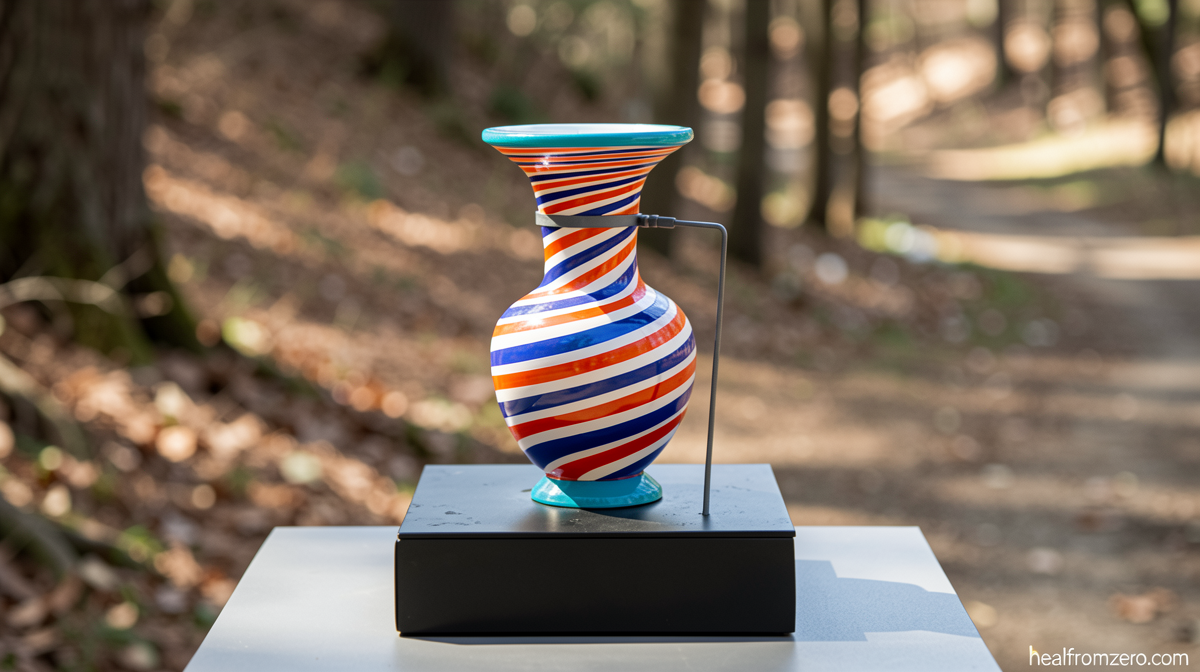
Healfromzero.com – Among the hundreds of thousands of imperial treasures housed in Beijing’s Palace Museum, one object stands apart from everything else on display. It is not porcelain. It is not cloisonné enamel. It is not lacquerware or jade. It is a blown-glass vase, barely eight inches tall, whose body twists with ribbons of red, white, and blue glass capped by an emerald-green mouth and base. At first glance, the piece reads as something pulled from a mid-century American apartment — a spinning barbershop pole rendered in molten silica. Yet it carries the reign mark of the Qianlong Emperor, one of the most powerful and acquisitive rulers in Chinese history, who governed for six decades during the eighteenth century.
An Emperor Who Believed More Was Always More
The Qianlong reign produced an extraordinary volume of art and craft. Most objects made under his authority — ceramics, textiles, metalwork, paintings — bore his reign mark, a set of Chinese characters inscribed or stamped as a kind of imperial signature. The scale of production was staggering, and the emperor’s personal taste leaned toward opulence, polychromy, and sensory excess.
“He loved the profusion of colors, and textures, and all kinds of fine things,” said Daisy Wang, Deputy Director and Chief Curator at the Hong Kong Palace Museum. “He always thought, ‘more is more.'”
Wang, who oversaw the vase’s exhibition on loan from the Beijing Palace Museum until August of this year, described the emperor as something of a micromanager in modern corporate terms. He documented objects meticulously, issued precise instructions on proportion, scale, and design, and enforced compliance through punishments that could include the forfeiture of an entire year’s salary. The imperial workshops — collectively known as the zaobanchu — employed nearly one thousand artisans during his reign, working under constant pressure to satisfy a demand that never seemed to crest.
Europe’s Glass Edge and China’s Ancient Material
The vase’s existence raises a question that stretches back millennia: why glass? Chinese artisans had been working with glass since the Western Zhou period, more than two thousand years before the Qing Dynasty. Yet by the eighteenth century, European glassmaking had advanced far beyond anything produced within China’s borders. Domestic glass objects tended to be small, plain, and single-toned. The swirling multicolored ribbons of this particular vase represented something genuinely alien to the Chinese decorative tradition.
Marco Almeida, Senior Vice President at Christie’s Asia Pacific and the auction house’s Head of Chinese Ceramics and Works of Art, noted that the technique behind the piece closely resembles the latticino method long practiced in Venetian glassmaking. Artisans would pull hot colored glass into thin tubes, adhere fragments to the vessel’s body, then roll and reheat the form repeatedly until the desired swirl pattern locked into place — a process Wang compared to pulling taffy candy.
“Suddenly, you have this vase with multiple colors, and a style of decoration that was alien,” Almeida observed. “I think the emperor must have been quite taken by it and quite pleased.”
Missionaries, Workshops, and a Cosmopolitan Court
The most probable explanation for the vase’s European technique is the presence of foreign missionaries within the imperial workshops. During the earlier Kangxi reign, the German Jesuit Kilian Stumpf had begun overseeing glass production inside the zaobanchu complex. By the Qianlong period, the court — much like the Mughal court in India — actively welcomed artisans from across China and beyond, integrating foreign skills into state-sponsored manufacturing.
The zaobanchu itself was a sprawling network of specialized departments scattered through the Forbidden City complex and provincial sites, each handling a narrow discipline: painting, textile weaving, wood carving, material science, and dozens of other crafts. The glasswork that emerged from these workshops was, in effect, a hybrid product — European technique married to Chinese form and imperial iconography.
“It’s the perfect, and clear-cut marriage of what is Chinese and what is Western,” Almeida said.
Rarity and Value
The vase’s scarcity is striking. The Beijing Palace Museum holds more than 300,000 porcelain pieces spanning thousands of years of Chinese ceramic history. Glass vases, by contrast, number only a “handful” within that vast collection. Wang emphasized that the object’s rarity amplifies its significance: it is not merely decorative but documentary, recording a moment when imperial China absorbed and repurposed Western material science for its own aesthetic ends.
Almeida declined to assign a monetary figure, calling the artifact “borderline priceless.” Wang, who is preparing a forthcoming exhibition on the imperial workshops at the Hong Kong Palace Museum scheduled for September, framed the vase’s value in cultural rather than commercial terms. To the Qianlong Emperor himself, she argued, the object’s worth lay in its novelty — its difference from everything else in the palace collection, its demonstration that the court could command materials and techniques from every corner of the known world and bend them to imperial taste.
The vase thus occupies an unusual position in art history: a small, brightly colored object that is simultaneously Chinese in its shape, its inscription, and its patronage, and European in its material science. It is a reminder that the eighteenth-century Qing court was not a sealed, inward-looking institution but a cosmopolitan engine of production, drawing on global knowledge to feed an emperor’s appetite for the new, the strange, and the spectacular.
Related Reading
Frequently Asked Questions
What is A Qing Dynasty vase 200 years?
A Qing Dynasty vase 200 years is the main topic of this guide. The article explains the context, practical details, and next steps readers should understand.
Why does A Qing Dynasty vase 200 years matter?
A Qing Dynasty vase 200 years matters because readers are looking for a useful answer, not just a short summary. Good content should match search intent and help them decide what to do next.