London’s newest sculpture is not another White man

A New Figure Steps Into Trafalgar Square
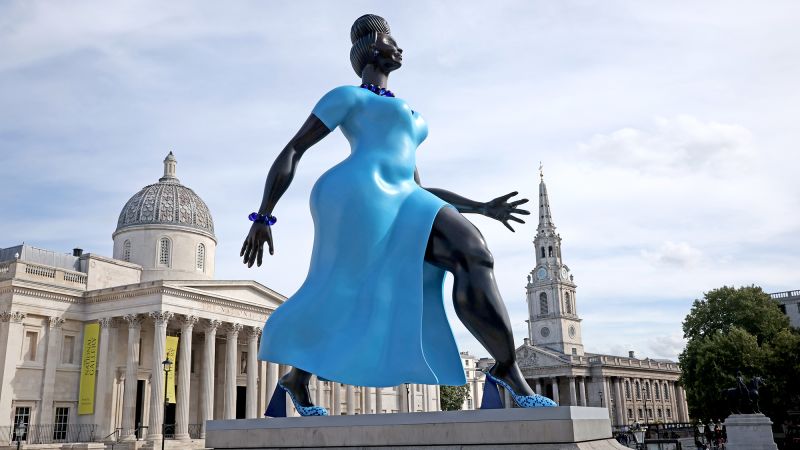
Healfromzero.com – Trafalgar Square has gained a distinctly contemporary presence: a bronze woman in blue, captured mid-stride and looking toward what lies ahead. New York-based artist Tschabalala Self’s “Lady in Blue” has been installed on the Fourth Plinth, where it will remain for two years amid some of London’s best-known 19th-century monuments.
The work is the 16th commission to occupy the plinth, an ongoing public-art program initially established by the Royal Society of Arts and now supported by the Mayor of London, Arts Council England and Bloomsbury Philanthropies. Nearby stand Nelson’s Column and Landseer’s Lions, landmarks shaped by Britain’s historical memory. Self’s sculpture instead places an imagined present-day Londoner at the center of the square.
“Lady in Blue” portrays an unnamed young Black woman in a fitted blue dress, coordinating high heels and glass-beaded jewelry. Her braided hair, ornaments and lapis lazuli-colored clothing make the figure visually vivid, while her posture gives the work its central energy. She is not posed as a passive memorial subject; she appears to be heading somewhere.
“I wanted to direct everyone’s attention to the future,” the artist said. “I don’t think there are enough monuments that are about our shared future to come.”
A Monument for the Present
Public statues often honor military leaders, monarchs, explorers or political figures from earlier eras. Self chose a different route, creating a figure intended to evoke a contemporary everywoman rather than a specific individual from the past. That distinction becomes especially visible in Trafalgar Square, one of London’s busiest public spaces and a place where historical symbols are constantly encountered by residents and visitors.
The sculpture is also unusual within the city’s existing statuary. London has roughly 1,500 statues, yet only a small number depict women of color. Self, whose work frequently explores the Black female body and questions surrounding race, gender and sexuality, said the work should offer viewers a sense of freedom without making identity the sole lens through which the sculpture is understood.
“I really want people to take away from the sculpture the feeling that they can feel free to exist as they are without explanation,” she said.
For Self, the figure’s Blackness is meaningful but should not narrow the interpretation of the piece. She has cautioned against approaching the work only through identity politics, arguing that doing so can reduce its subjects to fixed categories rather than allowing them complexity, presence and possibility.
“It’s not that speaking about blackness minimizes the work, because I don’t believe that to be the case,” Self said. “It’s just that I don’t think that’s the focal point of the project.”
“I also feel like when people enter the work through that framework, they’re already starting a process of reduction because they have come to name and define the figures by their identity politics.”
Moving Forward
The color choice carries its own historical resonance. The rich blue of the figure’s outfit refers to lapis lazuli, a rare stone long valued for the pigment it provided. Yet the artwork’s most important feature may be its sense of movement. Instead of standing formally at attention, the woman advances through the square with visible purpose.
“She’s not static,” Self said. “She has a desire to move, and in her having this courage to be optimistic and move forward, I hope that is going to be inspiring to all people who encounter her to know that this is something that’s also available to them — the ability to stride and to move forward.”
That forward motion gives “Lady in Blue” a different relationship to the traditions of monumental sculpture. The work does not simply ask viewers to look backward at an established historical narrative. It invites them to consider who has been absent from public commemoration, who belongs in civic spaces and what future monuments might communicate.
Experience, Damage and Restoration
The Fourth Plinth installation is Self’s first public sculpture in the United Kingdom since 2023. That year, her work “Seated,” installed in Bexhill-On-Sea, was vandalized when someone spray-painted the sculpted Black woman’s skin white. Self described the incident as upsetting, but said it ultimately deepened her understanding of what the work could reveal.
“I was very upset when the sculpture was vandalised, but ultimately that experience turned out being one that was very edifying for me,” Self said.
“It highlighted how real people, not just figurative sculptures, experience these same kind of aggressions and acts of violence and intimidation in real life. So I feel like for those reasons, the sculpture did its work.”
Local people organized a clean-up day after the damage, and the paint was removed. For Self, that response mattered as much as the vandalism itself because it demonstrated a shared determination to repair harm.
“Through the restoration of the sculpture, it also showed people’s willingness and desire to overcome the societal ills.”
She now expects “Lady in Blue” to spark further discussion about figurative art and the visibility of many identities in public settings, including difficult exchanges. Self sees value in those conversations if they can help broaden understanding.
Over the next two years, thousands of pedestrians will pass the sculpture each day in a city known for its cultural diversity. Self’s hope is simple: that the anonymous woman in blue will become a familiar part of the capital’s visual life rather than an exception within it.
“I want her just to become a Londoner at the end of the day,” she said.
Related Reading
Frequently Asked Questions
What is London s newest sculpture is not another?
London s newest sculpture is not another is the main topic of this guide. The article explains the context, practical details, and next steps readers should understand.
Why does London s newest sculpture is not another matter?
London s newest sculpture is not another matters because readers are looking for a useful answer, not just a short summary. Good content should match search intent and help them decide what to do next.