‘World’s first solar ambulance’ just proved it works

Daftar Isi
Healfromzero.com – A third of Africans live more than two hours from health services. And electricity access is a major issue at medical facilities across the continent, limiting what care can be offered. A group of students from the Netherlands hopes a newly developed vehicle called Stella Juva can help bring healthcare to those who are struggling to access it.
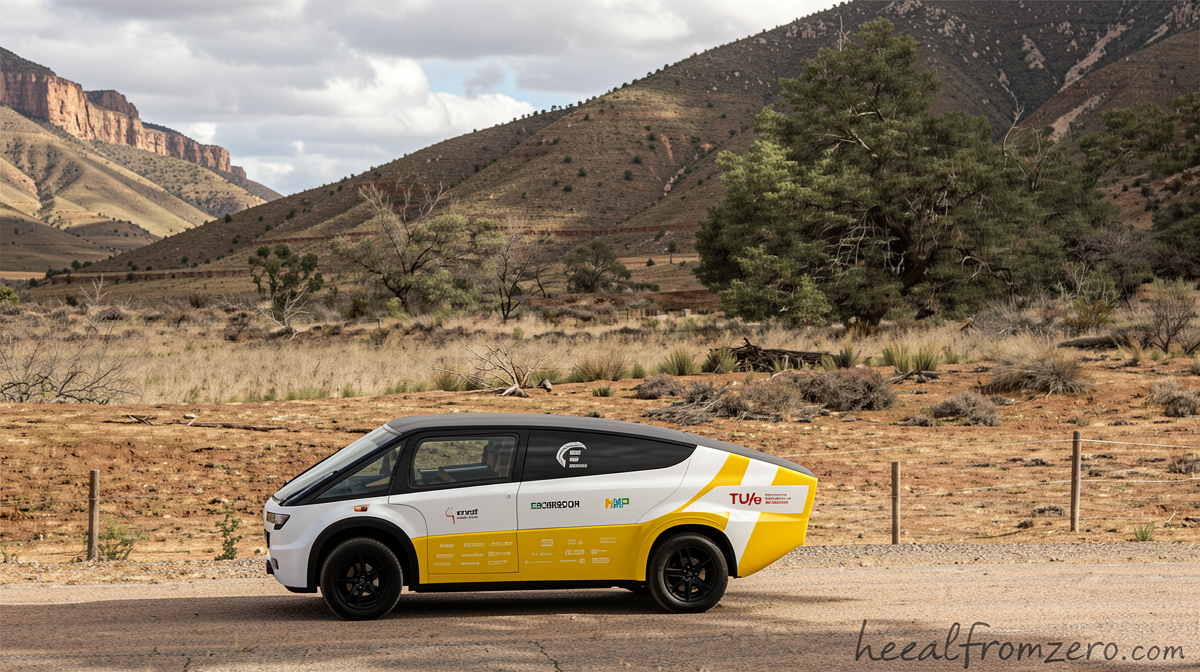
The solar-powered ambulance carries medical equipment including an X-ray machine, an ultrasound, and a fridge to keep vaccines cool. It has solar panels on its rooftop so it can charge while driving. Extendable solar panels that can fold out when it’s not moving give it extra charging area.
Solar Team Eindhoven, a team of 23 students from Eindhoven University of Technology and two other educational institutions, says Stella Juva is the “world’s first solar ambulance.” In practice, it operates more like a mobile health clinic. Instead of ferrying patients around, it transports medical equipment, and the energy to power it, to places that don’t have those things. This month, the students tested the vehicle in Kenya, in partnership with the nongovernmental organization Amref Health Africa, to see if it could manage long distance travel across tricky terrain, and if it could power the onboard medical equipment once it reached remote communities.
They found that while stationary, Stella Juva generated more energy than it consumed while using all its onboard medical equipment simultaneously. That demonstrates that it can operate independently, without traditional fuel or plugging into charging infrastructure, they say. The equipment wasn’t used on real patients, but approximately 200 people could have been treated over two days, according to Solar Team Eindhoven and Amref Health Africa.
In total, the students drove Stella Juva more than 800 kilometers (about 500 miles) around the country, including a visit to a health clinic in Mosiro, in the Narok region in southwest Kenya, that doesn’t have electricity. That required several hours navigating a dusty clay road marked with potholes. “We were all very positively surprised,” 22-year-old Isabella Wanningen, a member of Solar Team Eindhoven who is studying computer science and engineering, tells CNN.
Stella Juva “reacted even better than we had expected,” she says. The lack of power at clinics in places like Mosiro impacts people including expectant mothers, who don’t have easy access to ultrasounds, says John Kutna, a program manager for Amref Health Africa. “The solar ambulance would be quite useful in these locations,” he says.
Since 2013, Solar Team Eindhoven has gathered students to collaborate on yearlong innovation projects to build sustainable vehicles. That’s included a solar-powered campervan, Stella Vita and “the world’s first off-road solar-powered vehicle,” Stella Terra. Some projects have found commercial success.
This year, Lightyear, a startup founded by five Solar Team Eindhoven alumni, unveiled a demo electric vehicle with advanced solar charging technology, developed with the Japanese car manufacturer Nissan. Stella Juva will be shipped back to the Netherlands, but the students hope it’s not the end of the road for the idea. “We hope to inspire industry and society to use innovative technologies like Stella Juva to tackle some societal problems,” says Yarno Basten, a 23-year-old team member who is studying sustainable energy technology.
There could be other impediments to getting the prototype onto the road. Funding is a major challenge for the healthcare sector in Kenya — a problem exacerbated when US President Donald Trump’s administration cut foreign aid. Still, health experts in Kenya say the ambulance’s successful testing could have ripple effects, from inspiring Kenyan students to work on homegrown innovation, to demonstrating how the sun can be harnessed to power the healthcare sector.
The country has made impressive strides in increasing its renewable energy capacity, but solar power is not widely used to provide medical care, says Kutna. UNICEF and others have supported solar powered refrigeration systems to keep vaccines cool. Corporate foundations have also provided funding for solar-powered lighting at some facilities.
Kennedy Wakoli, a family and reproductive health expert at Amref Health Africa, says that harnessing the power of the sun could be crucial for improving healthcare access in remote areas, because “solar energy is everywhere.” He hopes Stella Juva can help act as a catalyst to make that happen. “The country is moving towards renewable energy, and this will be very significant in terms of how we adopt it in the health sector,” he says.
Related Reading
Frequently Asked Questions
What is World s first solar ambulance just?
World s first solar ambulance just is the main topic of this guide. The article explains the context, practical details, and next steps readers should understand.
Why does World s first solar ambulance just matter?
World s first solar ambulance just matters because readers are looking for a useful answer, not just a short summary. Good content should match search intent and help them decide what to do next.