A date to remember: The Abu Dhabi ice cream maker turning palm trees into soft serve

Daftar Isi
From Date Palm to Dessert: How One Abu Dhabi Entrepreneur Is Reimagining the Gulf’s Oldest Crop
Healfromzero.com – The date palm has stood at the center of Arabian life for millennia — its fruit sustaining nomadic caravans, its fronds shading desert compounds, its trunk providing timber and fiber. In the United Arab Emirates, the tree is woven into national identity so deeply that it appears on currency, emblems, and state ceremonies. Yet for decades, the fruit’s culinary role in modern foodservice remained narrow: a garnish, a syrup, a seasonal treat. That narrowness is what Amira Al Dosari set out to dismantle when she opened Ice Station in 2023, a soft-serve parlor tucked behind the working docks of Zayed Port in Abu Dhabi.
Al Dosari, now 53, did not set out to build a date-palm restaurant. She had completed ice-cream-making courses across several countries and returned home with a conventional recipe book. What unsettled her was not the technique but the inputs: ready-made flavor mixes, preservatives, artificial colorants, and above all, enormous quantities of refined sugar. The question that kept circling her mind was simple and personal.
“I was thinking about what the future could be for (children) who eat a lot of sugar when they are that young. How would that affect their body?”
The answer she arrived at was neither a lecture nor a reformulation of the recipe. It was a substitution drawn straight from the landscape outside her kitchen window. She began working with kholas rotab — the softest, most fully ripened stage of the kholas date variety — whose natural sugars and dense fiber content could, she hypothesized, replicate the body and sweetness of a traditional base without a single gram of added cane sugar.
The Sugar Problem, Reconsidered
Dates are, by any nutritional measure, sugar-rich. What distinguishes them from a spoonful of sucrose is the matrix: the fruit’s dietary fiber slows gastric absorption, producing a gentler glycemic curve than refined sugar delivers. For Al Dosari, that distinction was the entire thesis. The sweetness had to arrive from the fleshy, dark fruit itself, not from a separate ingredient bolted onto the formula.
“The main thing in soft serve is the sugar. It gives it its creamy texture.”
Removing that structural role while preserving mouthfeel proved brutal. Over months of trial runs, she broke fifteen machines. The eventual rotab-flavored soft serve that emerged from the wreckage was dense, naturally sweet, and free of added sugar — but it was only the first of what would become a far larger project.
Every Part of the Tree
Once the fruit proved viable, Al Dosari looked up the trunk. Over the three years since opening, she has developed 145 distinct flavors, many of which draw on parts of the palm that most foodservice operators discard.
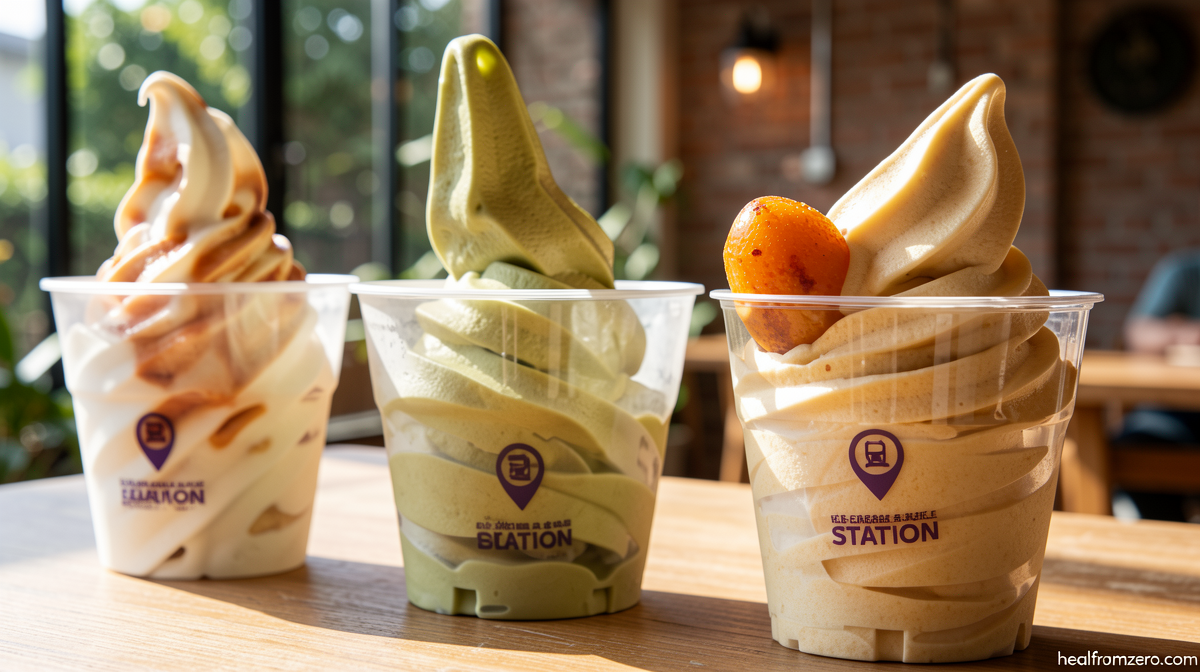
The leaves, ground into a fine green powder she calls “safcha,” deliver a flavor profile and vivid chlorophyll hue that she says mirrors matcha without the caffeine. The substitution is timely: global demand for Japanese green-tea powder has strained supply chains, and Al Dosari’s household was no exception.
“Every single person in my family is like, ‘matcha, matcha, matcha!’ I said, ‘Okay, but matcha has caffeine, so let’s go for something similar, but with no caffeine.'”
The seeds, once the flesh is removed, are brewed into a caffeine-free coffee. Her daughter, Ghalia Al Mazrouei — a sustainability consultant who joined the venture — helped shape that application and the way it is served: poured over a mound of soft serve and branded an “affogato,” echoing the Italian tradition of espresso-drowned gelato.
“We know that the entire plant is quite safe for consumption, so it was just more about how we could present this in a way that is enjoyable for everyone?”
Pollen harvested from the male flowers has been turned into its own standalone flavor. Date molasses — the concentrated syrup left after juicing — sweetens several bases. And because different date cultivars carry distinct aromatic compounds, Al Dosari has isolated tastes ranging from caramel to something she describes as banana-like, depending on the variety pressed.
Beyond the Palm
The date tree anchors the menu, but it does not monopolize it. Ice Station’s rotating lineup has included Costa Rican pineapple, Philippine ube (purple sweet potato), and a series of savory pairings that have drawn eyebrows and repeat visits alike: smoked salmon with cream cheese, caviar over vanilla, parmesan with white truffle. Al Dosari is currently sketching her 448th flavor.
“I have so many (ideas),”
she says, laughing, as though the number itself were the joke.
A Shift That Begins at Night
The operational rhythm of the shop is inverted from most hospitality businesses. By the time the last daytime customer departs, Al Dosari’s own shift is only starting. From 9 p.m. onward she spends up to three hours in the kitchen prepping, churning, and tasting twelve separate bases before they are transformed into the day’s premium soft-serve batches. By morning, a dozen flavors are staged and ready.
The scale of global date production underscores why this work matters beyond one parlor. Nearly 11 million metric tons of dates were harvested worldwide in 2024, with Saudi Arabia and Egypt leading output and the UAE ranking among the top ten producers, according to the UN Food and Agriculture Organization. For a Gulf state whose agricultural identity is inseparable from the palm, converting that crop into a contemporary, exportable, culturally resonant food product is not merely a business model — it is an act of regional self-definition.
“All Gulf countries share the same heritage: the palms.”
The date palm thrives in arid, saline soils where few other crops survive. Its roots grip sandy ground; its canopy shades temperatures that would scorch most fruit trees. That resilience is precisely what makes it a symbol. Al Dosari’s scoops, loaded with the fruit’s fiber, the leaf’s chlorophyll, the seed’s roasted bitterness, and the pollen’s faint floral note, are an attempt to carry that resilience into a new century of taste — one where the oldest crop in the Gulf becomes, once again, central to the table.
Related Reading
Frequently Asked Questions
What is A date to remember?
A date to remember is the main topic of this guide. The article explains the context, practical details, and next steps readers should understand.
Why does A date to remember matter?
A date to remember matters because readers are looking for a useful answer, not just a short summary. Good content should match search intent and help them decide what to do next.