Kim Jong Un’s powerful sister says she is ‘completely unaware’ if he contacted Trump

Daftar Isi
North Korea’s Inner Circle Casts Doubt on Trump’s Claimed Back-Channel Contact with Kim Jong Un
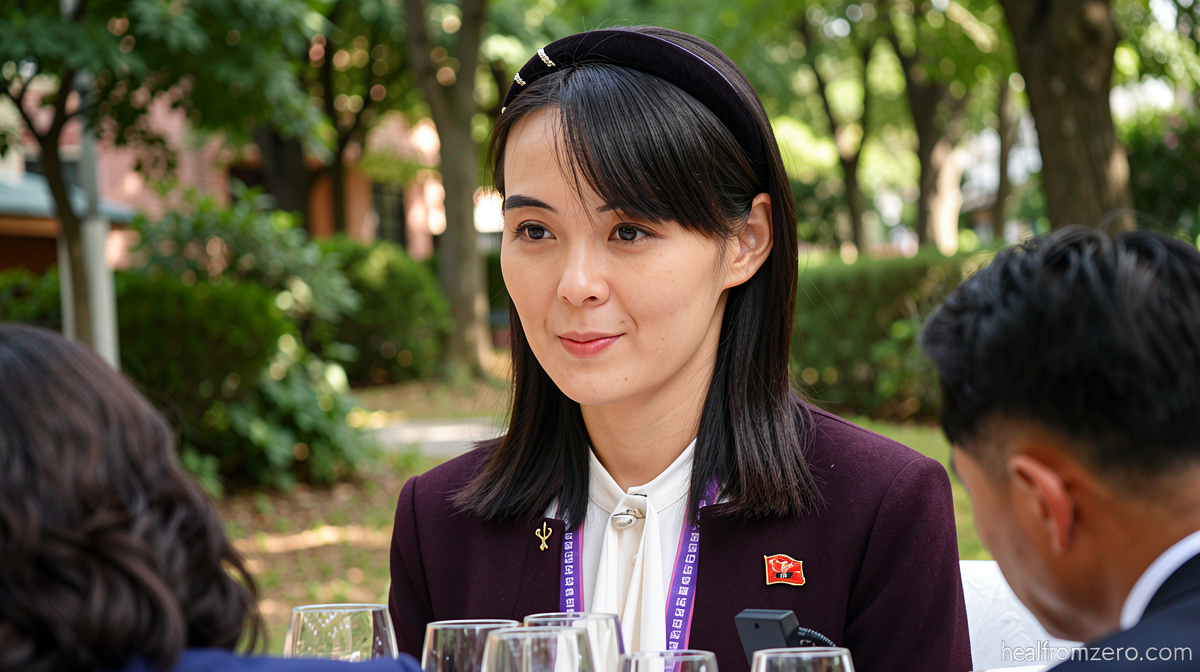
Healfromzero.com – Washington’s assertion that it has opened a fresh line of communication with Pyongyang has run into an unexpected obstacle: the person closest to North Korea’s supreme leader says she knows nothing about it. Kim Yo Jong, Kim Jong Un’s sister and one of the most influential figures in the DPRK’s ruling apparatus, issued a statement through state media on Wednesday declaring herself “completely unaware” of any recent exchange between her brother and US President Donald Trump.
The remark lands with particular weight because Kim Yo Jong is not a peripheral figure. She routinely appears beside her brother at public events, delivers policy pronouncements on his behalf, and functions as a principal voice of a regime that has long guarded its diplomatic intentions behind layers of opacity. For someone occupying that position to publicly acknowledge a blind spot in foreign policy is, by the standards of North Korean governance, a striking admission.
A Statement That Confirms and Denies Simultaneously
In the same statement, Kim Yo Jong conceded that her brother harbors “good memories and feelings” toward Trump and described their rapport as a “great relationship.” Yet she drew a firm line before validating the president’s specific claim of recent contact. Her phrasing was pointed:
“I am not aware of it at all, and perhaps it may be the only thing I do not know as regards the foreign policy of our supreme leadership.”
The sentence operates as both a diplomatic rebuff and an internal signal. By singling out one item she supposedly does not know, she implies that every other facet of Pyongyang’s external posture is fully transparent to her — and that this particular episode falls outside her purview. Whether that reflects genuine ignorance, a deliberate distancing, or a calibrated message to Washington remains open to interpretation.
Trump’s Timeline and the Drills Dispute
The controversy erupted over a compressed sequence of events. On Monday, Trump told reporters that Kim Jong Un had responded to his request for a conversation. He offered no further detail — no date, no format, no confirmation of written correspondence. On Wednesday he added that he intends to meet the North Korean leader later in the year, again without specifying when or where. He declined to say whether any letters have passed between the two offices.
The contact claim surfaced immediately after Trump demanded a sudden curtailment of annual joint military exercises with South Korea, a long-standing and close US ally. The president framed the drills as expensive, provocative, and inconsistent with his desire to rebuild dialogue with Pyongyang. He also cited Seoul’s perceived failure to assist the United States in its operations against Iran as a factor in his decision.
What the Reduced Exercises Actually Involve
The annual combined drills, normally scheduled for ten days, will run for only five this year at Washington’s insistence. A spokesperson for US Forces Korea explained last week that the exercises are calibrated to North Korea’s evolving military capabilities and incorporate specific training against drone swarms, GPS jamming, and cyberattacks. They are not merely symbolic posturing; they represent months of planning and coordination between two militaries.
Analysts have flagged a structural tension in Trump’s approach. By shrinking the very exercises that build South Korea’s capacity to assume wartime operational control of the combined US-South Korean force on the peninsula — a capability Seoul has lacked since the Korean War erupted in 1950 — the administration risks undermining its own stated objective of shifting the burden of peninsula defense onto Seoul. Once South Korea demonstrates it can shoulder that burden, Washington’s role in any future conflict would narrow to providing selective firepower while the ally absorbs most of the cost and command responsibility. Cutting the training pipeline short delays that transition.
Seoul’s Calculated Response
South Korean President Lee Jae Myung has publicly welcomed the reduction. Speaking on X late Wednesday, he expressed sympathy for what he called Trump’s “determination and effort to create conditions for dialogue to establish peace regime on the Korean Peninsula,” even at the expense of scaling back recent joint exercises and field training.
“We sympathize with President Trump’s determination and effort to create conditions for dialogue to establish peace regime on the Korean Peninsula, even if it means scaling back the recent South Korea-US joint military exercise and field training exercises, and we pay tribute to that decision.”
Lee went further, stating he “fully agrees” that South Korea should assume primary responsibility for peninsula security and that it must rapidly increase defense spending to reach a target of 3.5 percent of GDP. The alignment between Seoul’s public posture and Washington’s pressure is notable: the ally is absorbing the diplomatic cost of the reduction while signaling continued commitment to self-reliance.
Why the Discrepancy Matters
The gap between Trump’s confident assertion of contact and Kim Yo Jong’s categorical ignorance creates an awkward diplomatic posture. If no communication occurred, the president’s public framing of a bilateral reset risks appearing premature. If communication did occur and Kim Yo Jong simply was not briefed, the episode underscores how tightly Pyongyang compartmentalizes its highest-level negotiations — and how little outside observers, including allied capitals, can verify what transpires behind the regime’s famously opaque decision-making.
For now, the question of whether two leaders have actually spoken since the president’s remarks remains officially unresolved. What is clear is that the drills dispute, the Iran-assistance grievance, and the prospect of a later-year summit have all been folded into a single narrative of renewed US-North Korea engagement — a narrative that Pyongyang’s own inner circle has, at least publicly, declined to confirm.
Related Reading
Frequently Asked Questions
What is Kim Jong Un s powerful sister?
Kim Jong Un s powerful sister is the main topic of this guide. The article explains the context, practical details, and next steps readers should understand.
Why does Kim Jong Un s powerful sister matter?
Kim Jong Un s powerful sister matters because readers are looking for a useful answer, not just a short summary. Good content should match search intent and help them decide what to do next.