Iran’s latest warning to the US signals the hardliners are just getting started

Daftar Isi
Tehran Pivots Toward Aggression as the US-Iran Truce Collapses
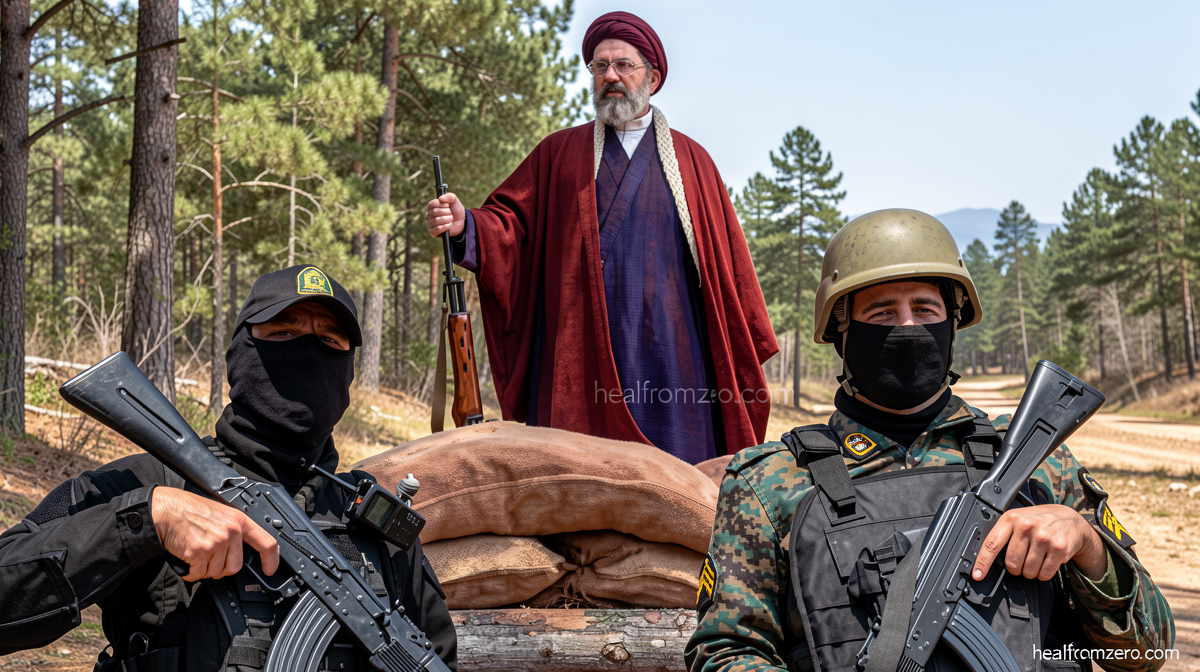
Healfromzero.com – The war that Donald Trump ignited roughly six months ago has entered a phase its architect never anticipated: the adversary is no longer waiting to be struck. Iran’s hardline establishment, operating under the direction of Supreme Leader Mojtaba Khamenei, has begun openly architecting a doctrine of sustained confrontation with Washington — one that pairs defensive readiness with what officials now call “offensive operations” aimed at reshaping the regional balance of force.
The timing is deliberate. The Memorandum of Understanding, the bilateral arrangement designed to halt hostilities, is reaching its expiration date while the question of who controls the Strait of Hormuz remains unresolved. With that diplomatic scaffolding crumbling, Tehran’s military leadership appears convinced it occupies a position of sufficient strength to demand further concessions from the United States and to close the technological gap with more heavily armed opponents through continued adaptation of its own weapons systems.
A New Command Architecture Built for Attack
The institutional signal came last week, when a series of decrees issued in Khamenei’s name reorganized the country’s security leadership. Among the most consequential appointments: Mohsen Rezaie installed as head of the Supreme National Security Council, and Ahmad Vahidi confirmed as commander of the Islamic Revolutionary Guards Corps. The decree accompanying Vahidi’s elevation explicitly called for heightened preparedness for “strong offensive operations against the enemy.”
Hamidreza Azizi, a scholar at the Clingendael Institute in the Netherlands, read the mandate plainly: Vahidi’s role was to steer Iranian military planning in a more assertive, forward-leaning direction. Days after the decree, Brig. Gen. Yadollah Javani, the IRGC’s political deputy, told the semi-official Fars news agency that Iran’s actions remain defensive in character but “may also take on an offensive aspect in the future.” Mohammad Reza Naqdi, another adviser attached to Vahidi’s office, went further on state broadcaster IRIB, stating that the force must develop the capacity to conduct operations “on enemy soil” whenever ordered.
The IRGC has been tasked with the ability to “launch attacks against the enemy in an intelligent, selective, and targeted manner” — language that, in practical terms, points toward renewed strikes on American military installations scattered across the Gulf region.
Allies Mobilized, Pressure Multiplied
The shift in posture is not confined to Iranian territory. In recent weeks, Houthi forces in Yemen have pressed threats against Saudi shipping lanes and struck oil refineries on the Arabian Peninsula, while Iranian-backed militias operating out of Iraq have targeted Saudi petroleum infrastructure. The pattern suggests a coordinated widening of the pressure envelope, stretching Washington’s defensive commitments across multiple theaters simultaneously.
Mohammad Mokhber, an adviser close to Khamenei, framed the strategic logic in stark terms:
“The strategy of shifting the war to an offensive posture if Iran’s conditions are not met will undoubtedly transform the balance of power in the world.”
Sina Azodi, assistant professor of Middle East politics at George Washington University, noted that Rezaie belongs to an IRGC faction whose internal calculus holds that “the only way to get concessions from the US is the continuation of fighting, exerting pressure on the US and a steady dose of pain on Donald Trump.”
Weapons Adaptation and Tactical Evolution
On the battlefield, Iran has been iterating rapidly. A newer generation of ballistic missiles — more maneuverable and fitted with cluster warheads — has entered service alongside increasingly inventive drone employment. These developments, analysts note, indicate that Tehran has compressed its learning curve over the past several months, converting the experience of absorbing American and Israeli barrages into refined strike capability.
H.A. Hellyer, senior associate fellow at the Royal United Services Institute in London, observed that the regime “has withstood the US/Israeli barrage and retaliation from the Gulf Arab states, and they are still standing.” His assessment: Tehran now seeks to convert that demonstrated resilience into a durable political advantage rather than allowing the initiative to decay passively over time.
The Escalation Calculus
Trita Parsi of the Quincy Institute for Responsible Statecraft put the strategic stakes in blunt terms: “Tehran believes it has the military edge and is openly discussing going on the offensive instead of merely responding to American attacks.” In his reading, the move would allow Iran to seize control not only of the war’s scope and geography but also of its timing — a fundamental inversion of the dynamic that has characterized the conflict since its inception.
Azizi, writing from the Clingendael perspective, argued that Tehran is preparing for both short- and long-term scenarios. The present condition — a frozen conflict with no formal peace and deepening economic strain — could push the leadership toward deliberate escalation, designed to force Trump either to lift the naval blockade or to negotiate on terms more favorable to Iran. He added that the leadership may simply conclude that the costs of entering another war are lower than the costs of watching its capabilities erode gradually under the twin pressures of sanctions and blockade.
For Washington, the implications are immediate. A president already struggling to articulate an exit strategy now faces an adversary that has stopped waiting for the next American strike and begun planning the next Iranian one. The Strait of Hormuz, the Saudi energy infrastructure, and the forward-deployed US bases of the Gulf all sit inside what Tehran now treats as its operational canvas. The question for American policymakers is no longer whether the conflict will continue, but on whose terms it will be conducted.
Related Reading
Frequently Asked Questions
What is Iran s latest warning to the US?
Iran s latest warning to the US is the main topic of this guide. The article explains the context, practical details, and next steps readers should understand.
Why does Iran s latest warning to the US matter?
Iran s latest warning to the US matters because readers are looking for a useful answer, not just a short summary. Good content should match search intent and help them decide what to do next.