Why Ossoff’s savage lampooning of Trump is taking off

Daftar Isi
Ossoff’s Escalating War of Words With Trump Signals a New Democratic Strategy Ahead of Midterms
Healfromzero.com – With less than two months separating the American electorate from the November midterm elections, the Democratic Party has abandoned its long-running playbook of alarm and fear. For years, party leaders warned voters that Donald Trump was building an authoritarian regime, a tyrant king reshaping the republic into something unrecognizable. That framing, while persistent, has grown stale. What is replacing it is something sharper, more theatrical, and considerably more personal: sustained ridicule aimed at portraying the president as a diminished, self-absorbed figure whose excesses are consuming the country around him.
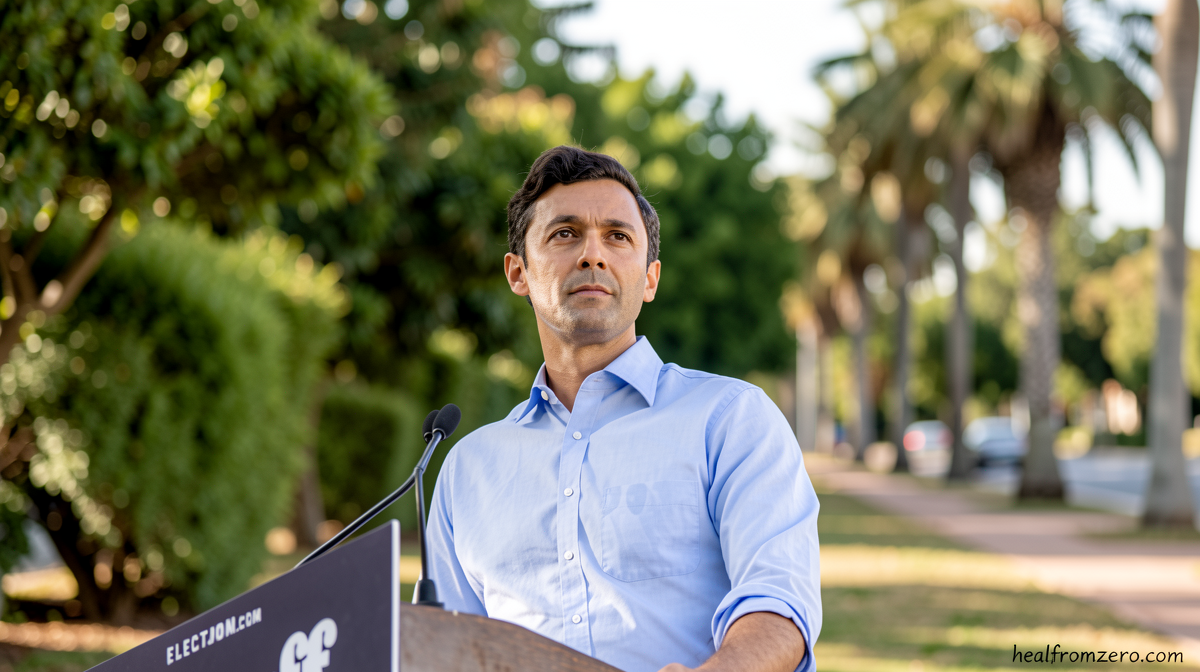
At the vanguard of this rhetorical pivot stands Georgia Senator Jon Ossoff, whose combative style has transformed his own reelection campaign into what many in the party see as a dress rehearsal for the 2028 presidential field. Ossoff’s attacks are not casual barbs; they are calculated strikes designed to puncture the aura of invincibility that has surrounded Trump since his dramatic return to power.
The Latest Volley
On Tuesday, Ossoff raised the temperature considerably, describing the president in terms that left little ambiguity about his intent:
“A draft-dodging, crook president who has plunged our nation recklessly into a war he knows not how to end or to win.”
The language is deliberately inflammatory, and Ossoff knows it. His goal is not merely to score points with Democratic donors but to force Trump into reactive, emotionally charged responses that expose what Ossoff and his allies frame as fragility beneath the strongman performance.
A Pattern of Democratic Provocation
Ossoff is not operating in isolation. The tactic of mocking the president to generate clashes that elevate the mocker beyond their home state has become a recognizable Democratic playbook. Illinois Governor JB Pritzker, last year, poked at Trump’s self-image by asserting that
“He cheats on his wives, he cheats at golf.”
California Governor Gavin Newsom has taken a different but equally pointed approach, running social media accounts that parody the president’s online persona in full-caps lock. One recent post declared:
“MANY ARE SAYING HE CAN’T EVEN DO THE ‘BIG STAIRS’ ON AIR FORCE ONE ANYMORE.”
The strategy mirrors, in a sense, Trump’s own classic move of selecting foils for political gain. If you cannot defeat your opponent, adopt his methods. But the stakes are different now. In 2024, Democrats tried similar mockery and lost. At that year’s Democratic National Convention, former President Barack Obama savaged the president’s
“Childish nicknames, the crazy conspiracy theories, this weird obsession with crowd sizes.”
Vice presidential nominee Tim Walz gained brief traction by ridiculing Trump for stopping at a McDonald’s drive-thru and by labeling MAGA loyalists as “weird.” Yet those jabs did not prevent Trump from reclaiming the White House. The decisive factor in 2024 was not the president’s eccentricities but the catastrophic decision by a fading Joe Biden to seek reelection, followed by an unconvincing ticket pairing with Vice President Kamala Harris.
Why the Calculus Has Changed
The political atmosphere surrounding Trump has shifted materially since his first year back in office. His popularity now sits at historic lows. His legacy-building construction spree — a series of monuments and projects that critics describe as out-of-touch extravagance — has reinforced perceptions of a leader more interested in his own monument than in governing. His struggles against Iran have produced no clear victory. His dismissal of affordability anxieties that affect millions of working Americans has alienated voters who once tolerated his economic nationalism. And the spectacle of his ongoing building projects provides Democrats with fresh, visual material for their case.
Two years ago, by contrast, Trump was riding the crest of what many called the greatest comeback in political history, projecting near-invincibility after surviving an assassination attempt. The atmospherics of that moment made mockery feel almost quaint. Today, with two years remaining in his term and midterm pressure mounting, the window for ridicule to translate into genuine political damage appears wider.
The Natalie Harp Flashpoint
Ossoff demonstrated his willingness to play hardball by referencing Natalie Harp, a ubiquitous Trump aide, in his attacks. The move carried obvious risk — dragging in a third party invites criticism of personal vendetta — but it produced exactly the reaction Ossoff sought. Trump erupted at an event on Monday when pressed about the jab, comparing Ossoff to Pee Wee Herman, the 1980s comedic character. The comparison, forty years behind the cultural moment, hardly projected youthful vigor. The White House launched a furious pushback, and conservative pundits who have long tolerated the president’s sometimes-misogynistic rhetoric issued condemnations.
That reaction validated the strategy in Democratic eyes. Savage mockery, the theory goes, provokes precisely the kind of overreaction that Democrats hope to highlight. If attacks can expose the president as brittle and diminished rather than commanding, his political position deteriorates further.
The Risks of Piling On
Yet the approach carries its own dangers. Trump remains a feral political street fighter, and those who join him in the gutter typically get roughed up. The age of stunt politics may be waning among voters who grew tired of spectacle in 2024. Newsom’s partisan gratification, however satisfying to the base, did not move the needle in a general election. Ossoff’s own reelection race, while energizing donors, could become a liability if voters perceive the senator as more interested in scoring points than in governing Georgia.
The question facing the Democratic Party in the final stretch before midterms is whether merciless lampooning can accomplish more than cheer partisans and drum up campaign cash. Can it do true political damage to a president who still commands enormous institutional power, a loyal media ecosystem, and a base that treats every insult as confirmation of his mythic status? The answer will shape not only November’s results but the architecture of the 2028 race, where Ossoff and others will be judged not on how loudly they mocked, but on whether the mockery changed a single vote.
Related Reading
Frequently Asked Questions
What is Why Ossoff s savage lampooning of Trump?
Why Ossoff s savage lampooning of Trump is the main topic of this guide. The article explains the context, practical details, and next steps readers should understand.
Why does Why Ossoff s savage lampooning of Trump matter?
Why Ossoff s savage lampooning of Trump matters because readers are looking for a useful answer, not just a short summary. Good content should match search intent and help them decide what to do next.