Four UK pro-Palestinian activists jailed over raid at Israeli firm Elbit

Four UK pro-Palestinian activists jailed over raid at Israeli firm Elbit
Verdict and Sentences
Four UK pro Palestinian activists jailed – In a recent ruling, four British pro-Palestinian activists have been handed cumulative prison terms exceeding 20 years for their involvement in a 2024 assault on an Elbit Systems UK factory. The judge emphasized that the attack, which caused over £1 million in damage, was deemed to have a “terrorist link.” The group, Palestine Action, was banned under UK law, and the activists were members of this organization. The sentencing took place at Woolwich Crown Court, where they were found guilty of criminal damage and, in the case of Samuel Corner, grievous bodily harm after he struck a police officer with a sledgehammer.
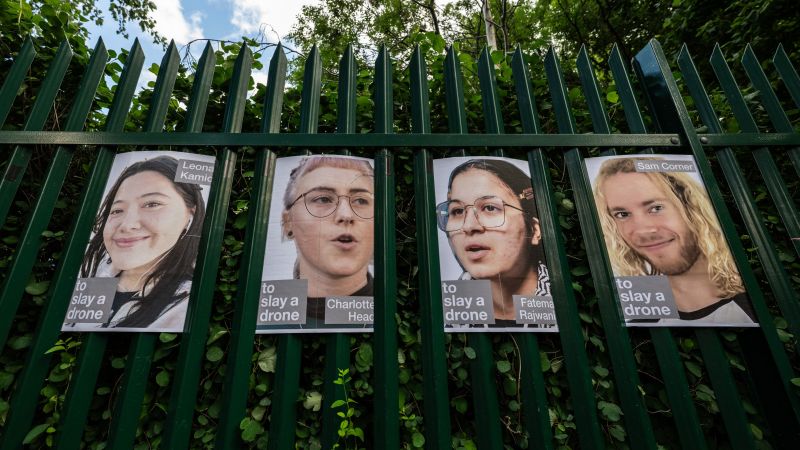
The four individuals—Charlotte Head (30), Samuel Corner (23), Leona Kamio (30), and Fatema Zainab Rajwani (21)—were initially acquitted of aggravated burglary charges. However, prosecutors argued that the incident should be classified as a terrorism-related offense, leading to harsher penalties. The judge acknowledged the “aggravating factor” of the terrorist connection but noted the activists’ previous good character as a significant mitigating point. Corner, who was sentenced to seven years and eight months, faced criticism for using “extreme and gratuitous” force, with his autism not considered a valid explanation for the sledgehammer attack.
Kamio and Head received five-year sentences, while Rajwani was given four years and eight months for the criminal damage. All four will serve an additional year on licence after release. The legal battle over their convictions continues, with their lawyers challenging the classification of their actions as terrorism. They were not charged with any direct terrorist offense, yet the court determined the attack had a “terrorist link” due to its intent to influence British government policy toward Israel.
Context of the Raid
The raid occurred approximately 10 months into Israel’s bombardment of Gaza, which followed a deadly attack by Hamas-led fighters in October 2023. The activists claimed their goal was to destroy weapons used in the conflict and halt what they described as Israel’s “genocide” in the region. They explicitly rejected violence against people, stating their focus was on dismantling military equipment. The attack targeted Elbit Systems’ UK facility in Bristol, southwest England, and resulted in the destruction of specialized military drone equipment, IT systems, and computers.
Elbit Systems, the Israeli defense firm involved, stated in impact statements that it had received nearly £1.2 million from insurers to cover the damage. The company also highlighted the lasting impact on staff safety and wellbeing. Despite the financial compensation, the incident sparked debates about the proportionality of the sentences. Human rights groups and prominent supporters have condemned the use of terrorism charges for what they see as a miscarriage of justice. The High Court ruled the group’s proscription under terrorism law unlawful, though the decision remains pending as the government prepares an appeal.
Reactions and Legal Arguments
Amnesty International UK’s chief executive, Kerry Moscogiuri, expressed concerns about the sentencing, stating,
“Criminal damage has never been treated as terrorism within the UK justice system before and it is dangerous to treat them as the same thing. It is completely disproportionate to punish protesters for criminal damage as if they were terrorists, a sentence that will stay with them for the rest of their lives.”
This sentiment was echoed by over 100 public figures, including author Sally Rooney, activist Greta Thunberg, and actor Steve Coogan, who signed an open letter urging the court to reconsider the severity of the sentences. They argued that the conviction as a terrorism-related offense sets a dangerous precedent.
Outside the court, police reported that more than 100 individuals had been arrested for supporting Palestine Action. The group’s proscription under terrorism law, which was initially deemed unlawful by the High Court, has become a focal point of legal and political discourse. Judge Jeremy Johnson, who presided over the case, clarified that while Palestine Action was not officially proscribed at the time of the offense, the attack’s intent to influence British policy and the seriousness of the damage justified the terrorist connection in sentencing.
As the sentences take effect, the activists’ future remains uncertain. Their legal team continues to challenge the classification, emphasizing that the charges were not based on any direct terrorist activity. Meanwhile, the broader implications of the case have ignited discussions about the balance between national security and civil liberties. The ruling underscores the ongoing tensions between pro-Palestinian activism and the UK’s approach to defining and prosecuting terrorism-related offenses.