The website where crypto promoters pay people to tattoo ads on themselves

The Website Where Crypto Promoters Pay for Facial Advertising in Exchange for Cryptocurrency
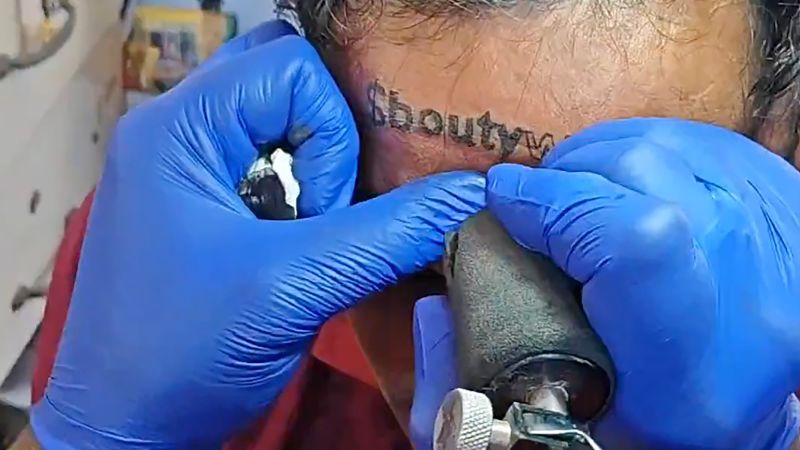
The website where crypto promoters pay people – On June 6, a man with a receding hairline entered a tattoo shop in Chennai, India, and submitted a message from his phone to the shop owner. With a camera recording the entire process, he prepared to have a line of text inked across his forehead. The individual, known as Arivu, was following instructions from a 21-year-old named Ayush in Florida, who had posted a request on a crypto trading platform called Pump.fun. In exchange for the tattoo, Ayush promised to send Arivu cryptocurrency valued at roughly $3,000. Arivu chose to remain anonymous to protect his privacy.
Pump.fun is a well-known platform that supports the development and trading of memecoins—cryptocurrencies with little to no intrinsic value, often inspired by internet memes. The platform thrives on attention, as its entire business model relies on users “pumping” a coin’s value by generating hype or sharing it widely. Last week, Pump.fun unveiled a new feature dubbed Pump.fun GO, allowing users to issue public bounties in cryptocurrency for completing specific tasks. “Pay ANYONE to do ANYTHING. Create & complete bounties for ANY task and leverage the power of humans & money across the globe,” the company posted on X.
This feature has turned into a peculiar marketplace where individuals are incentivized to engage in extreme acts. In one instance, Arivu agreed to have a cryptocurrency message permanently etched onto his face, a decision driven by the promise of $3,000 in crypto. Ayush, the Florida-based promoter, expressed surprise at the arrangement but noted the payment was substantial for someone in a region where daily wages often exceed only a few dollars. “I was just shocked, but at the same time that $3,000 is him working for 5 years,” he shared in a direct message on X.
A Global Experiment in Crypto-Driven Incentives
Across the world, similar arrangements have emerged. Jordan, a 27-year-old artist in Toronto, accepted a $3,000 crypto bounty last week to tattoo a promotional message for a cryptocurrency casino on his leg. Jordan used a pseudonym to shield his identity, fearing potential backlash from the crypto community. “I’m struggling financially, and my girlfriend is a tattoo artist, so it was a little easier for me,” he explained. The reward, he said, was a significant boost during a challenging period.
Bounty creators on Pump.fun typically require proof of completion, often through social media posts or video evidence. Arivu, for example, uploaded a video of his tattoo session to X as verification. This practice underscores the platform’s reliance on public validation to sustain its memecoin economy, where value is subjective and dependent on engagement.
Despite the attention-grabbing nature of these bounties, their legal standing remains unclear. The use of cryptocurrency allows transactions to occur anonymously, making it difficult to trace or regulate the agreements. “Pump.fun has always operated at the controversial edge of the internet’s attention economy,” remarked Vetle Lunde, head of research at the cryptocurrency firm K33. Lunde highlighted how, during the 2024 memecoin boom, the platform’s livestreams became infamous for encouraging extreme behaviors, such as threats of self-harm or violent acts, as creators vied for visibility.
After facing backlash, Pump.fun temporarily halted its livestream functionality, stating it would “pause live streaming until the moderation infrastructure is ready to handle the increased activity.” The feature was reintroduced the following year with updated policies aimed at curbing violence, harassment, and explicit content. However, the bounty system quickly evolved into a space where even the most unusual tasks could be monetized, as noted by Nicholas Vrousalis, a philosophy professor at Erasmus University in Rotterdam, Netherlands.
Vrousalis, author of “Exploitation as Domination,” argued that the bounty platform’s success was predictable given the vulnerabilities of certain populations. “The greater the precarity and vulnerability of a given group, the more pronounced the predatory instincts of those seeking to exploit them,” he said. This dynamic is evident in the range of tasks now available on Pump.fun GO, from relatively benign activities like visiting a McDonald’s to more drastic choices, such as documenting a suicide.
According to BeIn Crypto, one of the first bounties offered on the platform involved a user requesting 10,000 Solana—equivalent to about $690,000 at the time—to someone willing to film their own death. The listing has since disappeared, but the incident reflects the platform’s role in amplifying risky behavior. Meanwhile, some bounties have had positive outcomes. For instance, a user was rewarded with 15 Solana, or approximately $1,000, to assist in bailing a person out of jail. Another individual shared a video of themselves paying a $35 bail for a 70-year-old homeless man named Dickie Schultz in Lincoln, Nebraska, and providing him with transportation to a shelter, along with food and cash.
These examples illustrate the dual nature of Pump.fun’s bounty system: it can incentivize both helpful actions and extreme sacrifices. The platform’s ability to connect people with financial rewards to tasks as varied as tattooing, jail bail, or even suicide highlights its growing influence in the crypto sphere. Critics argue that the system exploits those in need of quick cash, particularly in regions where poverty is widespread and people may accept unusual terms for a modest income.
As of now, the platform’s co-founder, Alon Cohen, has not responded to multiple inquiries about the program’s implications. Emails and social media messages sent to Pump.fun accounts have gone unanswered. Stephen D. Palley, Cohen’s lawyer, stated when contacted by phone, “I’m not able to talk” and hung up without further comment. This silence raises questions about the platform’s accountability and its role in fostering a culture where attention is the ultimate currency.
With the bounty system gaining traction, its impact on global behavior and economic systems continues to evolve. Whether it serves as a tool for innovation or a means of exploitation depends on how individuals and communities navigate the rewards offered by the crypto-driven attention economy. As Pump.fun expands its reach, the line between voluntary participation and coercion grows thinner, prompting ongoing debate about the ethical boundaries of such digital experiments.
The Future of Crypto Bounties
Experts suggest that the trend may only accelerate as more people seek financial opportunities in the crypto market. “We’re seeing a shift where individuals are trading their time, effort, or even physical presence for digital rewards,” said Lunde. The platform’s success in turning everyday tasks into monetizable assets has sparked both fascination and concern. While some view it as a novel way to generate income, others warn of its potential to normalize self-sacrifice for economic gain.
For now, the bounty system remains a part of Pump.fun’s broader strategy to engage users and drive traffic. Its creators argue that the platform empowers individuals by connecting them with global markets, but the examples of extreme bounties suggest a darker undercurrent. As the memecoin economy continues to evolve, the question of whether such practices are sustainable—or simply a reflection of the broader digital capitalism that prioritizes attention over ethics—remains unanswered.