Why is China less worried about an AI dystopia than the US?

Daftar Isi
China’s AI Boom Is Framed as Everyday Convenience, Not an Existential Threat
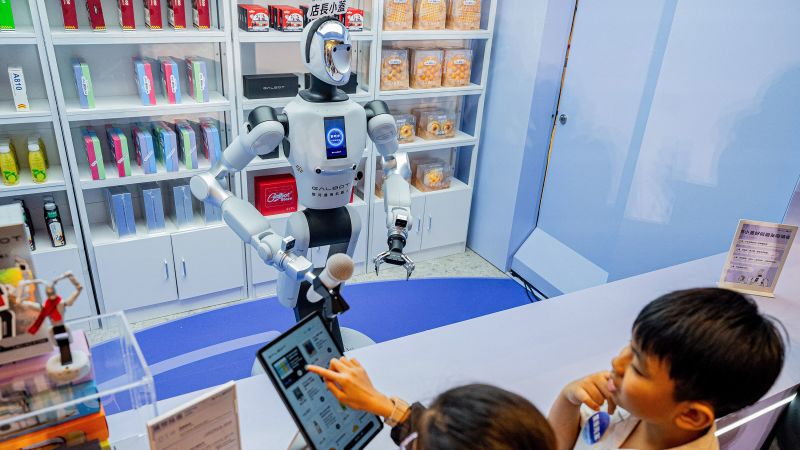
Healfromzero.com – Artificial intelligence has already become a routine part of daily life for many people in China. Residents can interact with AI-powered digital staff for local government services, students can photograph written work for rapid feedback, and hotel visitors may receive packages delivered by robots. These practical encounters help explain why public anxiety about an AI-driven catastrophe appears far less visible than it is in the United States.
A Morgan Stanley survey released Monday found that 80% of respondents in China used AI at least once a week, compared with 54% in the United States. The contrast is not simply about access to technology. It also reflects different public debates, differing levels of trust in government oversight and the way AI is presented to consumers.
This technology was created to serve humanity. We shouldn’t see it as something to fear, but as something that brings greater conveniences to our lives.
Xu Jingyuan, a 22-year-old business student in Beijing, said he believed the Chinese government was “absolutely capable” of managing the risks associated with AI. His view echoed sentiments expressed by other Chinese citizens: AI is often assessed through its immediate usefulness rather than through speculative fears about humanity’s long-term survival.
Useful Products Shape Public Attitudes
China’s highly competitive technology sector has rapidly made AI features inexpensive or free. Chatbots, automated tools and AI-enhanced services are increasingly embedded in apps people already use. Companies across e-commerce, manufacturing, filmmaking and other industries are also adopting the technology, making its productivity benefits more visible to workers and consumers.
For many users, AI arrives first as a service that saves time or lowers costs. That experience can make abstract warnings about future dangers seem remote.
Most Chinese people meet AI as a cheap product first and as a debate second. When a technology shows up as a useful, low-cost service, people judge it by what it does for them, not by what it might do to them.
Poe Zhao, an analyst and founder of the Hello China Tech newsletter, said this consumer-first experience is central to understanding the public response. In a country where AI is increasingly visible in ordinary transactions, education and logistics, the technology can feel less like an unknown force and more like an extension of existing digital life.
Shi Hongchao, 51, from Liaoning province in northeastern China, described AI as pervasive and difficult to avoid.
Everyone I know says AI has already permeated every aspect of our lives. Everyone is either talking about it or has already started using it. It feels almost unstoppable at this point.
A Wide Gap With the United States
The difference in attitudes is apparent in survey data. Ipsos found earlier this year that 83% of respondents in China considered AI-powered goods or services exciting. In the United States, that view was shared by 33% of respondents.
American discussion around AI has been shaped in part by high-profile warnings from technology executives and researchers. Some have called for development to slow because they believe increasingly capable systems could pose an existential danger. Concerns in the United States also include whether large technology companies can be adequately supervised, whether AI could intensify misinformation or fraud, and how quickly automation may reshape work.
Chinese discussions tend to use a different frame. Rather than centering on the prospect of human extinction, concerns are more often described in terms of operational control, malicious misuse and social disruption. Those issues can still be serious, but the language emphasizes managing AI as a strategic technology rather than halting its expansion.
Chinese warnings are quieter and use a different vocabulary. The dominant framing is loss of operational control, malicious use and social disruption, rather than human extinction.
That framing is consistent with Beijing’s broader approach to the sector. Chen Yixin, China’s intelligence chief, published an article last Sunday calling for AI to be incorporated as a strategic industry in the country’s economic development while also addressing risks identified by the government.
Trust, Politics and Oversight
Confidence in public institutions is another major dividing line. An Edelman survey found that 86% of respondents in China trusted their government to do what is right, compared with 39% in the United States. Such differences can influence whether people expect regulators to intervene if new technologies cause harm.
In the US, there is a general public perception that without whistleblowing, big corporations could escape accountability or scrutiny due to weak government oversight. Whereas in China, I think there is this very strong confidence from the public that if any sh*t hits the fan, the government will step in.
Lian Jye Su, chief analyst at technology research firm Omdia, linked the divide to contrasting expectations of corporate accountability and state intervention. In the United States, whistleblowing and public conflict frequently play an important role in exposing failures. Policy arguments can become especially contentious in a polarized democracy.
China’s one-party political system operates differently. Its top-down structure allows the state to set priorities with less open criticism, and that can reinforce the belief that authorities will step in when technological risks emerge. It also means public debate may be less visible, even when policymakers and security officials are considering potential harms.
The contrasting responses do not mean that one country is embracing AI without concern while the other rejects it. Both are pursuing leadership in a technology expected to affect economic competitiveness, public services and industry. The central difference is the public lens: in China, AI’s immediate utility and the expectation of state control have helped make optimism more prominent than dystopian fear.
Related Reading
Frequently Asked Questions
What is Why is China less worried about?
Why is China less worried about is the main topic of this guide. The article explains the context, practical details, and next steps readers should understand.
Why does Why is China less worried about matter?
Why is China less worried about matters because readers are looking for a useful answer, not just a short summary. Good content should match search intent and help them decide what to do next.