Secret CIA visit highlights Putin and Trump’s common strategic trap

Daftar Isi
Two Presidents, Two Unwinnable Wars: The Strategic Trap Binding Washington and Moscow
Healfromzero.com – The six-month mark of the American military campaign in Iran arrived this week amid a quiet but consequential diplomatic maneuver: CIA Director John Ratcliffe flew into Moscow to deliver a blunt message to Kremlin leadership — that Russia is losing its war in Ukraine. The irony was not lost on his hosts. Russian intelligence officials, steeped in a national tradition of gallows humor forged across centuries of invasion and upheaval, likely appreciated the bitter comedy of an American spymaster arriving to announce their military failure while his own president grapples with a parallel conflict he cannot win and cannot cleanly exit.
The Shared Dilemma
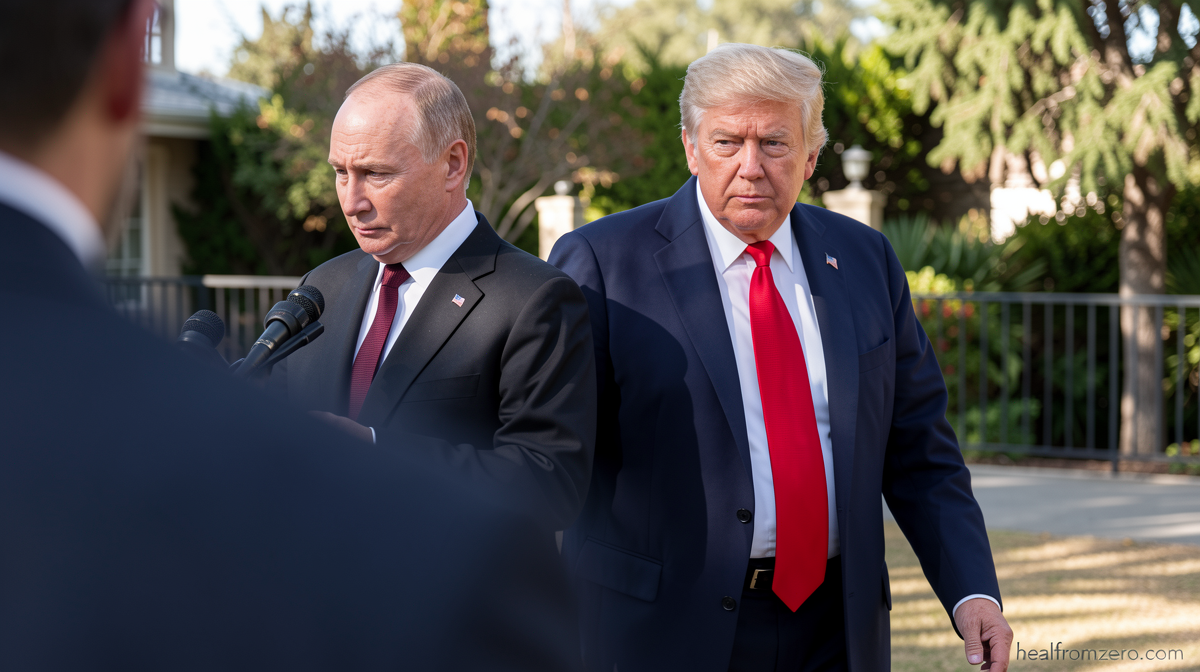
What unites Trump and Putin at this moment is not ideology or geography but a structural predicament. Both men launched hostilities after underestimating the resilience of opponents whose armed forces were, on paper, dwarfed by the conventional firepower and matériel of their respective superpowers. Both watched their initial tactical superiority dissolve under asymmetric warfare — cheap drones, decentralized strike networks, and a new grammar of combat pioneered by Ukraine and Iran alike. The result is identical in shape: war aims remain out of reach, yet withdrawal would carry an unbearable cost to prestige and domestic standing.
Washington’s foreign-policy establishment has long worried that Putin receives sanitized briefings about the trajectory of his Ukrainian campaign. The question now extends to the White House itself. If the president’s consistently upbeat characterizations of American progress in Iran mirror the pattern, then his inner circle may be filtering out unfavorable intelligence just as Moscow’s apparatus has allegedly done for decades. Two autocratic-adjacent decision-makers, insulated from candid counsel, steering two wars toward stalemate or escalation.
Historical Echoes and Their Limits
Both capitals know the terrain of costly foreign entanglement. The United States was humbled in Afghanistan; Russia suffered its own protracted Afghan catastrophe. The scale of Russia’s Ukrainian disaster carries unmistakable echoes of Vietnam for American audiences. Yet the comparison, while apt at the level of strategic overreach, breaks down in critical particulars.
Trump has not replicated Putin’s most consequential error: the decision to pour divisional ground forces into a land war of attrition. According to the Center for Strategic and International Studies, that choice has left more than 1.4 million young Russians dead, wounded, or missing. A comparable toll would be politically unsustainable in the United States. Putin, operating under genuinely authoritarian constraints, faces fewer domestic checks than Trump, who must answer to a Congress, a press corps, and an electorate that has watched the Iran campaign unfold in real time.
There is also a distinction in conduct. Putin has subjected Ukrainian cities and power infrastructure to sustained missile and drone bombardment. Trump has largely refrained from deliberately targeting civilian populations or civil infrastructure in the Iranian theater. He has not, however, offered a full public accounting of a February missile strike that struck an Iranian school, killing nearly 200 children and adults — a blow apparently attributable to reliance on outdated intelligence. The absence of explanation has deepened skepticism about the administration’s transparency.
Ratcliffe’s Agenda and Its Regional Stakes
The CIA chief’s Moscow itinerary extended well beyond a single talking point. Two people familiar with the matter told CNN that Ratcliffe warned Russian counterparts against any overt or covert strike on NATO territory, a message calibrated to Europe’s growing anxiety that Putin might probe the alliance’s collective-defense guarantees at a moment of American distraction. He also pressed Russian espionage officials to curtail economic and military support flowing to Tehran.
For NATO allies who have spent years fretting over the durability of American security commitments under this administration, any visible US diplomatic engagement aimed at ending the Ukrainian war would be received with relief — even as the president’s downgrading of military aid to President Volodymyr Zelensky’s government fuels suspicion about his true intentions. Trump has not followed through on an apparent summer offer to permit Ukraine to license production of Patriot anti-missile systems. His earlier prediction that he could end the war in 24 hours has gone nowhere, and his repeated assertion that Putin desires peace is contradicted weekly by battlefield events.
The Iran Dimension and Economic Warfare
The United States has maintained an arm’s-length posture toward the Ukrainian conflict since its outset, while Russia occupies an over-the-horizon role in the Iranian war. That role sharpened this week as the administration pivoted from kinetic military action to all-out economic warfare against Tehran. CNN reported in March, citing multiple people familiar with the matter, that Russia has been supplying Iran with intelligence on the locations and movements of American troops, ships, and aircraft — a quiet but significant channel of support that complicates any quid pro quo arrangement.
Any attempt to trade Ukrainian concessions for Russian cooperation on Iran would founder on the president’s prior failure to browbeat Kyiv into territorial concessions. Moscow, meanwhile, may harbor little strategic incentive to ease Trump’s predicament in the Persian Gulf. The wider Middle East destabilized by two simultaneous wars, the entanglement of great powers, and the specter of widening geopolitical conflict make this moment one of flux and somber omen. Two leaders, two wars, one shared trap: the inability to achieve victory without surrendering the very authority that made the war seem worthwhile in the first place.
Related Reading
Frequently Asked Questions
What is Secret CIA visit highlights Putin and Trump?
Secret CIA visit highlights Putin and Trump is the main topic of this guide. The article explains the context, practical details, and next steps readers should understand.
Why does Secret CIA visit highlights Putin and Trump matter?
Secret CIA visit highlights Putin and Trump matters because readers are looking for a useful answer, not just a short summary. Good content should match search intent and help them decide what to do next.