The closest planet to our sun is shrinking. Here’s what that means

Daftar Isi
Mercury’s Surface May Hide a Larger History of Planetary Shrinkage
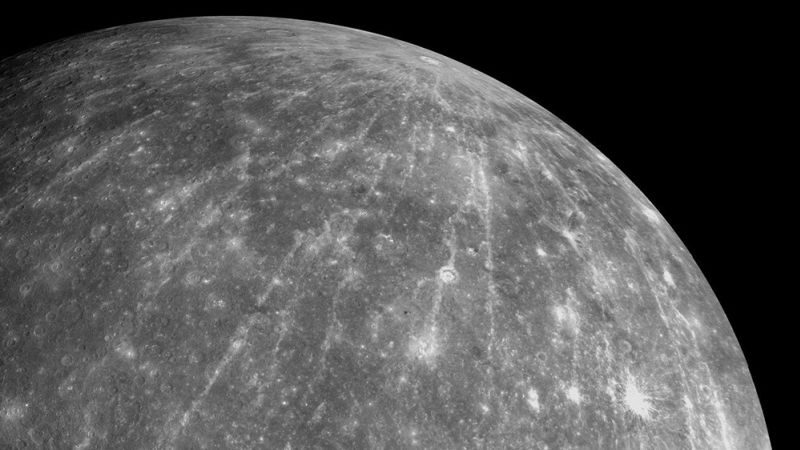
Healfromzero.com – Mercury’s battered landscape is filled with clues that the planet has been slowly contracting for billions of years. New research suggests that the small world nearest the sun may have diminished more than earlier estimates indicated, with debris from countless impacts potentially concealing some of the surface fractures created as the planet cooled.
The study, published Thursday in Geophysical Research Letters, examines the ridges and cliff-like landforms that trace Mercury’s long-term loss of heat. These features, known as shortening structures, form as the planet’s interior cools and its outer shell is compressed. Scientists now estimate that hidden structures could mean Mercury contracted 10% to 30% more than previously thought.
A Planet That Cooled and Tightened
Mercury orbits at an average distance of about 36 million miles, or 58 million kilometers, from the sun, completing a year in just 88 days. It is the solar system’s smallest planet and formed roughly 4.5 billion years ago from the gas and dust surrounding the young sun.
Its earliest era was violent. Planetary bodies and smaller rocky objects repeatedly collided as the solar system took shape, adding energy to already hot newborn worlds. Over immense spans of time, that heat escaped into space. As a rocky planet cools, its interior can contract, squeezing the crust and producing cracks, ridges and steep scarps.
On Mercury, some of those cliffs rise as high as 1 mile, or 1.6 kilometers, and stretch for hundreds of miles. Yet the same ancient environment that helped create the planet’s geological record also obscured it. Asteroids and comets have struck Mercury throughout its history, leaving craters and scattering debris over much of its surface.
Rough Terrain May Be Concealing the Evidence
Lead author Gaku Nishiyama, a planetary scientist at the German Aerospace Center’s Institute of Space Research in Berlin, and colleagues analyzed observations from NASA’s MESSENGER spacecraft. Their work produced a global map of surface roughness that revealed an important pattern: the roughest regions contained fewer visible shortening structures than smoother areas.
That contrast raised the possibility that impact debris has covered fractures and cliffs that would otherwise be visible. If those concealed structures are counted, Mercury’s radius may have decreased by about 7.2 miles, or 11.6 kilometers. Earlier work had placed the estimated reduction between 0.6 and 1.2 miles, or 1 to 2 kilometers, with some studies suggesting up to 4.3 miles, or 7 kilometers.
“It made us think that there’s a process obscuring shortening structures,” Nishiyama said.
The result does not simply revise a number on a planetary chart. Mercury’s contraction is tied to questions about its internal architecture, its rocky shell and the evolution of its magnetic field. A better measurement of the change can help researchers test models of how the planet’s layers formed and changed over time.
Why Mercury Matters Beyond Its Small Size
Mercury is difficult to investigate because of its punishing proximity to the sun. Only two previous missions have explored it closely: NASA’s Mariner 10, which flew past Mercury in 1974, and MESSENGER, which entered orbit in 2011. Mariner 10 first revealed the world’s unusual network of wrinkles, while MESSENGER delivered a far broader view of its terrain.
Dr. Hannes Bernhardt, an assistant research scientist in the Department of Geological, Environmental and Planetary Sciences at the University of Maryland, College Park, said Mercury provides an unusually valuable setting for studying rocky worlds. Bernhardt was not involved in the new research and has examined Mercury’s contraction in separate work.
“There are lessons about the formation and evolution of large, rocky bodies like our Earth, that can be learned on Mercury better than anywhere else in our Solar System,” Bernhardt wrote in an email.
Earth is far more geologically active than Mercury. Its crust is reshaped by plate tectonics, weather, oceans and life, which can erase or transform ancient features. Mercury lacks those same surface processes, allowing old tectonic scars to remain visible for extraordinarily long periods. That makes its terrain a useful record of the cooling and compression that affect rocky planets.
Dr. Paul Byrne, associate professor of Earth, environmental and planetary sciences at Washington University in St. Louis, said it is reasonable that previous efforts may have overlooked some cracks in rugged terrain. He also noted that Mercury’s highly uneven crust could mean that some structures did not develop everywhere in the same way. Byrne, who was not involved in the latest study, is also director of the NASA Planetary Data System’s Geosciences Node.
“Yet if we can accurately measure how much Mercury has contracted, we can make better estimates of its interior layering, the size and make-up of its core, its tectonic and volcanic histories, how its magnetic field is generated, and a whole lot more,” Byrne wrote.
More Answers May Be Close
The new findings arrive as Mercury is set to receive renewed attention. An unprecedented mission is expected to place two orbiters around the planet in November, potentially delivering new observations of its surface, interior and magnetic environment.
For now, Mercury remains one of the least understood rocky planets in the solar system. Its folded crust, enormous cliffs and impact-scarred plains show that even a small, seemingly quiet world can preserve evidence of dramatic internal change. The latest analysis suggests some of that story may still be hidden beneath the debris of ancient collisions.
Related Reading
Frequently Asked Questions
What is The closest planet to our sun is?
The closest planet to our sun is is the main topic of this guide. The article explains the context, practical details, and next steps readers should understand.
Why does The closest planet to our sun is matter?
The closest planet to our sun is matters because readers are looking for a useful answer, not just a short summary. Good content should match search intent and help them decide what to do next.