Empty podiums, prizes for e-voting, no opposition: Russians head to the polls amid intensifying war in Ukraine

Daftar Isi
Russia’s parliamentary vote unfolds with little visible political competition
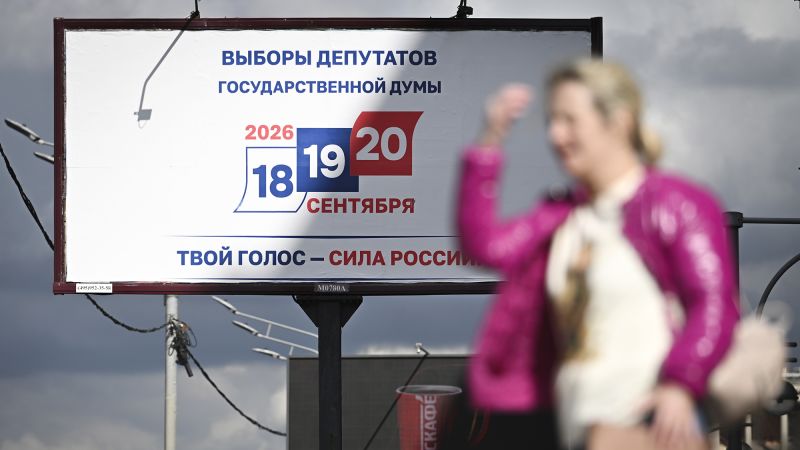
Healfromzero.com – Russia begins three days of voting Friday in parliamentary elections held under the shadow of a war in Ukraine that has entered its fifth year. The contest will choose all 450 members of the State Duma, the lower chamber of parliament, but it is taking place in a system where meaningful opposition has largely been pushed aside, prohibited from participating or driven abroad.
The vote is the first nationwide parliamentary election since Russia launched its full-scale invasion of Ukraine more than four years ago. United Russia, the party aligned with President Vladimir Putin and dominant in domestic politics for over two decades, is expected to retain a majority.
Polling is also being conducted in Russian-controlled Ukrainian territory, including Crimea and parts of Donetsk, Luhansk, Kherson and Zaporizhzhia. Those areas remain central to the wider conflict, while the Kremlin continues to describe the invasion as a “special military operation.”
Empty lecterns before the vote
The limited nature of the campaign was illustrated in Ryazan, about 122 miles southeast of Moscow, where a scheduled television debate went ahead without any of its participants. Six registered candidates had been invited, yet none arrived at the Russia-1 studio.
“The candidates have not shown up at our studio, so I’ll say goodbye for now,”
Anchor Elizaveta Dorokhina told viewers as empty podiums stood on both sides of her. The program then cut to advertising.
The episode captured the carefully maintained form of electoral competition: registered candidates, campaign programming and voting procedures, but little indication that the result could alter the country’s political direction. Stability and the appearance of orderly institutions have become key elements of Putin’s long-running rule, even as political space has narrowed sharply.
Anti-war party removed from the ballot
Yabloko, whose name translates as “apple,” had been Russia’s only officially registered party openly opposing the war. It was initially permitted to take part before the Supreme Court barred it last month.
Grigory Yavlinsky, a Yabloko co-founder and one of Russia’s best-known liberal politicians, said the party had attracted unexpected support for its central demand: a ceasefire in Ukraine. Its exclusion further reduced the options available to voters seeking an anti-war position inside the formal electoral system.
Putin is not personally standing for election, but his influence over the process remains unmistakable. Andrei Kolesnikov, a Moscow political analyst and columnist for The New Times and Novaya Gazeta, described Russia’s system as one centered on an individual leader rather than competitive institutions. Russian authorities have designated Kolesnikov a “foreign agent.”
“The Russian political system is a rigid, personalistic regime with institutions that are imitational,”
Kolesnikov said. He argued that elections do not determine policy, which is set in advance, but instead reinforce an impression that public opinion overwhelmingly supports Putin’s agenda and isolates those who disagree.
War pressures reach daily life
The election comes at a difficult moment for many Russians. Restrictions on internet access, pressure on civil society and continuing crackdowns on dissent have reshaped public life since the invasion began. At the same time, the effects of the conflict are becoming harder to separate from everyday concerns inside Russia.
Ukraine has expanded long-range drone operations against targets far from the front lines in an effort to increase pressure on Moscow and encourage negotiations. The attacks have caused deaths and injuries, though on a far smaller scale than the destruction and casualties experienced in Ukraine.
Strikes on oil refineries have also contributed to fuel shortages, producing lines of vehicles in major cities. Attacks affecting some of Russia’s largest online retailers have added strain to an economy already carrying the burden of prolonged wartime spending and disruption.
For voters, these pressures can sit alongside doubts about whether elections offer a way to influence public policy. In Moscow, a week before the vote, conversations reflected both private anxiety and a familiar caution about speaking openly.
Raisa, who declined to provide her full name, said she hoped elected representatives would be decent people who considered the needs of ordinary citizens. Asked about the future, she expressed a wish shared by many Russians who are weary of the conflict.
“I’d probably say what many people would: peaceful. I really want it all to end.”
Her comment was accompanied by a careful reference to the war, underscoring the sensitivity surrounding public discussion of the conflict.
Another Moscow voter, 73-year-old Marina Alexandrovna, said she had not decided whom to support but planned to cast a ballot because she always does. Her assessment of the process was more skeptical.
“It’s not who votes that matters, but who counts the votes.”
Speaking about Russia’s political environment, she said people understood the realities of daily life and the laws being adopted, even if they felt powerless to change them.
“I don’t like it, but there’s nothing we can change.”
A vote shaped by constrained choices
Russia’s parliamentary elections remain an important public demonstration of state authority, even when their practical impact on national policy is limited. The Duma approves legislation and provides a formal parliamentary framework, but the political balance has long favored the Kremlin and parties that operate within its accepted boundaries.
For the authorities, a high-turnout, orderly vote can help project normality while the war continues and domestic pressures grow. For voters, the election offers a formal civic ritual at a time when open political disagreement carries substantial risks and the main anti-war option has been removed from contention.
The contrast between those two realities was visible in the vacant Ryazan debate studio: the machinery of an election was in place, but the contest it was meant to display was largely absent.
Related Reading
Frequently Asked Questions
What is Empty podiums prizes for e voting?
Empty podiums prizes for e voting is the main topic of this guide. The article explains the context, practical details, and next steps readers should understand.
Why does Empty podiums prizes for e voting matter?
Empty podiums prizes for e voting matters because readers are looking for a useful answer, not just a short summary. Good content should match search intent and help them decide what to do next.