Body of war criminal Mladić lies in state in Serbian capital ahead of funeral

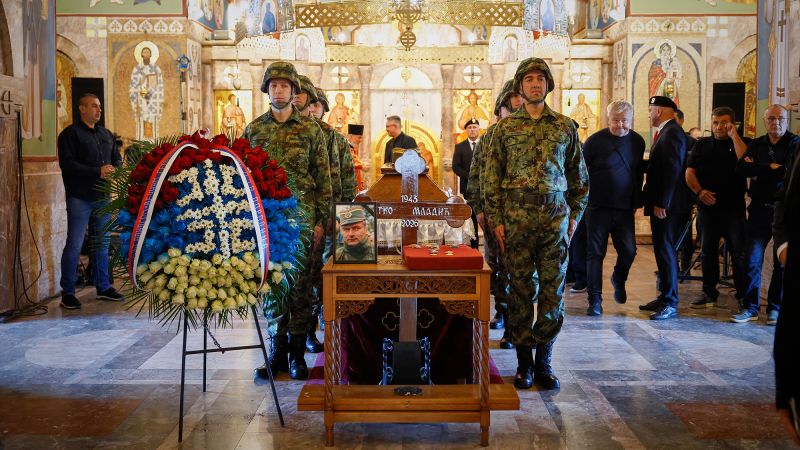
Serbia Holds State Funeral for War Criminal Mladić
Healfromzero.com – The body of war criminal Mladić lay draped in the Serbian flag inside the small Church of St. Luke in Belgrade on Monday morning, surrounded by thousands of mourners who had gathered hours before the ceremony began. A military officer’s cap and saber rested on the casket while rows of soldiers in fatigues stood guard — a tableau of state homage that Brussels had explicitly urged Serbia to avoid. The Balkan capital pressed ahead regardless, converting the passing of a convicted genocide perpetrator into a full military honors event.
Ratko Mladić, the Bosnian Serb commander responsible for some of the worst atrocities of the 1992–95 Bosnian war, died at age 84 on August 27 while serving a life sentence at the International Criminal Tribunal in The Hague, Netherlands. In 2017 the tribunal convicted him of genocide, war crimes, and crimes against humanity, most notably for orchestrating the 1995 massacre of more than 8,000 Bosnian Muslims at Srebrenica, the yearslong siege of Sarajevo, and the operation of concentration camps holding non-Serb civilians and captured soldiers.
A State Ceremony Disguised as Private Mourning
Although the family formally arranged the funeral, government fingerprints were everywhere. A state aircraft ferried the remains from the Netherlands to Belgrade the previous week. Soldiers carried the coffin through the capital, and a military commemoration ceremony took place Saturday at an official army venue. Patriarch Porfirije, head of the Serbian Orthodox Church, led the liturgical service. Pro-government outlets confirmed that full military honors would accompany the burial.
For a large segment of the Serbian public, the late commander remains a figure of pride. Milan Dobric, a mourner who traveled from Kosovo, framed the day in personal terms:
“Mladić was a man who gave everything in his life for the Serbian people. I am glad that this morning people are coming to pay special respect.”
In the days following his death, nationalist admirers held candlelit vigils, painted murals bearing his likeness across Belgrade, and lit flares in his name. On Sunday evening, soccer supporters unfurled a massive banner at a match in the capital and chanted his name through the stands.
Brussels Pulls Back and Domestic Politics Take Hold
The ceremony collided sharply with Serbia’s ongoing bid for European Union membership. Marta Kos, the bloc’s enlargement commissioner, canceled a scheduled visit to Belgrade in protest, arguing that the public glorification surrounding the death stood at odds with the foundational values underpinning the accession process. Other European officials, regional leaders, and families of Bosnian war victims joined the chorus of criticism. The reaction touched a wound that has never fully closed: the Bosnian conflict killed more than 100,000 people and displaced over a million before a US-brokered peace agreement halted the fighting in 1995. Srebrenica, designated a UN “safe haven” for Bosniaks, was overrun by Bosnian Serb forces who stripped men and boys, executed them, and bulldozed their bodies into mass graves. Serbia has never formally recognized that genocide occurred there, preferring the term “horrific crime” in official discourse.
Populist President Aleksandar Vucic — a former extreme nationalist who backed Serbia’s expansionist agenda during the war — framed the funeral as a spontaneous national expression rather than a political statement, describing it as an “emotional outpouring” that “has nothing to do with whether Vucic allowed something or not.” He was, however, conspicuously absent from the ceremony itself. Vucic has sharpened his anti-Western rhetoric in the run-up to an early parliamentary election expected next month, accusing Kos of “lying” and casting Serbia’s wartime role in a light of perpetual victimhood:
“We (Serbs) have been persecuted and harassed for 30, 40 years … always guilty whatever happens. People just won’t take it any more.”
The timing is not incidental. Serbia’s EU candidacy has already stalled amid democratic backsliding and Vucic’s refusal to align with international sanctions imposed on Russia following its invasion of Ukraine. Last year, the same government buried former army chief of staff Nebojša Pavković — another convicted war criminal — with full military honors at a cemetery reserved for distinguished individuals. The ceremony extends that pattern, signaling to domestic audiences that the state will continue to honor figures the West treats as symbols of accountability.
Frequently Asked Questions
Where and when did the state funeral take place? The ceremony was held on Monday at the Church of St. Luke in Belgrade, following a military commemoration on Saturday at an official army venue.
What charges led to Mladić’s conviction? The International Criminal Tribunal for the former Yugoslavia found him guilty of genocide, war crimes, and crimes against humanity in 2017, including the Srebrenica massacre and the siege of Sarajevo.
Why did the EU react negatively? Enlargement Commissioner Marta Kos canceled a planned Belgrade visit, stating that the state-level glorification conflicted with EU accession values. Serbia’s candidacy is already stalled over democratic backsliding and its refusal to mirror sanctions on Russia.
Has Serbia acknowledged the Srebrenica genocide? No. Official Serbian discourse continues to describe the event as a “horrific crime” rather than genocide, a position that distinguishes it from neighboring Bosnia and Croatia, both of which have formally recognized the genocide.