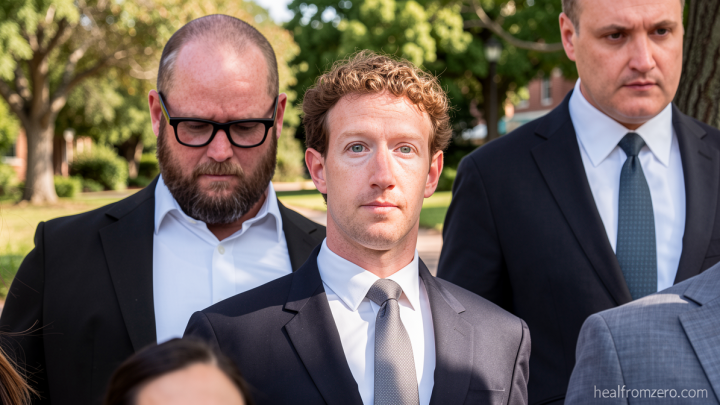
Meta settles landmark state child harm claims for $18 billion and promises changes to its platforms

Daftar Isi
Meta’s $18 Billion Child-Safety Settlement Reshapes the Social Media Landscape
Healfromzero.com – In what is being called the largest settlement ever reached between a major technology company and state governments, Meta has committed roughly $18 billion to resolve a sprawling multistate lawsuit alleging that its social platforms were deliberately engineered to addict young users and damage their psychological well-being. The deal, announced Wednesday, effectively closes out a landmark legal confrontation that had drawn scrutiny from regulators, parents, and mental-health advocates across the country.
The financial structure of the agreement splits the payout: just over $17 billion addresses the joint action filed by 29 states back in 2023, while the remaining sum settles parallel claims lodged by additional states and territories. Meta described the funds as earmarked for state-level “youth online safety initiatives,” signaling that the money will flow into programs designed to protect minors online rather than simply compensating past grievances.
A Trial Interrupted
The settlement landed barely more than a week after a high-stakes trial commenced in California, where four states had pressed for as much as $1.4 trillion in damages alongside sweeping structural reforms to Meta’s products. Instagram chief Adam Mosseri was scheduled to take the witness stand for a second consecutive day on Wednesday, and Meta’s chief executive Mark Zuckerberg was also expected to appear as a witness. Both executives were set to face questioning about internal design decisions and the company’s knowledge of how its algorithms affected adolescent users.
Meta had spent years publicly contesting the premise that its platforms cause measurable harm to children. Company spokespeople characterized the states’ allegations as “unsubstantiated” and pointed to substantial internal investment in safety tooling. Notably, the settlement does not include an admission of fault or wrongdoing by Meta.
“Ensuring teens have a safe and productive experience on our platforms is an absolute imperative for Meta. We want to get this right for parents and teens, and that’s why we partnered with state attorneys general to set a new industry standard.”
That statement appeared in a company blog post published Wednesday alongside the settlement announcement.
Why States Preferred a Deal Over a Verdict
North Carolina Attorney General Jeff Jackson, speaking at a Wednesday press conference, framed the agreement as the single largest settlement ever extracted from a big-tech firm. His reasoning was pragmatic: a full trial, even a favorable one, would have pushed meaningful platform changes years into the future.
“Litigation would mean that we were still many years away from bringing any of these child safety upgrades to these platforms, it would risk losing another generation.”
Jackson’s remarks underscored a broader tension in child-safety litigation — the gap between the speed at which adolescent users encounter platform features and the glacial pace of multi-year court proceedings.
Concrete Platform Changes Mandated by the Deal
Beyond the cash, the settlement imposes a suite of operational restrictions on Meta’s apps. The most consequential provision caps cumulative daily usage at two hours for users aged 13 through 17, a limit that only a parent or guardian may adjust. After every 15 minutes of uninterrupted scrolling on Facebook or Instagram, the platform will interrupt the session with a prompt designed, in the company’s words, “to encourage intentional use.”
Additional defaults include a “night mode” that locks teen accounts out of the apps between midnight and 6 a.m., and a “school mode” that throttles notification volume during typical school hours. The number of likes and reactions attached to a teen’s posts will be concealed by default, and so-called “extreme makeup filters” will be blocked for younger users. These measures build on Teen Accounts settings Meta had already deployed, though state attorneys general and several outside researchers had questioned whether those earlier tools were sufficient.
Financial Stakes and Business-Model Implications
At face value, $18 billion looks modest against Meta’s roughly $200 billion in annual revenue from last year. Yet the operational changes embedded in the deal — particularly hard time caps and notification throttling — strike directly at the attention-extraction engine that underwrites the company’s advertising revenue. In its most recent earnings filing, Meta itself flagged the youth-safety trial docket as a source of potential “material loss,” acknowledging that continued litigation could erode earnings beyond the settlement figure.
The payout schedule adds another layer of complexity. Seventy percent of the fund will be disbursed to states in annual installments spread across the coming decade. The remaining thirty percent is contingent: it becomes payable only if YouTube and TikTok commit to comparable payments and implement analogous product changes. That condition effectively ties Meta’s final obligation to the cooperation of two rival platforms, introducing a negotiation dynamic that could stretch the timeline well beyond ten years.
A Pattern of Losses and Ongoing Exposure
The multistate settlement is not Meta’s first courtroom defeat on addiction-related claims this year. Earlier in 2026, a New Mexico attorney general secured an order compelling Meta to pay nearly $1 billion in damages. Separately, a teenager identified only as K.G.M. prevailed in a suit that produced joint damages of $6 million shared between Meta and YouTube.
Those rulings sit alongside hundreds of individual lawsuits filed by families, school districts, and private plaintiffs alleging that Meta’s products hook children and cause lasting psychological injury. Future verdicts in those cases could impose further financial penalties, though the company continues to dispute each claim.
What the States Alleged
The original state complaints painted a detailed picture of intentional design. Prosecutors pointed to the infinitely scrolling feed, algorithmic recommendation engines calibrated to maximize session length, and aggressive notification cadences as features engineered specifically to capture adolescent attention. They further alleged that Meta misled the general public about the magnitude of risk its platforms posed to young users and that it collected personal data from children under 13 without obtaining parental consent, in violation of federal and state privacy statutes.
Whether those design choices constituted deliberate harm or merely aggressive product optimization was precisely the question the California trial was meant to answer. The settlement, by resolving the matter before a jury verdict, leaves that question formally unresolved — even as it compels Meta to alter the very features at issue.
For parents and policymakers watching the fallout, the practical takeaway is clear: the next generation of teenagers will encounter a structurally different set of guardrails on Meta’s platforms, imposed not by voluntary corporate goodwill but by the financial and operational terms of the largest child-safety settlement in American legal history.
Related Reading
Frequently Asked Questions
What is Meta settles landmark state child harm?
Meta settles landmark state child harm is the main topic of this guide. The article explains the context, practical details, and next steps readers should understand.
Why does Meta settles landmark state child harm matter?
Meta settles landmark state child harm matters because readers are looking for a useful answer, not just a short summary. Good content should match search intent and help them decide what to do next.