Living, dying (and flying) artworks — Inside Anicka Yi’s ephemeral universe

Living, Dying (and Flying) Artworks — Inside Anicka Yi’s Ephemeral Universe
Living dying and flying artworks – At the Storm King Art Center in New York’s Hudson Valley, Anicka Yi’s towering structures are alive with microbial energy, their surfaces glowing in shades of acid green and coffee as if caught in a feverish fever dream. These columns, teeming with mercurial life, resemble an ancient excavation site, their organic forms suggesting a hidden history beneath the earth. Just 60 miles south, in Manhattan’s Lower East Side, two of her jellyfish-like contraptions hover above the fourth floor of the New Museum, their tentacles mimicking the slow, deliberate movements of creatures from the deep. Earlier this month, one of her radiolaria-inspired sculptures, a delicate representation of oceanic microorganisms, floated suspended at Frieze New York, its fiberoptic limbs curling in hypnotic rhythms. These works, spanning continents and mediums, are part of a larger vision Yi has cultivated over two decades: one that blurs the boundaries between machine, microbe, and human perception.
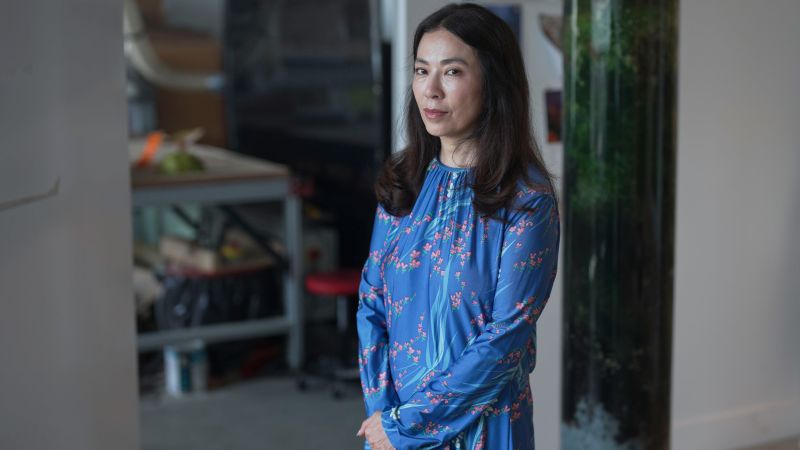
Anicka Yi’s Studio as a Living Archive
Yi’s Greenpoint studio, bathed in natural light, doubles as a lab and a repository for her evolving experiments. Shelves overflow with glass prototypes shaped like biomorphic organisms, alongside vials of fragrances that range from the familiar to the obscure. A bottle of Chanel No. 5 sits beside her own concoctions, a testament to the alchemy she practices. On a nearby table, cocoon-like lanterns rest open, their forms evoking both nature and technology. Samples of dyed and embroidered kelp are displayed in numbered bags, their textures and colors a catalog of her material explorations. In one corner, a solitary prototype from her Storm King commission remains, its surface clouded with soil and water from the sculpture park’s grounds. This physical residue, Yi notes, is a key part of the work’s identity, embodying the passage of time and the interaction between art and environment.
“I hope that people who are familiar with my practice can thoughtfully weave these works together and see the broader syntax I’m aiming for,” she said. “It takes time to develop that kind of scope and depth — (ideas) need to age and season and marinate, and you can’t do that as a young artist.”
Yi’s creations often challenge the permanence of art itself. “Message from the Mud,” her latest installation at Storm King, is a fleeting presence, existing only during the sculpture park’s summer season. The structures, made of columns housing microorganisms sensitive to light and heat, are designed to dissolve and reform over time, mirroring the impermanence of natural systems. “It’s a great way to encapsulate something about this deep history and deep time that Storm King stands on, and that goes so far beyond human time,” Yi explained. The work’s transient nature invites viewers to consider how life, in all its forms, is both fragile and resilient.
Her approach to artmaking is deeply rooted in the interplay between organic and synthetic worlds. Earlier projects, such as her “living paintings” derived from bacterial cultures, showcased this duality. The same technique underpins “Message from the Mud,” which utilizes Winogradsky columns — small, self-contained ecosystems developed by Russian-Ukrainian microbiologist Sergei Winogradsky over a century and a half ago. These columns, filled with local soil and pond water, are further enriched with shredded newspapers for carbon, eggshells for calcium, and diatomaceous earth, creating a fertile ground for microbial diversity. Over two years, the installation has been slowly incubating in a heated barn under UV lights, its evolution a collaboration between Yi and the unseen forces of nature.
Yi’s work often questions the relationship between art and the invisible systems that surround us. “I’ve swabbed bacteria from successful women to create perfume, placed thousands of ants in observable colonies shaped like circuit boards, and built ecosystems where machines can learn,” she said. These experiments reflect her fascination with the unseen, from the microscopic to the technological. Her art is not just a reflection of the world but a reimagining of it, one that invites viewers to engage with the complexities of life in new ways. “We are living in a time when our relationships to both machine and microbe are heightened — and perhaps wondering which might take us out for good first,” she added, emphasizing the precarious balance between human and non-human forces.
At the Venice Biennale, Yi’s installations drew crowds not only for their visual impact but also for their olfactory and sensory dimensions. One of her works, for instance, required visitors to line up for the toilets — a detail that underscored the interplay between human and microbial ecosystems. The humor in this observation reveals Yi’s ability to merge the scientific and the poetic, making the invisible tangible. “The other ingredient is time,” she said, laughing. “They’ve just been cooking for two years.” This patience, she suggests, is essential to her process, allowing the microbial communities to develop their own rhythms and patterns.
Yi’s collaboration with the natural environment is a defining feature of her practice. “It’s the artist’s first outdoor installation,” said Nora Lawrence, executive director of Storm King. “And a true collaboration with the earth itself.” Unlike her algorithmic-based works, which rely on precision and control, the Winogradsky columns embrace uncertainty. “Without the right environmental variables, the microbial neighborhoods will simply die off,” she noted, acknowledging the fragility of her creations. Yet she has also considered the unexpected: “I was actually a little concerned that bears would come to the installation once it was up and that they would just tip over the columns,” she admitted, adding with a smile that they are “pretty securely fastened to the ground.” Still, she looks forward to the day when turtles and frogs join the pond, their presence a natural extension of the ecosystem she has designed.
Yi’s art is a meditation on ephemerality, a reminder that even the most meticulously crafted works are subject to the passage of time. “Message from the Mud” is not just a sculpture but a living system, its layers of color and texture shifting as the microbes respond to their surroundings. This dynamic quality challenges traditional notions of art as static, instead positioning it as an evolving dialogue between human intervention and natural processes. “I’m trying to make visible the systems around us that are microscopic, impermanent, or technologically abstract,” she said. “Sometimes, they’re even odorous.” The result is a universe of art that is as much about the unseen as it is about the seen, a space where the boundaries between life and art blur.
Her work resonates with a growing awareness of our interconnectedness with the natural and technological worlds. In an era where climate change and artificial intelligence are reshaping our understanding of existence, Yi’s installations offer a lens through which to view these transformations. The microbial columns, the flying machines, and the fragrant sculptures are all part of a larger narrative, one that questions how we perceive and interact with the world around us. “It’s not just about creating art,” she said. “It’s about creating a space where people can think differently about life, death, and the unseen forces that shape our reality.”
Through her practice, Yi has built a universe of possibilities, where art is not merely an object but a process, a presence, and a phenomenon. Her work invites viewers to consider the delicate balance between the tangible and the intangible, the temporary and the eternal. In a world increasingly dominated by machines and data, Yi’s art reminds us that the smallest elements of life — microbes, soil, light — hold the most profound stories. As the columns at Storm King continue to evolve, their hues shifting with each passing day, they become a symbol of this enduring interplay, one that challenges us to see the world with fresh eyes.