Trump administration plows ahead with groundbreaking for the president’s ‘triumphal arch’

Daftar Isi
Excavation for Trump’s Monumental Arch Set to Begin Within Two Weeks Despite Legal and Regulatory Hurdles
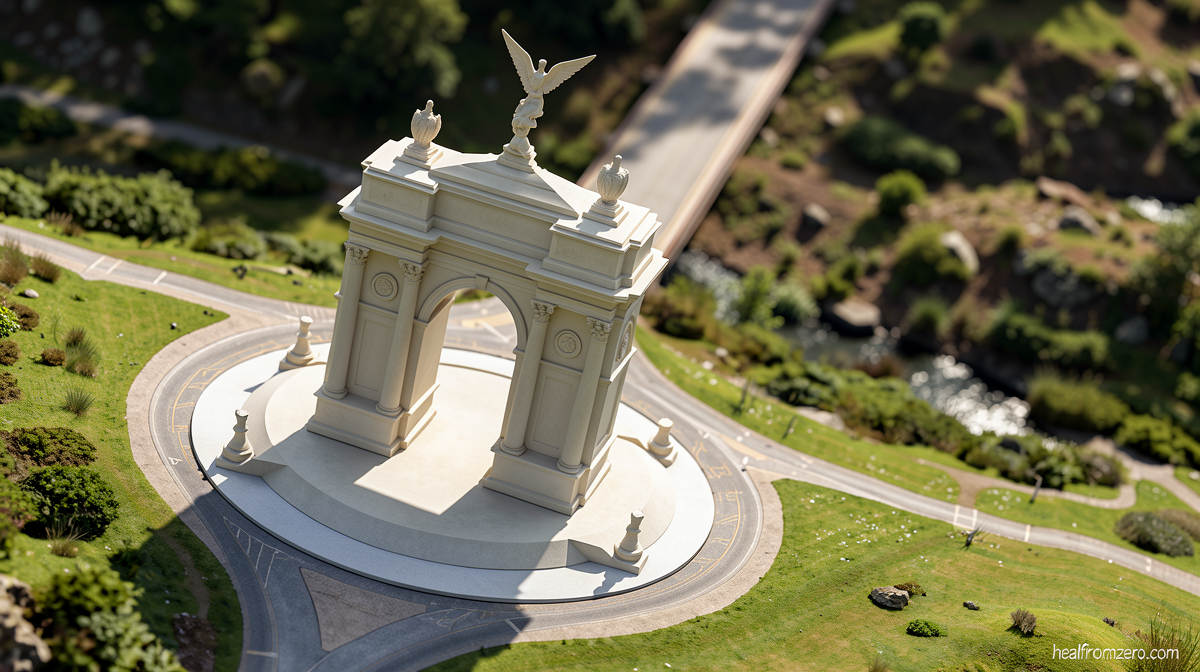
Healfromzero.com – The ground beneath a stretch of Washington, D.C. parkland will soon be turned over for what the White House calls the Great Triumphal Arch — a massive commemorative structure that Interior Secretary Doug Burgum confirmed will enter its excavation phase within the coming fortnight. Speaking on Thursday, Burgum framed the milestone as the culmination of a wait stretching back more than 125 years, when the idea of a grand arch on the National Mall first entered the public imagination.
“We are pleased to announce that after a very long wait (over 125 years!), we are preparing to start, over the next two-week period, the excavation work necessary for the Great Triumphal Arch,” Burgum wrote on X.
The announcement lands amid a thicket of unresolved legal questions, incomplete regulatory reviews, and an active lawsuit seeking to halt the project entirely. None of the standard federal approvals required for a structure of this scale on government land in the capital have been finalized, yet the administration is pressing forward with earthwork.
A Lawsuit and the Question of Congressional Authority
At the center of the dispute is whether the president can direct construction of a permanent monument on federal property without a specific act of Congress authorizing it. The administration’s position, articulated by Trump himself, is that no further legislative approval is required. Officials have pointed to a 1925 congressional authorization that called for decorative columns near the proposed arch site as sufficient legal cover — though those columns were never erected, and critics argue the century-old statute does not translate into a blank check for a structure of this magnitude.
Plaintiffs in the suit, represented by the nonprofit Public Citizen, include veterans who contend the arch would sever a historically significant sightline running from the Lincoln Memorial across the Potomac River to Arlington National Cemetery and to Arlington House, the memorial dedicated to Robert E. Lee. For these individuals, the arch is not merely an aesthetic intrusion but a tangible alteration of a view they consider part of the nation’s commemorative landscape.
“We’re frankly befuddled as to what sorts of legal authority the government believes that has to begin on the ground construction of the arch,” Nicolas Sansone, an attorney at Public Citizen, said.
Sansone added that his team would move as swiftly as possible to file responsive motions in court.
Planning Commission and Historic Preservation Gaps
The National Capital Planning Commission, one of two principal federal bodies charged with reviewing major alterations to government property in the District, has issued only a preliminary nod toward the project. Its next monthly meeting is scheduled for October 1, the earliest date on which a final approval could theoretically be granted. Even that timeline assumes completion of a Section 106 review — the assessment mandated by the National Historic Preservation Act that examines how a proposed structure affects historic and cultural resources in its vicinity. That review has not yet been finished.
Ed Stierli of the National Parks Conservation Association characterized the sequencing as a serious lapse in institutional norms.
“The fact that they’re moving forward on this before any of the legal steps required is egregious,” Stierli said.
The FAA Question: Airspace, Obstruction Lights, and a Two-Mile Radius
A separate regulatory track runs through the Federal Aviation Authority. The arch, once completed, would stand fewer than two miles from a runway at Ronald Reagan Washington National Airport, one of the highest-traffic facilities in the country. FAA rules require that any structure taller than 200 feet located where it could intersect controlled airspace undergo a formal review. A preliminary FAA study concluded the arch would not create a flight hazard but recommended installation of red obstruction lighting on the structure. The agency’s full review, however, remains open.
Courtroom Maneuvering and the Ballroom Precedent
The Department of Justice has asked a federal court to dismiss the arch lawsuit outright. In a filing submitted Thursday, DOJ leaned on a recent Supreme Court ruling that permitted construction of the East Wing Ballroom — another Trump-era project at the White House — to proceed. In that 5-4 decision, the conservative majority held that courts could not enjoin the ballroom work because the challengers had not demonstrated a concrete, particularized injury sufficient to trigger judicial intervention.
Translating that logic to the arch case, DOJ wrote:
“Plaintiffs cannot establish standing based on desires to view Arlington House or the Lincoln Memorial.”
Whether a lower court will accept that framing — particularly given that the plaintiffs here are veterans with a direct commemorative interest in the sightline — remains to be seen.
A Pattern in the Capital
For observers of Washington’s built environment, the arch episode fits a recognizable template: a president announces a grand-scale alteration of the capital’s landscape, pushes construction ahead of completed reviews, and invokes executive prerogative to sidestep the usual legislative and interagency checkpoints. Democratic Rep. Don Beyer, whose Northern Virginia district encompasses Arlington National Cemetery and the historic grounds directly across the river from the arch site, summed up the local reaction.
“This project is not even close to being ready for prime time,” Beyer said. “Plans to begin excavation are plainly illegal without congressional authorization.”
The Department of Interior did not immediately answer questions about the scope of the planned excavation or the specific legal authority under which crews would operate. As the first shovels approach the ground, the arch project enters a phase where every subsequent step — from historic-preservation clearance to final planning-commission sign-off to FAA certification — will be measured against a construction schedule that has already begun.
Related Reading
Frequently Asked Questions
What is Trump administration plows ahead with groundbreaking?
Trump administration plows ahead with groundbreaking is the main topic of this guide. The article explains the context, practical details, and next steps readers should understand.
Why does Trump administration plows ahead with groundbreaking matter?
Trump administration plows ahead with groundbreaking matters because readers are looking for a useful answer, not just a short summary. Good content should match search intent and help them decide what to do next.