Thwarted attack on UFC fight is another reason to build White House ballroom, Trump DOJ argues

Thwarted Attack on UFC Fight Bolsters DOJ’s Case for White House Ballroom Expansion
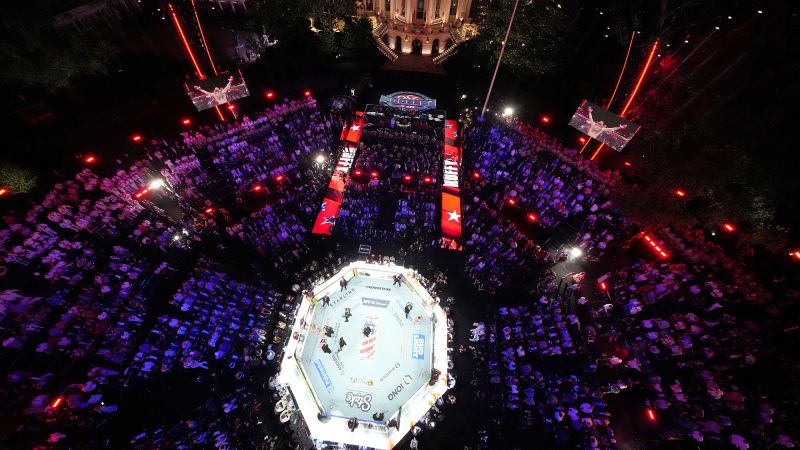
Thwarted attack on UFC fight is another – President Donald Trump’s legal team has intensified its defense of a proposed White House ballroom project, citing a recent attempted attack on an outdoor UFC event as further evidence of the structure’s necessity. Federal courts, which have previously questioned Trump’s claim to unilaterally construct the space without congressional approval, now face renewed arguments from the Department of Justice (DOJ) that the threat of violence underscores the urgency of the plan. The latest assertion comes as the DOJ seeks to bolster its case before a three-judge panel at the DC Circuit Court of Appeals, which is expected to rule soon on the legality of the expansion.
Security Concerns as Central Argument
Brett Shumate, the head of the DOJ’s civil division, penned a brief letter to the court late Tuesday, asserting that the thwarted attack on last weekend’s UFC fight “demonstrates the compelling need” for the nearly 90,000-square-foot ballroom. According to Shumate, the new facility would serve as a critical defense mechanism, shielding the White House grounds from potential threats. He emphasized that the ballroom’s “mass and height will create a barrier against attacks,” while also granting the Secret Service enhanced visibility to detect and neutralize risks.
“It will protect the president and guests at major events that are currently held in plastic tents that cannot even shield highly esteemed guests from inclement weather, let alone high-caliber bullets or kamikaze drones,” Shumate wrote, referencing the temporary structures often used for large gatherings on the South Lawn.
The DOJ’s argument hinges on the idea that the current setup—plastic tents and open-air spaces—leaves the president vulnerable to both environmental and physical threats. Shumate’s letter highlights a specific incident where attackers planned to target the UFC event, which was held in a temporary venue near the White House. This attack, though foiled, is presented as a pivotal moment that validates the need for a permanent, secure location.
Historical Precedents and Legal Strategy
Earlier this year, the DOJ had already leveraged similar security concerns to justify the project. Following a shooting at the White House Correspondents’ Dinner and another incident near the White House, the administration cited these events as proof of the president’s need for improved infrastructure. The first shooting, which occurred at a hotel in Washington, DC, in late April, involved a suspect who allegedly targeted Trump and other officials. The second incident, last month, saw Secret Service officers shoot and kill an individual who approached a security checkpoint and fired at them.
These events, the DOJ argues, are part of a broader pattern of threats to the presidency. By emphasizing the risks associated with temporary structures, the department aims to position the ballroom as an essential upgrade. However, critics note that the planned facility may not address the specific security challenges posed by recent attacks. The National Trust for Historic Preservation, which is challenging the project, has pointed out that the ballroom’s construction would not replace the existing spaces used for presidential events, including the East Wing.
Legal Challenges and Counterarguments
The National Trust for Historic Preservation has consistently argued that the White House’s architectural changes should require legislative approval. In a recent response, the group reiterated its stance that the case is not about whether a new ballroom is needed, but whether Trump could proceed with such a significant alteration without congressional oversight. The trust’s lawyers highlighted that the president’s safety was a valid concern, but the ballroom’s design and location—though impressive—do not necessarily resolve the issue of security.
Democratic Rep. Alexandria Ocasio-Cortez criticized the DOJ’s approach, noting that the rationale for the ballroom expansion was established long before the recent attacks. “The idea that they are now trying to change the rationale for this in retrospect doesn’t quite add up,” she told CNN’s Manu Raju in April. Ocasio-Cortez argued that the White House already had sufficient facilities for hosting events, including the East Wing, which Trump’s team has since demolished as part of the project.
Legal analysts have scrutinized the DOJ’s strategy, pointing out that the department has used violence as a recurring argument to justify the project. The first incident—a shooting at the White House Correspondents’ Dinner—was invoked in early arguments to sway Judge Richard Leon, who had initially ordered a halt to construction. The DOJ later referenced the separate shooting near the White House as additional support, suggesting that the administration’s security claims are becoming central to its case. Leon, a George W. Bush appointee, has yet to issue a formal ruling on the latest appeal, leaving the legal battle in limbo.
Broader Implications of the Ballroom Project
Supporters of the project argue that it represents a necessary modernization of the White House, offering long-term benefits for hosting events and enhancing security. However, opponents view it as an overreach of executive power, highlighting the lack of public consultation and the scale of the proposed construction. The ballroom, which would replace the East Wing, is described as a “highly integrated national security facility” by DOJ lawyers, who claim it would provide a “SAFE HAVEN” from future threats.
Despite these claims, some legal experts question whether the ballroom’s size and design are proportionate to the risks it aims to mitigate. They argue that while the structure may offer improved protection, the administration’s repeated use of security threats to justify the project raises concerns about prioritizing aesthetics and expansion over legislative accountability. The DOJ’s approach has also been criticized for its reliance on specific incidents, rather than a comprehensive analysis of the White House’s overall security needs.
As the DC Circuit prepares to deliberate, the case has become a microcosm of the broader debate over executive authority and infrastructure projects. The ballroom’s construction, which has been ongoing for months, is not just a matter of physical space but also a test of how courts perceive the balance between national security and democratic processes. The decision could set a precedent for future presidential initiatives, influencing how lawmakers and judges evaluate similar proposals.
In the meantime, the administration continues to emphasize the benefits of the ballroom, including its capacity to host large events and its strategic location. The DOJ’s arguments, while compelling in their focus on safety, have drawn scrutiny for their timing and the extent to which they connect the attack to the project’s design. Whether the court agrees that the ballroom is a necessary response to the threat or sees it as an opportunistic move remains to be seen. For now, the legal battle persists, with the ballroom serving as both a symbol of executive power and a battleground for the nation’s constitutional boundaries.