From New York to Seattle to DC, more cities are picking democratic socialist leaders

Democratic Socialists Gain Momentum in Key Urban Centers
From New York to Seattle to DC – In a significant shift of political dynamics, the rise of democratic socialist mayors across major American cities signals a growing influence of the movement within urban governance. Washington, D.C., New York City, and Seattle have seen electoral victories by candidates aligned with the Democratic Socialists of America (DSA), challenging the traditional Democratic Party’s dominance. These wins highlight a broader trend as progressive voters increasingly gravitate toward candidates who prioritize policies such as universal healthcare, affordable housing, and systemic economic reforms.
Washington, D.C.: A Breakthrough for the Left
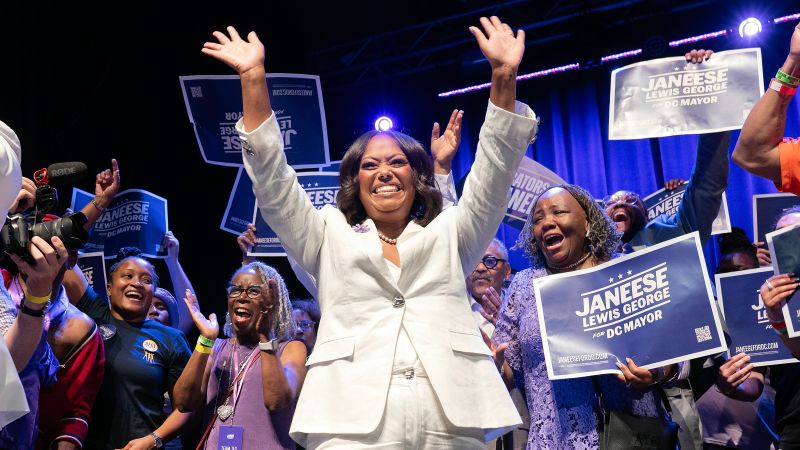
Janeese Lewis George, the Black candidate who narrowly defeated the incumbent in Washington, D.C.’s Democratic primary, has become a symbol of the DSA’s expanding reach. While some critics speculated that her support came primarily from wealthier, White residents or transplants from other regions, the final tally revealed a more inclusive coalition. Lewis George’s campaign emphasized unity, drawing from a diverse array of grassroots organizers, environmental advocates, and working-class professionals. Her victory, following 12 years of administration under the business-oriented Mayor Muriel Bowser, marks a pivotal moment for the left in the nation’s capital.
“Over the past year, we assembled the most diverse coalition in this city’s history,” Lewis George stated, highlighting the broad base of her campaign. “We are Democrats, independents, and democratic socialists.”
These results are part of a larger pattern where the DSA’s message resonates in densely populated areas. In Seattle, Katie Wilson’s mayoral win in November further solidified the movement’s foothold, while Zohran Mamdani’s victory in New York City earlier that same month underscored the party’s ability to mobilize voters in traditionally Democratic strongholds. The success of these candidates has fueled optimism about the DSA’s potential to reshape local politics, particularly in regions with high levels of economic inequality and housing crises.
Los Angeles and the Challenge to Incumbents
Outside the major cities, the DSA’s influence continues to spread. Earlier this month, Nithya Raman, a city councilmember in Los Angeles, advanced to the general election in the mayoral race, defying efforts by Mayor Karen Bass to promote a Republican rival, former reality show star Spencer Pratt. Raman’s campaign focused on issues such as public transit expansion and equitable tax policies, reflecting the DSA’s broader platform. Her presence in the race demonstrates how the movement is not only gaining traction in the Northeast and West Coast but also making inroads in the Sun Belt.
Meanwhile, the DSA’s national leaders are positioning their victories as part of a strategic effort to build a stronger pipeline of progressive candidates. Ashik Siddique, co-chair of the DSA’s national political committee, emphasized that the movement’s approach is rooted in long-term groundwork. “DSA’s electoral theory of change is really about starting from building the bench at the lowest levels of office,” he explained to CNN. This strategy, he argued, ensures that the movement can sustain its momentum across different levels of government.
The Push for a Forward-Looking Democratic Vision
Democratic socialists are also redefining what it means to be a progressive candidate. Aparna Raj, a DSA member leading her primary bid for a council seat in Northwest Washington, stressed the importance of crafting a vision that appeals to voters beyond partisan lines. “If we are going to provide a positive vision and a positive alternative compared to Trump and authoritarianism, we have to actually offer something tangible for people to support,” Raj said. Her focus on working-class concerns, such as job security and affordable childcare, aligns with the DSA’s emphasis on addressing systemic inequities.
However, not all within the Democratic Party share this enthusiasm. Moderate Democrats caution that the DSA’s successes are largely confined to the most liberal urban areas. “It is certainly true that they’ve had some success in these very, very blue areas, but that does not reflect the broader party’s position elsewhere,” noted Matt Bennett, executive vice president of public affairs at Third Way, a center-left think tank. He warned that overemphasizing these local victories could lead to misjudging the movement’s national appeal.
Strategies and Challenges in the Political Landscape
As the DSA continues to build its electoral presence, it faces both opportunities and obstacles. In New York City, Mamdani is leveraging his mayoral win to bolster democratic socialist candidates in upcoming House races. His focus on challenging the Democratic establishment has drawn attention, with Mamdani recently criticizing the party’s reliance on “old ways of thinking.” “Frankly, it will lose in South Carolina and New Hampshire,” he declared, referring to traditional early presidential primary states. “It will fall short of 270 electoral votes, because the party of the past will not lead us into the future.”
While the DSA’s successes in cities like Washington, D.C., and Seattle are notable, their influence in other regions remains limited. For instance, San Francisco’s 2024 mayoral race showcased a different dynamic. Voters rejected both the moderate incumbent, London Breed, and the progressive challenger, Aaron Peskin, opting instead for Daniel Lurie, a political outsider with a background in business and philanthropy. Lurie’s focus on street conditions, public safety, and government efficiency earned bipartisan support, illustrating how progressive voters may prioritize pragmatic solutions over ideological purity.
Contrast this with Chicago, where Mayor Brandon Johnson’s tenure has highlighted the complexities of balancing progressive ideals with governance. Although Johnson was celebrated by organizers during his 2023 election, his leadership has been tested by budget disputes and clashes with the city council over property taxes. Meanwhile, the Chicago school board’s recent scandals and ongoing labor tensions have further complicated the city’s political landscape. These challenges underscore the DSA’s struggle to translate its grassroots energy into broader political victories outside the most liberal urban centers.
Broader Implications for the Democratic Party
The DSA’s growing influence is forcing Democrats to reconsider their messaging and candidate selection strategies. With the party grappling over which leaders are most electable and which policies will resonate with a wider electorate, the movement’s success in cities like Washington, D.C., and Seattle offers a blueprint for progress. Yet, it also raises questions about how to adapt these ideas for more conservative or swing districts.
As the 2026 elections approach, the DSA’s efforts will likely shape the Democratic Party’s future. Their ability to attract voters in urban areas, where economic and social challenges are most acute, suggests a path toward more radical policy changes. However, the movement’s success depends on its capacity to address concerns that extend beyond urban centers. For now, the DSA’s achievements in Washington, D.C., Seattle, and New York City remain a testament to the power of progressive messaging in an era of political polarization.
Ultimately, the DSA’s expanding presence reflects a broader shift in American politics. As candidates like Janeese Lewis George, Zohran Mamdani, and Nithya Raman redefine the Democratic landscape, their campaigns serve as a reminder that the left’s influence is not confined to traditional strongholds. Whether this momentum translates into national power remains to be seen, but the trend is clear: democratic socialists are no longer a fringe force in urban politics.