On the brink: Black lawmakers could lose decades of gains in one year

On the Brink: Black Lawmakers Face a Major Shift in Congressional Representation
On the brink – The United States is witnessing a pivotal moment in its political history, with the potential for a substantial decline in Black representation in Congress since the Voting Rights Act (VRA) was passed in 1965. This year’s midterms could mark the most significant reduction in the number of Black lawmakers in the House of Representatives in nearly six decades, driven by aggressive redistricting strategies that gained momentum following the Supreme Court’s decision to weaken the VRA. The shift threatens to undo decades of progress, particularly in the South, where the majority of Black Americans reside. The consequences of this campaign—coupled with the Court’s ruling—could reshape the political landscape and diminish the influence of Black voices in national governance.
The Role of Redistricting in Shaping Political Power
Republicans and Democrats have both launched sweeping redistricting initiatives across the country, aiming to secure majority control in the upcoming elections. While the stated goal of these efforts was to win seats, they also sought to reshape the demographic balance in Congress. The Supreme Court’s recent decision, which limited the scope of the VRA, has emboldened states to redraw district boundaries in ways that prioritize partisan advantage over equitable representation. This has led to a surge in efforts to dilute the voting power of Black communities, particularly in states where such populations are concentrated.
Among the most vulnerable are six Black House Democrats who may lose their seats after this year’s midterms. Two incumbents are already facing uncertain futures, while the remaining four are seen as less likely to retain their positions. The situation has intensified as state legislatures have pushed forward with maps designed to split or pack Black voters, reducing their ability to elect representatives of their choice. A seventh Black lawmaker, Utah’s Republican Rep. Burgess Owens, is also set to exit the House after a court ruling invalidated the map that had previously benefited his party. These developments highlight the growing impact of redistricting on the political fortunes of Black candidates.
A Historical Context of Voting Rights and Black Representation
For much of American history, Black Americans faced systemic barriers to political participation. During the first century after the nation’s founding, they were largely excluded from the right to vote. In the decades that followed, they fought tirelessly to secure suffrage, culminating in the 15th Amendment in 1870. However, the promise of voting rights was short-lived in the South, where Jim Crow laws and voter suppression tactics ensured that Black representation remained minimal. It wasn’t until the late 1960s and early 1970s that the VRA provided a legal framework to protect Black voters, enabling a surge in the number of Black lawmakers elected to Congress.
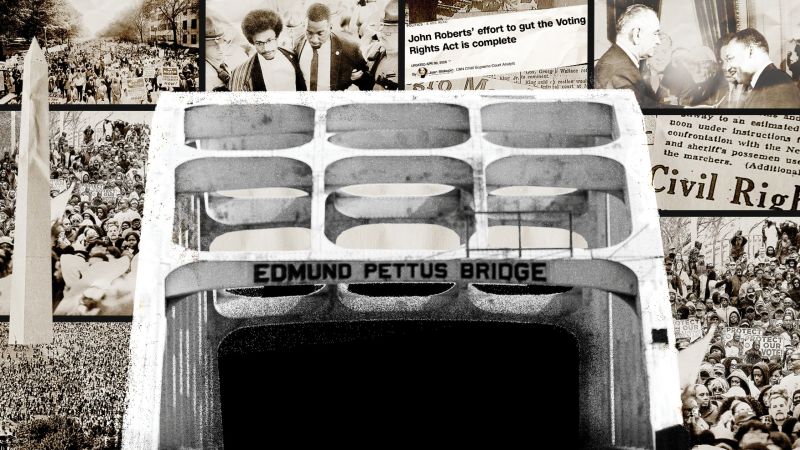
Derrick Johnson, president of the NAACP, described the Supreme Court’s actions as a form of political discrimination against African Americans. “What the Supreme Court has done is sanction discrimination against African Americans in the political process,” he said, noting that this parallels the post-Reconstruction era. The VRA, enacted in 1965, was a direct response to decades of voter suppression, including the violent confrontations that occurred in Selma, Alabama. The “Bloody Sunday” protest, where state troopers brutally attacked peaceful demonstrators on the Edmund Pettus Bridge, became a catalyst for the legislation that would later secure voting rights for millions. President Lyndon B. Johnson signed the VRA into law just five months after the event, marking a turning point in the fight for equality.
Since its passage, the VRA has played a crucial role in expanding minority representation in Congress. It facilitated the election of Black lawmakers who previously had little chance to hold office. Jim Clyburn, a prominent figure in South Carolina’s congressional history, is one such example. First elected in 1992, he became the ninth Black representative from the state—a historic milestone given the near-century gap since the end of Reconstruction. Clyburn’s rise to power reflects the transformative impact of the VRA, which allowed Black Americans to gain footholds in political institutions once closed to them.
Clyburn’s influence extends beyond his own district. As a senior Democrat in the House, he has been instrumental in shaping policy and advocating for minority communities. His endorsement of Barack Obama during the 2008 Democratic primary was a critical moment, helping the candidate prove his viability as the first Black president. Twelve years later, Clyburn’s support for Joe Biden in the 2020 election revived Biden’s campaign and influenced his promise to appoint a Black woman to the Supreme Court, a commitment fulfilled with the nomination of Ketanji Brown Jackson.
Targeting Clyburn and the Fight for Representation
A recent redistricting plan aimed at reconfiguring Clyburn’s district faced defeat when state Senate Republicans hesitated to disrupt the ongoing primary elections. Though the effort failed, some lawmakers have vowed to attempt similar changes ahead of the 2028 election cycle. This has raised concerns among South Carolinians, who recognize Clyburn’s role in securing federal resources and attention for their state. Claire Wofford, a political scientist at the College of Charleston, noted that Clyburn’s presence has been vital in elevating South Carolina’s profile on national issues, from infrastructure to education.
Despite these challenges, Clyburn remains undeterred. At 85 years old, he acknowledges the cyclical nature of political suppression, drawing parallels between the past and the present. “This Supreme Court is resegregating this country,” he stated, emphasizing that the current redistricting efforts mirror the strategies used to marginalize Black voters during the Jim Crow era. His comments underscore the historical continuity of racial disparities in voting rights and the potential for a new era of exclusion.
The implications of this shift are far-reaching. If the trend continues, the erosion of Black political power could become a defining feature of the next decade. The VRA, once a cornerstone of civil rights, now faces unprecedented challenges as states reclaim authority over redistricting. This has sparked debates about the future of minority representation and the role of federal oversight in safeguarding voting rights. For Black Americans, the stakes are high, as the loss of even a few seats could have a disproportionate impact on their ability to influence policy and shape legislation.
As the midterms approach, the focus remains on how redistricting will determine the composition of Congress. While the VRA has protected voting rights for generations, its weakened state leaves room for strategic gerrymandering that could undo decades of progress. The story of Black lawmakers in Congress is not just one of individual achievement but of collective struggle against systemic barriers. Whether this year’s changes mark a permanent shift or a temporary setback will depend on the resilience of Black voters and the commitment of political leaders to uphold their rights.