Want to be happier and healthier? Switch up your day with movement breaks

Want to be happier and healthier? Switch up your day with movement breaks
Want to be happier and healthier – Manoush Zomorodi, a New York City-based NPR journalist, has some compelling insights for those seeking to improve their well-being. Her latest book, Body Electric: The Hidden Health Costs of the Digital Age and New Science to Reclaim Your Well-Being, highlights how prolonged sitting can harm our health in ways we might not fully grasp. The key to reversing these effects, she argues, lies in simple, free interventions: brief movement breaks integrated into daily routines.
The Dangers of Sedentary Habits
Kara Alaimo, a communication professor at Fairleigh Dickinson University, has long focused on managing screen time for parents, students, and educators. In her 2024 book, Over the Influence, she emphasizes the toxic impact of social media on women and girls. Zomorodi expands on this by detailing the physical toll of remaining seated for extended periods. “Sitting all day is akin to a slow but steady poison,” she explains, noting that even standing desks offer limited relief. The core issue, she asserts, is the lack of movement that deprives our bodies of essential stimulation.
“There are three reasons it’s so physically detrimental. One is that your leg muscles need stimulation, so being at a standing desk doesn’t make a difference. They need stimulation in order to suck the glucose and the lipids out of your bloodstream and push the oxygen up to your brain.”
First, leg muscles require regular activity to function properly. When we remain seated, these muscles stagnate, leading to reduced efficiency in clearing glucose and lipids from the blood. Second, prolonged sitting compresses the diaphragm, limiting our ability to take deep, restorative breaths. Third, the body’s natural ability to communicate with the brain—known as interoception—becomes impaired. “When we’re staring at a screen, we’re in thrall with what is happening externally, and we ignore the signals that are coming from our bodies,” Zomorodi notes. This disconnect can leave our bodies craving movement, yet we remain unaware of the need.
Reversing the Trend with Small Changes
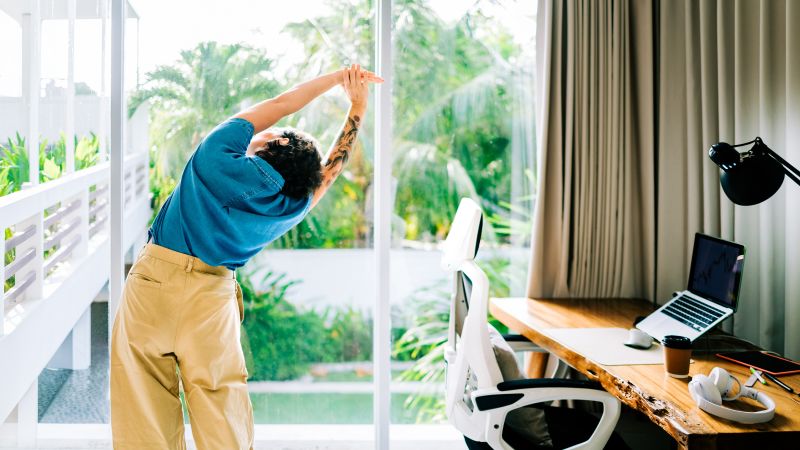
Zomorodi collaborated with Keith Diaz, a physiologist at Columbia University Medical Center, to test the benefits of movement breaks. The study asked participants to engage in five-minute activities every 30 minutes, whether they involved physical motion or simple shifts in posture. The options were as varied as the individuals: some marched during phone calls, others collected dishes, or even walked with imaginary companions. “Arm movements really do count,” she adds, emphasizing that even minimal activity can counteract the risks of inactivity.
The program quickly gained traction, with 23,000 people signing up within days. This surge in participation underscored the widespread desire for change. By the end of the two-week trial, 80% of participants continued their movement routines, and 82% reported enjoying the breaks. The results were striking: fatigue levels dropped by up to 28%, and many described a return of focus and clarity. “They were able to focus and lost that brain fog so many of us have these days,” Zomorodi says. These small shifts not only revived energy but also fostered a sense of positivity.
Why Exercise Alone Isn’t Enough
While Zomorodi acknowledges the value of traditional exercise, she stresses that it can’t fully offset the harm of prolonged sitting. “Don’t stop working out,” she advises. “It will improve your muscle strength and cardiovascular health, but it can’t undo the damage caused by sitting all day.” She likens this to a kinked garden hose: when you sit for hours, the muscles in your torso and knees become compressed, creating pressure that hinders blood flow and oxygen delivery to the brain.
“The human body evolved to need movement in order to survive. Every innovation and technology that we create reduces the need to move. We’re at this moment where we have to look at the things that humans have engineered out of our lives that our biology requires.”
This evolutionary perspective underscores the urgency of incorporating movement into everyday life. Our modern routines, filled with screens and static postures, have created a gap between our biological needs and our lifestyle choices. “Stop sitting still and do these 8 activities throughout the workday—3 minutes at a time,” Zomorodi suggests. These micro-interventions, she argues, can make a significant difference in maintaining health and vitality.
Boosting Productivity Through Activity
Contrary to common assumptions, Zomorodi’s research reveals that movement breaks can enhance productivity. “This was the biggest surprise to me,” she admits. “I had predicted that taking all these breaks would interrupt my workflow. But in our study, productivity actually rose by 4%.” Participants not only maintained their work quality but also rated it higher, suggesting that even brief disruptions can lead to improved focus and output.
These findings challenge the notion that constant work is the path to success. Instead, they advocate for a balanced approach where regular movement supports both mental and physical performance. “People reported feeling more energized and emotionally stable,” Zomorodi says. The study’s success demonstrates that small, consistent changes can yield substantial benefits, making them accessible to even the busiest individuals.
As the digital age reshapes our habits, Zomorodi’s message is clear: our health depends on reclaiming the movement our bodies crave. By integrating these breaks into daily life, we can combat the silent dangers of sitting, restore balance, and cultivate a more vibrant, productive existence. The science is compelling, and the evidence is undeniable. The question now is whether we’re ready to make the shift.