New image of the Crystal Ball Nebula captures the ‘spectacular’ throes of a dying star

Crystal Ball Nebula’s Spectacular Final Star Moments
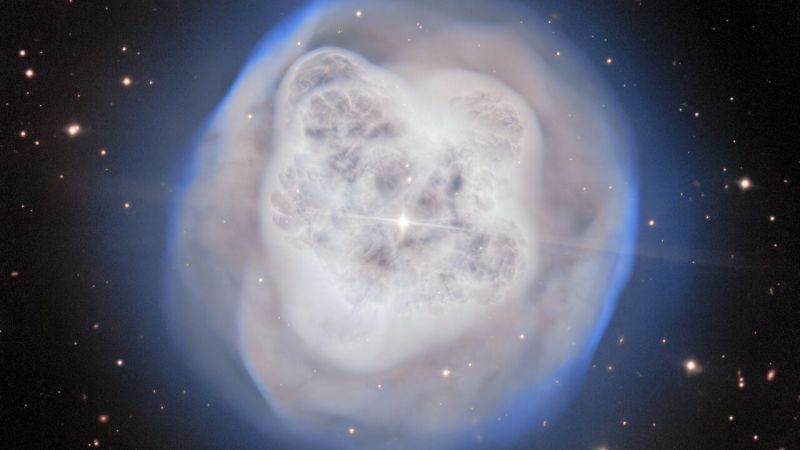
New image of the Crystal Ball – Scientists have captured a stunning new image of the Crystal Ball Nebula, revealing the dramatic final stages of a star’s life. This celestial object, officially designated NGC 1514, is nestled within the Taurus constellation and has been imaged using the Gemini Multi-Object Spectrograph on the Gemini North telescope. Located on Maunakea, a dormant volcano in Hawaii, the instrument allowed researchers to unveil the nebula’s intricate structure, showcasing the fleeting beauty of a dying star’s last breath. The resulting image, described as a “glowing crystalline sphere,” offers fresh insights into the processes that shape such cosmic phenomena.
Understanding the Star’s Last Moments
Planetary nebulae like the Crystal Ball Nebula are not stars themselves but the luminous remnants of stars that have expelled their outer layers. As a star nears the end of its life, it undergoes a transformation: its core contracts into a white dwarf, while the ejected material forms a glowing shell. The colors and shapes observed in these nebulae are influenced by the chemical composition of the gas and the way light interacts with it. For example, hydrogen and oxygen create the vibrant reds and blues seen in the Crystal Ball Nebula’s image, reflecting the complex interplay of elements in space.
The Crystal Ball Nebula’s unique structure has intrigued astronomers for decades. Its symmetrical, cloudlike appearance suggests a dynamic interaction between the central star and its companion. This relationship, though not the primary science goal of the recent imaging, highlights how cosmic phenomena can reveal unexpected beauty. Travis Rector, a member of the NOIRLab team, noted, “It’s a way to share how incredible our universe can be. The Crystal Ball Nebula wasn’t a main target, but its appearance made it a standout.”
Binary Stars and Cosmic Sculpting
NGC 1514 is part of a binary star system, where two stars orbit each other closely. This system plays a pivotal role in shaping the nebula’s form. The companion star’s gravity disturbs the expanding gas shell, creating ripples and symmetry that are difficult to explain with single-star models. The orbital period of these stars is nearly nine years, giving the system time to influence the nebula’s morphology. This process, likened to the spinning of cotton candy into a fluffy shape, demonstrates how gravitational forces can sculpt cosmic objects in ways we are only beginning to understand.
Such interactions are common in the galaxy, with over half of all stars existing in binary pairs. However, the Crystal Ball Nebula’s case is unusual due to its prolonged orbital cycle. This allows for more pronounced effects on the surrounding material, resulting in its distinctive features. The image captured by the Gemini telescope provides a visual record of this ongoing cosmic dance, offering a rare glimpse into the mechanics of stellar evolution. As the gas shell gradually disperses, the nebula will fade, but its story will continue to inspire scientific curiosity.
A Legacy of Cosmic Discovery
First observed in 1790 by William Herschel, the Crystal Ball Nebula was initially mistaken for a planetary object due to its round appearance. This misnomer persists, as planetary nebulae are not related to planets but to the final phases of stellar life. Herschel’s discovery laid the foundation for modern studies of such phenomena, which remain a vital area of research. With tools like the James Webb Space Telescope, scientists can now analyze these cosmic objects across different wavelengths, uncovering new details about their formation and evolution.
Despite its age, the Crystal Ball Nebula continues to captivate researchers. The latest image, taken by the Gemini telescope, complements previous observations and provides fresh data for analysis. Jan Cami, a professor at Western University, remarked, “If you examine the same object with the James Webb, you might think it’s entirely different.” This highlights the importance of multiple observations in piecing together the full story