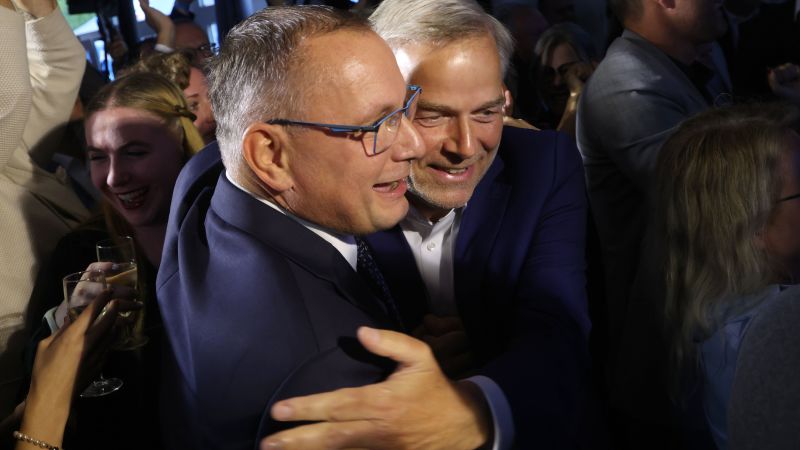
Germany’s far right AfD win another state election, piling pressure on Chancellor Merz, exit polls show

Daftar Isi
AfD Surge Deepens Pressure on Merz After State Election Exit Polls
Healfromzero.com – Germany’s political landscape appears to be shifting further at the regional level, with exit polls pointing to a major victory for the far-right Alternative for Germany in Mecklenburg-Vorpommern and a separate left-wing lead in Berlin.
The projected results place Chancellor Friedrich Merz and his Christian Democratic Union under renewed strain. In the north-eastern state of Mecklenburg-Vorpommern, the AfD is forecast to secure 38% of the vote, giving it a commanding position in an election that highlights the party’s growing strength beyond isolated local contests.
For Merz’s CDU, the outlook is notably bleak. Exit polling puts the party at 5% in Mecklenburg-Vorpommern, a result that leaves it only just above the threshold needed to enter the state parliament. The contrast between the AfD’s projected first-place finish and the CDU’s narrow margin underscores the scale of the challenge facing the chancellor’s party.
A second strong showing in eastern Germany
The Mecklenburg-Vorpommern vote comes only two weeks after the AfD recorded its strongest result to date in Saxony-Anhalt. Taken together, the two elections add to evidence that the party is gaining significant ground in eastern parts of the country, particularly in areas where established parties have struggled to maintain broad support.
State elections do not directly determine the federal government, but they can carry national consequences. They provide a measure of public sentiment, affect the standing of party leaders and shape expectations ahead of future contests. A poor regional performance can also intensify internal debate over strategy, messaging and leadership.
For Merz, the immediate political problem is not simply that the CDU trails in one state. The party is being pressured from multiple directions: by the AfD on the right and by left-leaning parties in other contests. That makes it harder for the CDU to present itself as the dominant alternative across very different parts of Germany.
Berlin produces a different political picture
In Berlin, voters appear to have delivered a sharply different result. Die Linke, the left-wing party, is projected to lead with 26%. The CDU and the Greens follow behind it in the exit polls, showing that the capital’s political balance remains distinct from that of Mecklenburg-Vorpommern.
The two elections illustrate the regional diversity of German politics. Mecklenburg-Vorpommern is a largely rural state in the country’s north-east, while Berlin is Germany’s capital and a major urban centre. Parties can perform very differently in these settings, reflecting local concerns, political traditions and competing views of the national government.
That divergence matters for parties attempting to build nationwide coalitions. Success in Berlin does not necessarily translate into support in rural eastern states, while a strong far-right result in Mecklenburg-Vorpommern does not automatically predict the outcome in every German city. Even so, the combined results may reinforce the sense that the political centre is under pressure from both ends of the spectrum.
What the results mean for the CDU
The CDU’s projected 5% share in Mecklenburg-Vorpommern is especially consequential because it places the party close to the line between parliamentary representation and exclusion. Falling below the threshold would have deprived the CDU of a role in the state legislature; narrowly clearing it offers little relief from the broader political damage of such a low result.
Merz now faces difficult questions about how his party can respond to the AfD’s advance without losing ground to competitors on the left. The CDU has long been one of Germany’s central political forces, and a weak showing in a state election is likely to prompt scrutiny of its ability to reach voters who feel drawn to more polarised options.
The result may also sharpen attention on the differences between federal leadership and regional campaigning. State elections are often influenced by local issues and candidates, but national figures still become closely associated with the outcome when their parties underperform. As chancellor, Merz is likely to face increased pressure to demonstrate that the CDU can recover support in areas where the AfD is gaining momentum.
A broader warning for Germany’s mainstream parties
The exit polls point to a fragmented electoral environment in which no single political force can assume support across the country. The AfD’s projected win in Mecklenburg-Vorpommern and Die Linke’s lead in Berlin show that voters in different regions are turning toward parties outside the traditional centre-right and centre-left blocs.
Final results will determine the exact distribution of seats and the practical consequences for governing arrangements in each state. But the early picture is already politically significant: the AfD is on course for another major regional breakthrough, the CDU is confronting an alarming result in the north-east, and Berlin is leaning toward a left-wing winner.
For Merz, the elections are a reminder that governing from the centre has become more difficult in a country where political competition is increasingly defined by strong regional contrasts. The challenge ahead will be to contain the damage from the CDU’s setback while addressing the wider forces that are reshaping Germany’s electoral map.
Related Reading
Frequently Asked Questions
What is Germany s far right AfD win another?
Germany s far right AfD win another is the main topic of this guide. The article explains the context, practical details, and next steps readers should understand.
Why does Germany s far right AfD win another matter?
Germany s far right AfD win another matters because readers are looking for a useful answer, not just a short summary. Good content should match search intent and help them decide what to do next.