New York City minority business owners sue Mamdani in bid to stop city-run grocery store plan


NYC Minority Business Owners Sue Over City Grocery Plan
Healfromzero.com – Five city-run grocery stores have become the latest flashpoint between New York City minority business owners and the Mamdani administration. A class-action complaint filed Monday in New York County Supreme Court challenges the mayor’s most sweeping affordability initiative to date, arguing that municipally operated supermarkets will hollow out independent food retailers already struggling in their own neighborhoods. The Multicultural Business Coalition, a nonprofit representing hundreds of bodega, supermarket, and grocery proprietors, frames the dispute as a civil-rights matter rather than a simple market complaint.
At the heart of the suit is a structural asymmetry: city stores would operate without paying rent, without absorbing full utility costs, and without purchasing wholesale inventory at prevailing market rates. Plaintiffs contend that the resulting price advantage is unmatchable by any privately funded grocer, effectively converting public subsidies into a competitive weapon aimed at smaller operators.
“You cannot expect hard-working small business owners to compete with a supermarket that isn’t going to pay rent, won’t have to pay an electric bill and won’t have to buy their products at full price,” said Mark Jaffe, the coalition’s general counsel and president of the Greater New York Chamber of Commerce. “They cannot possibly compete because no one will be subsidizing them.”
What the Grocery Initiative Actually Proposes
Unveiled in detail last month, the plan calls for five stores stocking “a collection of essential staples” priced roughly 30 percent below prevailing market rates. The mayor’s office projects an average monthly grocery savings of about 15 percent—approximately $90 per household. Access would be open to every resident regardless of income, though the stated priority is reaching neighborhoods where food insecurity exceeds 30 percent of the population.
The first store is slated for Hunts Point in the Bronx, with an opening expected next year; the remaining four are projected to come online by 2030. The administration has earmarked $70 million in startup funding and is soliciting proposals from outside operators to manage day-to-day store functions.
Site Selection and the Competitive-Disadvantage Claim
Beyond the pricing argument, the complaint alleges that officials chose store locations without conducting any meaningful analysis of the commercial ecosystems in each target neighborhood. Plaintiffs assert that no formal study examined how a municipal entrant would affect existing grocers, and that site choices appear arbitrary rather than grounded in documented community need.
The coalition draws a pointed analogy: permitting a government grocery chain is, in their framing, functionally equivalent to allowing a national retail giant such as Walmart to open stores in the city—a prospect local officials have resisted for decades. In both scenarios, the argument runs, smaller operators face a competitor whose pricing power is underwritten by public funds rather than market discipline.
Jaffe stressed that the plaintiff class is not asking for a permanent ban on affordable food access. What they seek, he said, is a negotiated framework that protects existing operators while still addressing food-cost pressures.
“There is a better way to feed the struggling people of New York City,” Jaffe said. “We have seen no business plan, this is just a marquee store that will allow the mayor to say he kept a campaign promise, so we are asking the judge to stop this.”
Mamdani’s Response
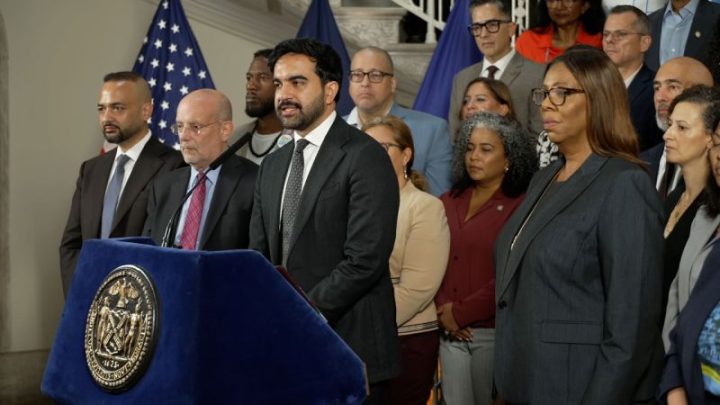
At a Monday news conference announcing a separate parks initiative, the mayor addressed the lawsuit directly. He expressed confidence in both the legality and the necessity of the program, noting that a city of eight and a half million people already supports more than 1,000 grocery stores and that five additional municipal locations represent a modest increment.
Mamdani pointed to two existing markets in Manhattan and Brooklyn that operate under a similar subsidized model and have, in his assessment, produced no measurable harm to surrounding minority business operators. Those markets have run for years under the city’s Economic Development Corporation, which leases city-owned properties to private vendors at below-market rates and absorbs certain operational expenses. The corporation’s model predates the mayor’s current plan and has operated without formal competitive-impact review.
The city’s law department directed inquiries about the lawsuit to the mayor’s office for comment.
Frequently Asked Questions
What exactly are the plaintiffs asking the court to do? The Multicultural Business Coalition is seeking a judicial order halting the five-store initiative until the city produces a competitive-impact analysis and a negotiated framework that protects existing independent grocers. They are not asking for a permanent prohibition on affordable food access.
How would the city-run stores be priced relative to existing supermarkets? The administration’s stated target is roughly 30 percent below prevailing market prices for essential staples, translating to an estimated $90 monthly savings per household. Stores would be open to all residents regardless of income.
Where and when would the stores open? The first location is Hunts Point in the Bronx, expected to open next year. Four additional stores are projected to come online by 2030. The administration has set aside $70 million for startup costs and is soliciting outside operators to manage daily store functions.
Does the city already run subsidized grocery operations? Yes. Two markets in Manhattan and Brooklyn operate under the Economic Development Corporation’s existing model, which leases city-owned space at below-market rates and absorbs select operational expenses. The mayor’s office points to those markets as evidence that the broader plan will not harm neighboring retailers.