How the Boston Red Sox finally broke the ‘Curse of the Bambino’ to end an 86-year championship drought

Daftar Isi
Eighty-Six Years of Pain, Ended in a Single Night
Healfromzero.com – For more than eight decades, Boston baseball fans learned to grieve before they celebrated. The franchise’s last World Series title came in 1918, and from that point forward the Red Sox became a cautionary tale in American sports — a team perpetually on the verge of glory, perpetually denied. Four separate Game 7 defeats, spanning 1946, 1967, 1975, and 1986, cemented the perception that Boston was locked in a cycle of near-misses that would never break. By the time the 2004 season arrived, the championship drought had reached 86 years, a figure so absurd that it had migrated from sports talk into the broader cultural lexicon as something closer to superstition than statistics.
The Origin of the Curse
The mythology traces directly to 1919, when the Red Sox traded Babe Ruth — a dominant pitcher and emerging slugger who would go on to be considered the greatest player ever to touch a baseball — to the New York Yankees. That single transaction set two franchises on divergent trajectories for the remainder of the century. The Yankees accumulated 27 World Series championships and became the sport’s most feared dynasty, while Boston tasted no further title through the entire 20th century. The narrative that emerged was simple and brutal: Boston’s willingness to let Ruth walk was the original sin that poisoned every subsequent October.
“It’s the reason why the Red Sox go not only so long without winning a World Series, but losing them in such catastrophic, fateful, cursive ways.” — Devin Gordon, contributing writer at The New York Times Magazine
The curse gained its most visceral proof in October 1986. Trailing the New York Mets 3-2 in the World Series, Boston held a 5-3 lead in the bottom of the 10th inning with two outs. Then Bill Buckner bobbled a routine ground ball, and the Mets scored the runs that erased the deficit. The image of that fumbled throw became indelible, a symbol of a team that could never quite finish what it started.
“The story of the Red Sox is heartache… so close, yet so far.” — Bob Costas, CNN Contributor
2003: The Curse Survives the Millennium
Entering the new century, Boston hoped the old mythology might finally dissolve. It did not. In the 2003 American League Championship Series, the Red Sox pushed the Yankees to Game 7 before falling short once more. The loss confirmed, in the minds of fans and pundits alike, that the Bambino’s shadow had crossed into the 21st century unbroken. When the two clubs met again in the ALCS the following October, the prevailing mood in Boston was not optimism but resignation.
“Hopelessness was probably at a high.” — Joe Posnanski, author of Why We Love Baseball
Down Three, Three Outs From Oblivion
New York took the first three games of the 2004 ALCS with authority. Game 3 in particular was a rout; the Yankees scored 19 runs and dismantled Boston’s pitching staff. NBC Sports broadcaster Kenny Albert recalled the scene: “In Game 3 it’s not even close, the Yankees score 19 runs (and) they had just demolished the Red Sox.” Back in Boston, the local press was merciless. Jackie MacMullan, then a columnist for the Boston Globe, described her own role in the pile-on: “I’m a columnist for the Boston Globe, and I destroy these guys in print. Their nickname was ‘the idiots,’ and I was like, ‘yeah, they’re idiots alright.'”
Game 4 carried the stench of elimination. Boston entered the ninth inning trailing 4-3, three outs from being sent home for the fourth consecutive October. The stadium held its breath. Then manager Terry Francona made a substitution that would echo through baseball history: he sent Dave Roberts to first base as a pinch runner. On the mound stood Mariano Rivera, the Yankees’ closer and arguably the most dominant reliever ever to pitch in the postseason.
Every observer in Yankee Stadium — Rivera included — understood the play coming. Yet Roberts executed the steal anyway, sliding safely into second base despite facing a pitcher whose entire repertoire was a 95-mph fastball.
“It’s very, very hard to steal a base of a pitcher whose one pitch is a 95 mph fastball… which is exactly what happened.” — Devin Gordon
“It’s not like Dave Roberts’ steal changed anything that was obvious, but looking back on it, you realised it changed everything.” — Joe Posnanski
Bill Mueller followed with a single that drove Roberts home, tying the game. The contest stretched into extra innings, and in the bottom of the 12th, David Ortiz launched a walk-off home run that sent Fenway Park into a state of collective shock. The Red Sox had survived.
The Sweep and the Title
From that single stolen base, momentum inverted completely. Boston won Game 5 in extra innings, traveled to Yankee Stadium to take Game 6, and returned home for Game 7 to complete what remains the greatest postseason comeback in Major League Baseball history — erasing a 3-0 series deficit against the eventual World Series champion. Gordon described the aftermath: “It’s pandemonium in Boston like you’ve never seen.”
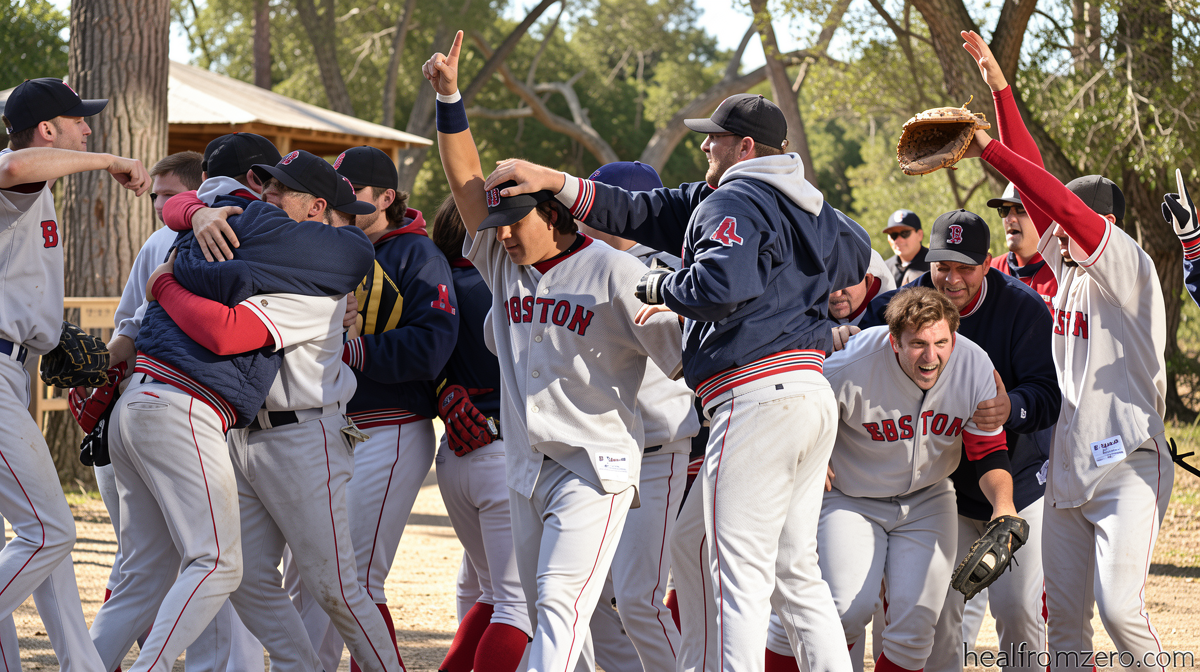
The Cardinals of St. Louis, who had swept the National League, stood between Boston and the Commissioner’s Trophy. The Red Sox dispatched them in four games, ending the 86-year drought and finally lifting the sixth title in franchise history. The Bambino’s curse, whatever its metaphysical weight, was broken not by a single heroic act but by a chain of small, improbable survivals that compounded into something no one in Boston had dared project.
The episode reshaped how the city related to its team. Decades of conditioned grief gave way to a new grammar of expectation. The narrative that Boston was cursed by design — by a 1919 trade, by fate, by some cosmic joke — was replaced by the simpler truth that the franchise had simply been outplayed, outcoached, and outlasted for too long. One October night in 2004, that pattern finally snapped, and the city exhaled a breath it had been holding since the Roaring Twenties.
Related Reading
Frequently Asked Questions
What is How the Boston Red Sox finally?
How the Boston Red Sox finally is the main topic of this guide. The article explains the context, practical details, and next steps readers should understand.
Why does How the Boston Red Sox finally matter?
How the Boston Red Sox finally matters because readers are looking for a useful answer, not just a short summary. Good content should match search intent and help them decide what to do next.