Trump criticism leads to rare criminal charges for Air Force officer who called for impeachment

Daftar Isi
Air Force Major Faces Rare Criminal Charges After Publicly Demanding Trump’s Impeachment
Healfromzero.com – Maj. Jason Watson, a United States Air Force officer who twice found himself behind bars over his outspoken opposition to President Donald Trump, has been formally indicted under the Uniform Code of Military Justice. A charging document, made available through his legal team, lays out a slate of offenses tied to his public remarks and actions spanning the past several months. The case draws attention to one of the most seldom-used provisions in American military law: Article 88, which penalizes contemptuous speech directed at the president and other senior civilian leaders.
The Charges
Watson now answers to three counts under Article 88, five counts under Article 92 (failure to obey orders or regulations), and two counts under Article 133 (conduct unbecoming an officer and a gentleman). Together, the allegations trace a timeline that begins with a June interview he gave to the Defenders of Our Republic Substack newsletter, continues through his July 1 appearance in full uniform at a protest on the steps of the U.S. Capitol, and culminates in an August 17 televised interview in which he renewed his call for impeachment.
The Article 92 counts allege that Watson violated Department of Defense rules prohibiting service members from endorsing partisan causes, wore his uniform at a Capitol press conference without authorization, traveled to Washington, D.C. in violation of leave regulations, and declined to don his uniform for a morning shift the day after his televised appearance. Prosecutors further contend that both the Capitol demonstration and the interview amounted to conduct unbecoming an officer.
Two Arrests, One Confinement Order
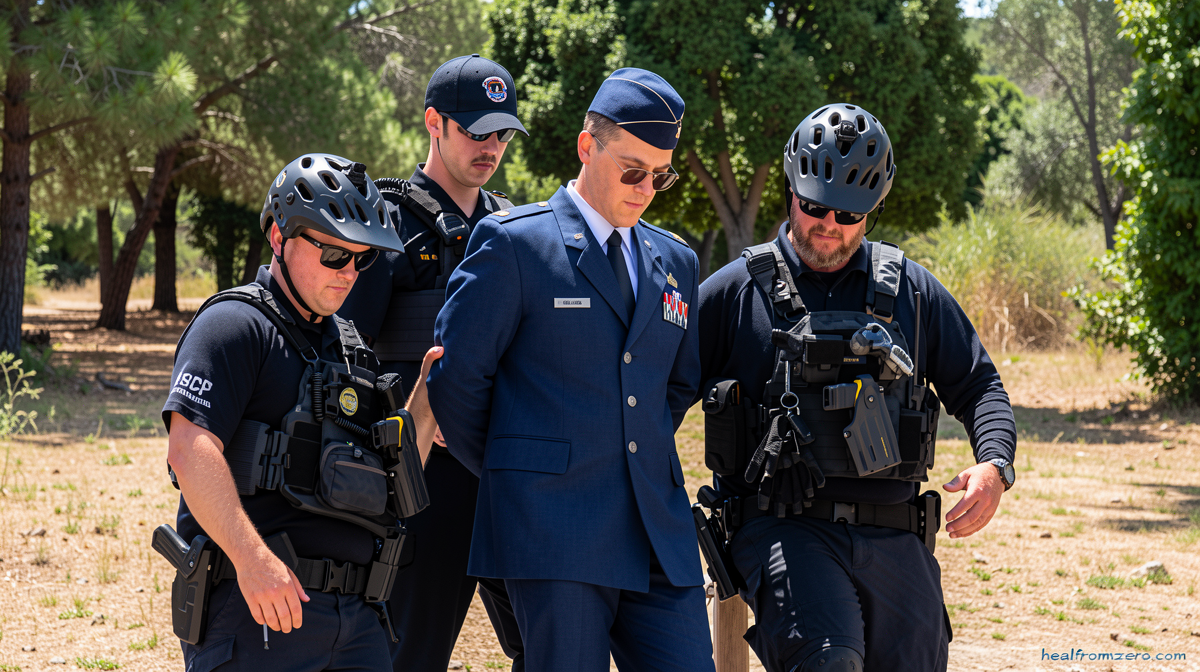
Watson was first taken into custody in July while protesting in uniform at the Capitol. A second arrest came just days after his August interview, in which he pressed his case against the president on national television. His attorney, Chris Mutimer, confirmed that Watson has been ordered into pre-trial confinement — the military equivalent of being denied bail in civilian proceedings — while the government pursues its case.
“Not only is (Trump) a failure as president, he is flagrantly violating the Constitution, breaking the law, engaged in rampant corruption, and is killing Americans,” Watson said during the interview. “And that is unacceptable to me.”
Command Response and Institutional Context
In July, Air Force Secretary Troy Meink issued a social media statement urging all airmen to “comply with all laws and policies government personal conduct, political participation, and the wear of the uniform.” He added: “Americans place their trust in us. We cannot, and will not, compromise the trust of the nation.” The remark underscored the service’s institutional preference for political silence among its ranks, a norm that has governed military conduct since the founding of the republic.
Watson’s protest was organized with the assistance of the Removal Coalition, a civic group whose founder, Jessica Denson, said at the time that Watson had contacted the organization by email, fully aware of the professional risks involved.
“We started having conversations and took this desire that he had to come out very seriously and thought about the best way to make his sacrifice worth it,” Denson said.
Article 88: A Provision Almost Never Used
The rarity of Watson’s prosecution cannot be overstated. Article 88 has been on the books since the modern Uniform Code of Military Justice took effect in 1951, yet convictions under it remain exceedingly uncommon. A review of available records identifies only two such convictions in more than seven decades.
The first came in 1965, when Army Lt. Henry Howe was convicted after joining an off-base demonstration against the Vietnam War in El Paso, Texas. Howe received a dismissal from the service — the officer’s equivalent of a dishonorable discharge — along with a year in the military prison at Fort Leavenworth, Kansas. Defense Secretary Robert McNamara later granted him parole, shortening his sentence.
The second conviction arrived in 2021. Former Marine Corps Lt. Col. Stuart Scheller pleaded guilty to contempt of officials and related charges stemming from a series of social media videos in which he criticized the Biden administration’s management of the U.S. military’s withdrawal from Afghanistan. After a period of confinement in the brig, Scheller accepted a plea deal that carried a $5,000 pay forfeiture and a resignation from the Marine Corps without pension. The Trump administration subsequently appointed Scheller as a senior adviser to the Pentagon’s undersecretary for personnel and readiness.
What Comes Next
The charging document does not yet determine the procedural path Watson’s case will follow. Military prosecutors must decide whether to refer the matter to a special court-martial or a general court-martial, a distinction that affects sentencing ranges and procedural rights. Until that determination is made, Watson remains in pre-trial confinement, awaiting the outcome of a case that has already placed him in the company of very few officers before him who have been prosecuted for speaking out against a sitting president.
The broader question the case raises — how far a uniformed officer may speak on partisan matters without inviting criminal liability — has animated debate within the ranks and among civilian observers alike. For Watson, the answer has already been written into a charging document, and the next chapter will be decided in a military courtroom.
Related Reading
Frequently Asked Questions
What is Trump criticism leads to rare criminal?
Trump criticism leads to rare criminal is the main topic of this guide. The article explains the context, practical details, and next steps readers should understand.
Why does Trump criticism leads to rare criminal matter?
Trump criticism leads to rare criminal matters because readers are looking for a useful answer, not just a short summary. Good content should match search intent and help them decide what to do next.