Inside DC’s historic heart, an IndyCar race backed by Trump kicks into gear

Daftar Isi
Engines Roar Past the Capitol: Washington’s 250th-Birthday IndyCar Spectacle Rolls Into Motion
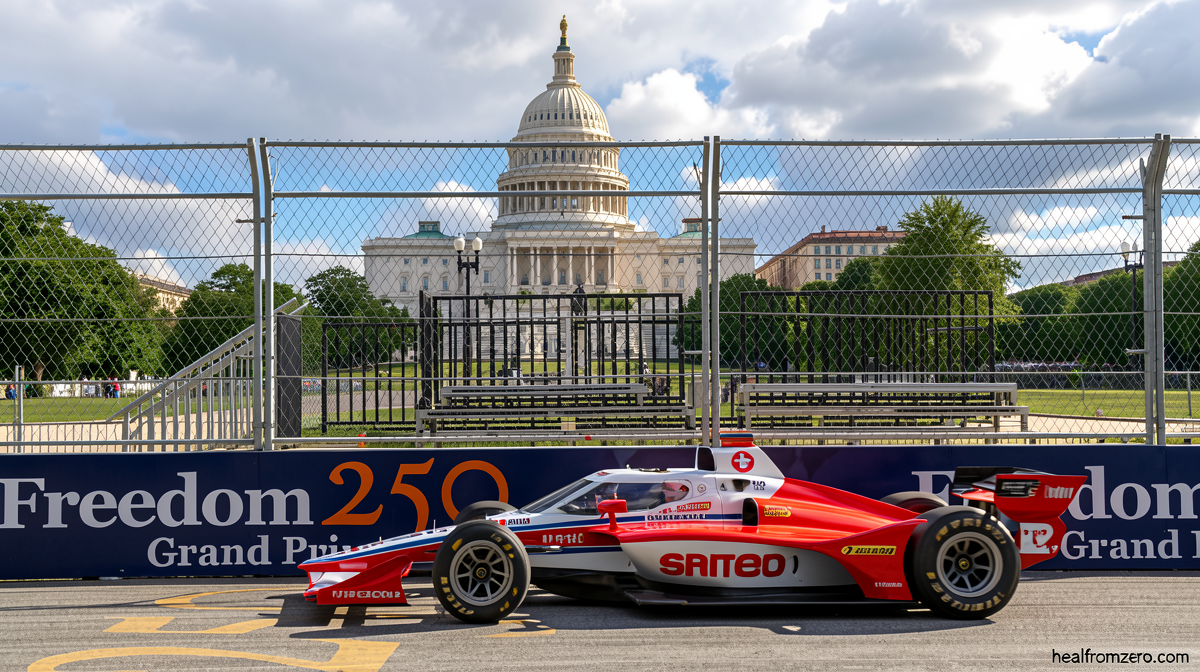
Healfromzero.com – For one weekend in late August, the most recognizable skyline in American politics becomes a backdrop for open-wheel racing. The Freedom 250 Grand Prix, a two-day street circuit threading through the heart of Washington, DC, opened its gates on Saturday morning, sending thousands of spectators into a corridor of monuments, museums, and government buildings where IndyCars will eventually scream past at speeds approaching 180 miles per hour. The event caps a summer of nationwide celebrations marking the republic’s 250th anniversary, and its very existence owes a debt to a single executive order signed in January by President Donald Trump, which swept aside local permitting delays and compressed what had been a years-long planning cycle into roughly eleven months.
From Pitch to Pavement in Under a Year
Bud Denker, president of Penske Corporation, had floated the concept of a street race through the capital’s most iconic avenues. What might have languished in municipal review queues for years was fast-tracked by presidential directive, transforming a speculative proposal into a sanctioned event expected to pull close to 300,000 attendees across its two days. The speed with which the race materialized drew attention to the unusual degree of executive leverage applied to a sporting spectacle, though organizers framed it simply as a patriotic milestone aligned with the semi-quincentennial.
The Track: Seven Turns Through the Seat of Power
The 1.66-mile circuit is as much a tour of American civic architecture as it is a motorsport layout. Drivers launch from a start-and-finish stretch on 3rd Street — its asphalt repainted in red, white, and cobalt blue, crowned by a bold black-and-white checkered band that dwarfs the faded crosswalk stripes nearby — then sweep along the National Mall with the Washington Monument rising on one side. The course hooks onto Pennsylvania Avenue, the broad boulevard that fronts the White House, before kinking sharply onto 9th Street NW. That tight corner proved treacherous during Saturday’s practice sessions; more than one driver clipped the apex, spun wide, and had to reverse course to rejoin the racing line.
From 9th Street the layout threads past the National Gallery of Art and the National Archives, then swings onto Constitution Avenue, bisecting the Mall at 7th Street before cutting across Independence Avenue alongside the Smithsonian’s Air and Space Museum. A final bend on Maryland Avenue returns cars to 3rd Street, completing a loop of seven corners. Pennsylvania Avenue’s generous width was selected specifically to accommodate a pit lane where teams will execute tire swaps, refueling, and mechanical repairs between stints. On Sunday, drivers will complete 147 laps — a figure chosen to echo the nation’s age — covering a total distance of 250 miles.
Saturday’s Buildup: Drizzle, Families, and First Laps
A light drizzle had settled over the sprawling paddock area by the time gates opened around 8 a.m., but the damp did little to cool the enthusiasm of fans who had driven or flown in from across the country. By mid-morning, several thousand spectators had gathered behind the tall metal fencing erected to shield the crowd from cars traveling at highway-plus velocities. Preliminary support races filled the schedule, serving as a warm-up for the main event on Sunday.
Among the early arrivals was Tom Lantz of Altoona, Pennsylvania, who had attended multiple previous IndyCar rounds but was bringing his 12-year-old son, Levi Steele, to a race for the first time.
“I’m just glad I’m here,” Levi said.
Scott Talbott, a visitor from Dallas, framed his excitement less in terms of lap times and more in terms of place. Standing along one of the track’s straightaways with the dome of the US Capitol visible in the distance, he summed up the mood:
“The nostalgia of DC, the heritage — I’ll take this any day.”
Sunday’s Presidential Moment
The White House confirmed that President Trump will attend the Sunday main race. Before the green flag drops, the president is scheduled to take a ceremonial lap aboard the presidential limousine — colloquially known as “The Beast” — and release the flag from his seat, according to a White House official. The gesture positions the head of state as the event’s symbolic starter, tying the motorsport spectacle directly to the anniversary theme.
Citywide Disruptions and Museum Protocols
Even residents who never set foot near the circuit will feel the race’s footprint. District officials announced sweeping traffic and parking restrictions across multiple neighborhoods for the duration of the event. The Federal Aviation Administration additionally announced a temporary suspension of departures from Ronald Reagan Washington National Airport, tentatively set from 10:15 a.m. to 1:15 p.m. on Sunday, though those windows remain subject to adjustment.
Several Smithsonian institutions sit directly in the racing line. Visitors wishing to enter those museums during race hours must present a Freedom 250 Grand Prix event ticket. The National Gallery of Art, whose galleries adjoin the pit lane, disclosed that it completed an “extensive vibration study” prior to the weekend and implemented a suite of protective measures designed to safeguard both patrons and the collection from the mechanical forces generated by 147 laps of open-wheel traffic at full throttle.
Why the Race Matters Beyond the Checkered Flag
Stripped of its spectacle, the Freedom 250 Grand Prix functions as a test case for how much executive authority can be marshaled to reshape a capital city’s public space on a compressed timeline. The January order that cleared the event of bureaucratic friction set a precedent that municipal planners and civil-liberties observers alike will watch closely. For the roughly 300,000 fans expected to pass through the gates over two days, however, the question is simpler: for one weekend, the monuments that have watched over American governance for two and a half centuries will hear something else entirely — the flat, sustained howl of IndyCar engines echoing off marble and steel.
Related Reading
Frequently Asked Questions
What is Inside DC s historic heart an IndyCar?
Inside DC s historic heart an IndyCar is the main topic of this guide. The article explains the context, practical details, and next steps readers should understand.
Why does Inside DC s historic heart an IndyCar matter?
Inside DC s historic heart an IndyCar matters because readers are looking for a useful answer, not just a short summary. Good content should match search intent and help them decide what to do next.