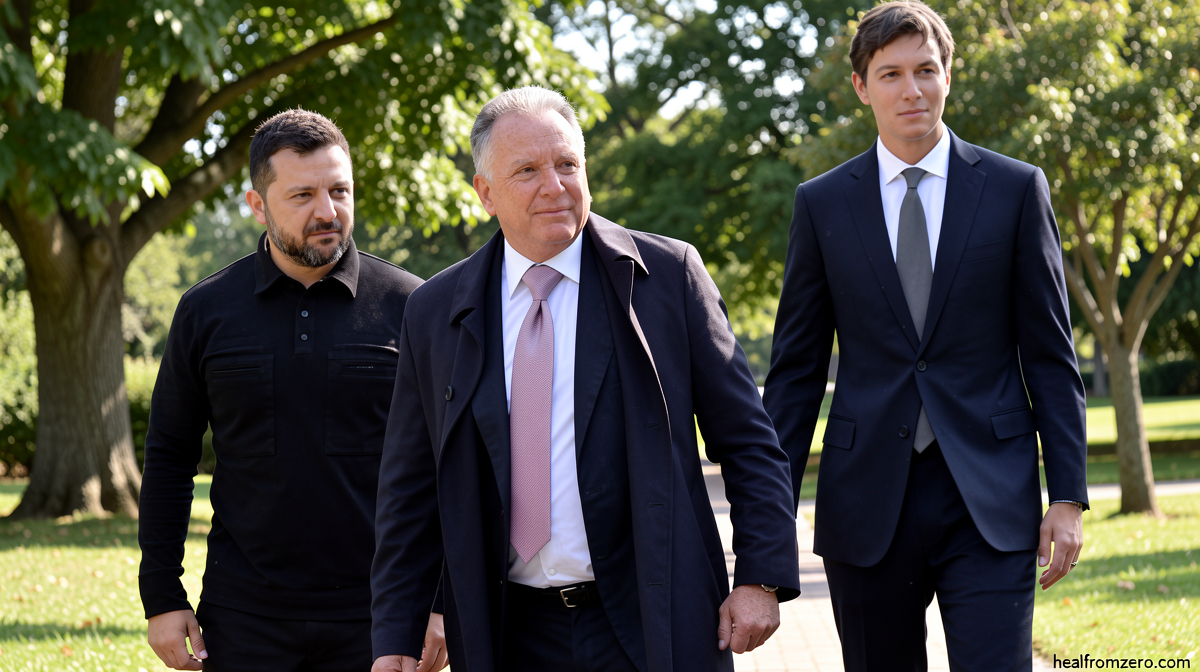
Witkoff and Kushner arrive in Kyiv for second leg of US diplomacy push

Daftar Isi
A Weekend of Diplomacy: American Envoys Complete Moscow-to-Kyiv Circuit as Ukraine Faces Its Most Acute Air-Defense Gap
Healfromzero.com – Two senior American diplomats wrapped up a compressed Moscow-to-Kyiv itinerary over a single weekend, bringing to a close what has emerged as the most sustained round of direct peace negotiations between Washington, Moscow, and Kyiv since Russia launched its full-scale invasion of Ukraine in February 2022. Steve Witkoff, the president’s personal envoy on the conflict, and Jared Kushner, Donald Trump’s son-in-law and longtime policy adviser, touched down in the Ukrainian capital on Sunday morning after spending Saturday afternoon and evening in the Kremlin.
The trip represents the first time either man has set foot in Kyiv since the war began. Their arrival came against a backdrop of near-continuous Russian missile and drone barrages aimed at Ukrainian cities, making the logistical and security challenges of the visit considerable.
The Kremlin Session
The weekend opened with a roughly three-hour sitting between the American delegation and Russian President Vladimir Putin at the Kremlin on Saturday afternoon, followed by a working dinner with the Russian leader. Kremlin aide Yuri Ushakov characterized the exchange afterward as “useful” and noted that the American representatives had “prepared seriously for this trip.” He added that the US team voiced a desire to end hostilities “as quickly as possible” and put forward “a whole series of considerations regarding possible paths to a settlement.”
A White House official confirmed the substance of the session, stating that both sides “discussed substantive plans for next steps, which will be announced in the coming weeks.” The phrasing suggests that whatever framework emerges from this weekend will be formalized publicly within a matter of days rather than months.
Transit Through Poland
Between Moscow and Kyiv, the American delegation made a brief stop in Rzeszow, a Polish city roughly 100 kilometers from the Ukrainian border. The aircraft touched down at 1:31 a.m. local time on Sunday. Russian state media indicated that the envoys most likely continued the final leg of their journey by rail, a choice that would have kept them below the radar profile of a second flight crossing contested airspace.
Zelensky’s Position Before the Talks
Ukrainian President Volodymyr Zelensky confirmed that he had convened his negotiating team in advance of meeting the American envoys. Speaking on Telegram, he framed Ukraine’s posture as one of readiness rather than concession:
“We are ready for talks. Ukraine has always been and will continue to be constructive. We are committed to bringing the war to an end. Peace is needed. Security guarantees are needed. A dignified post-war peace is needed. Our proposals are ready.”
The emphasis on “security guarantees” and a “dignified” outcome signals that Kyiv intends to press for binding commitments—likely from NATO members or other Western powers—rather than accepting a ceasefire without structural protections against renewed aggression. Zelensky has also publicly warned that a severe shortage of air-defense interceptors has left Ukraine exposed to ballistic missile salvos, a vulnerability that Russian forces have exploited with increasing frequency over recent weeks.
A Narrow Truce, and Its Limits
For the duration of the American envoys’ visits, Russia and Ukraine observed a 72-hour temporary truce specifically halting airstrikes on each other’s capital cities—Kyiv and Moscow. The pause took effect at midnight on Friday into Saturday and was scheduled to run through the weekend of diplomacy. Crucially, the arrangement applied only to the two capitals; it did not constitute a general ceasefire across the front.
That limitation became immediately apparent overnight into Sunday. Ukrainian Air Force data showed Russian forces launching 108 Shahed-type drones from inside Russia, while at least three people were killed in the latest wave of strikes. Infrastructure in the Kyiv region was hit, and a large-scale fire at an industrial facility in that area was eventually brought under control. Russian airstrikes were recorded at 11 locations across the country. In total, 10 Ukrainian civilians were killed over the preceding 24 hours, with a further 65 wounded.
The pattern underscores a recurring dynamic of the conflict: even when formal pauses are agreed, the broader war machine continues to operate, and the distinction between a capital-city truce and a nationwide ceasefire remains vast.
What Comes Next
The significance of this weekend lies less in any single concession extracted from either side and more in the fact that direct, high-level contact between the three capitals has been re-established at a frequency not seen since the early months of the war. The White House’s reference to “substantive plans” to be announced “in the coming weeks” implies that a structured roadmap—potentially involving phased de-escalation, verification mechanisms, and the security-guarantee architecture Zelensky has demanded—will be tabled publicly before the end of the month.
Whether that roadmap can survive the operational realities on the ground, where Russian forces continue to strike Ukrainian infrastructure at scale even under a narrow truce, remains the central question. The air-defense shortfall Zelensky has highlighted is not merely a tactical gap; it is a bargaining variable. Any durable settlement will need to address the question of how Ukraine protects its population from ballistic and cruise missile attack once the guns fall silent, and until that question is answered, the diplomatic window opened this weekend will remain fragile.
Related Reading
Frequently Asked Questions
What is Witkoff and Kushner arrive in Kyiv?
Witkoff and Kushner arrive in Kyiv is the main topic of this guide. The article explains the context, practical details, and next steps readers should understand.
Why does Witkoff and Kushner arrive in Kyiv matter?
Witkoff and Kushner arrive in Kyiv matters because readers are looking for a useful answer, not just a short summary. Good content should match search intent and help them decide what to do next.