
Too ugly, too noisy, too… American? France’s great air con debate
Too Ugly, Too Noisy, Too… American? France’s Great Air Con Debate
Too ugly too noisy too American – France is bracing for yet another heatwave, with scorching temperatures returning this week and the same question resurfacing: why won’t the nation simply embrace air conditioning? The issue has sparked widespread debate, revealing a complex interplay of cultural pride, environmental concerns, and political agendas. As the heat intensifies, so does the pressure on French society to adapt, yet the adoption of cooling systems remains a contentious topic.
The Public’s Growing Frustration
With temperatures climbing, the demand for air conditioning has surged, leading to chaotic scenes at retail outlets. On Thursday, thousands of residents flocked to several Lidl stores across the Paris region, creating a frenzy that resulted in overcrowding and clashes. In Aubervilliers, a Paris suburb, the situation escalated when doors gave way under the weight of the crowd. “I saw people get trampled,” one shopper recounted to *Le Parisien*. “I was in shock, I got shoved around in every direction, and unfortunately I didn’t leave with an AC unit,” another added. This desperation highlights how far French households have strayed from their traditional approach to cooling, with only 24% currently equipped, a figure that rose from 18% just two years ago but still lags behind Italy’s 50%.
“I saw people get trampled.” – Shopper in Aubervilliers “I was in shock, I got shoved around in every direction, and unfortunately I didn’t leave with an AC unit.” – Shopper in Aubervilliers
A Cultural Struggle with Technology
French attitudes toward air conditioning are deeply rooted in a cultural identity that often contrasts with American influences. For decades, the country has viewed AC as an unnecessary addition, a symbol of excess rather than a necessity. This perception is tied to a long-standing belief that conditioned air can compromise health, with some fearing it leads to respiratory issues or a reliance on artificial environments. Historically, passive cooling methods like thick stone walls and shuttered windows sufficed, especially during milder summers. But as heatwaves become more frequent and severe, these old techniques are proving insufficient.
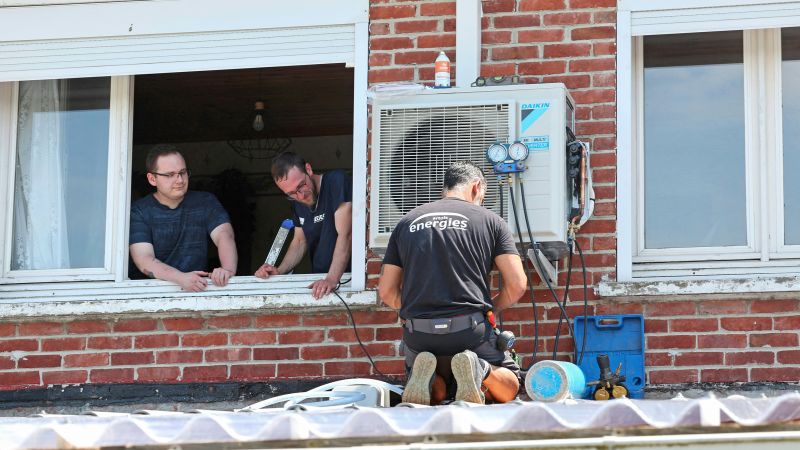
France’s resistance to air conditioning is also fueled by its architectural heritage. The 19th-century buildings that define Paris’ skyline are protected by strict regulations, making it difficult to install exterior condenser units. Residents often face bureaucratic hurdles, with co-owned buildings requiring approval from the co-ownership body before any AC unit can be installed. Without this permission, installations may be forcibly removed, further complicating the process. These rules preserve the city’s aesthetic, but they also contribute to the ongoing debate about modernization versus tradition.
Political Ramifications and the 2027 Election
As the 2027 presidential race approaches, air conditioning has emerged as a hotly contested political issue. Marine Le Pen’s National Rally party has taken the lead in advocating for widespread adoption, proposing a national “plan clim” to equip every school and hospital with cooling systems. The plan also includes $23 billion in government-guaranteed, interest-free loans to help 30 to 40 million households install units. This push for AC reflects a broader strategy to address the nation’s climate challenges through infrastructure investment.
On the left, the debate is more nuanced. The Greens, traditionally the most vocal critics of air conditioning, have begun to shift their stance. Party leader Marine Tondelier recently acknowledged that cooling is essential in certain settings, such as schools and hospitals. However, Jean-Luc Mélenchon’s hard-left France Unbowed party remains skeptical, warning that universal AC installation could exacerbate environmental harm. “Means causing more harm,” Mélenchon cautioned, emphasizing the need for balance between comfort and sustainability.
France’s government finds itself in the middle, approving emergency AC units for critical facilities while trying to avoid abandoning the country’s insulation-first philosophy. The recent motion of no confidence filed by the Greens against the government’s heatwave response underscores how deeply politicized the issue has become. Although the motion is unlikely to pass, it signals growing frustration with the current approach.
The Energy Factor: A Compromise in the Climate Debate
The environmental argument against air conditioning has also gained traction, with critics claiming it directly contributes to climate change through energy consumption. Yet this concern is challenged by France’s energy mix. Over 95% of the country’s electricity comes from low-carbon sources, with nuclear power alone accounting for around two-thirds. This means running an air conditioner in France has a significantly smaller carbon footprint compared to countries like Poland or Germany, where fossil fuels dominate the grid.
Despite this, the debate continues. Environmentalists argue that even with clean energy, air conditioning still demands resources and may encourage overconsumption. The government, however, sees it as a necessary step to mitigate the health risks posed by extreme heat. During the June heatwave, over 2,000 excess deaths were recorded, prompting a reevaluation of France’s traditional cooling methods. As temperatures rise, the country is forced to confront the reality that its cultural resistance to AC may no longer be sustainable.
Broader Implications and the Road Ahead
The conflict over air conditioning is not just a technical or aesthetic issue; it reflects a deeper cultural tension. For many, AC represents a departure from French values of simplicity and natural living. Others see it as a vital tool to combat the escalating climate crisis. The recent heatwave has intensified this divide, with families and schools bearing the brunt of the discomfort. Parents, in particular, are feeling the strain as classrooms become unbearable, forcing closures and highlighting the urgent need for solutions.
As the debate unfolds, France’s approach to air conditioning will likely shape its energy policies and urban development. The country’s dual identity—rooted in history yet adapting to modern challenges—means there is no single answer. Whether it’s the political push for AC, the environmental concerns, or the cultural pride in traditional methods, the path forward requires navigating these competing priorities. The heatwave may have cracked the door, but the question remains: will France finally embrace the cool? The answer could determine how the nation copes with the next wave of rising temperatures.