The Milky Way’s black hole is eerily quiet. Scientists have now found evidence of its missing wind

The Milky Way’s Black Hole Is Eerily Quiet. Scientists Have Now Found Evidence of Its Missing Wind
The Milky Way s black hole – For over half a century, the supermassive black hole at the heart of our galaxy, Sagittarius A*, has remained an enigma. While astronomers have long understood that black holes should not merely absorb matter but also eject it in the form of high-energy winds or jets, this particular object has been remarkably inactive. Recent breakthroughs, however, may have resolved a longstanding puzzle. Researchers have uncovered signs of a massive gas outflow from Sagittarius A*, potentially explaining why this black hole has defied expectations for decades.
A Black Hole That Defied Expectations
Sagittarius A* is one of the most studied cosmic entities, yet its behavior has been perplexing. Despite decades of observation, scientists could only trace evidence of wind eruptions that occurred more than 20,000 years ago. The lack of recent activity has left many questions unanswered. “This is our closest and best understood black hole,” said Mark Gorski, a research assistant professor at Northwestern University in Evanston, Illinois. “It’s the one we can resolve with high precision, and yet it didn’t seem to have a wind. Every black hole in the universe behaves in this way, but the one nearest to us is an exception. That was a huge problem.”
“This study presents a pretty compelling case that a wind from our galaxy’s supermassive black hole has pushed outwards through the surrounding dust and gas,” wrote Christopher Reynolds, a professor of astronomy at the University of Maryland, College Park, who was not involved in the research. “They haven’t actually seen the wind itself, but its presence is quite clear. This required very careful analysis of almost five years of data from the world’s most sensitive radio telescope — a real tour de force.”
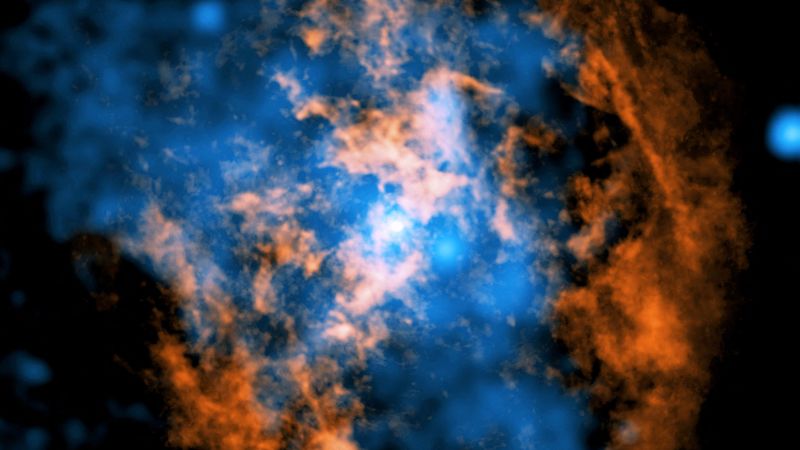
Now, after five years of meticulous observations, Gorski and Lena Murchikova, an assistant professor of physics and astronomy at Northwestern, believe they have solved this mystery. Their findings, detailed in a study published on June 4 in *The Astrophysical Journal Letters*, reveal a striking feature: a large, cone-shaped cavity in the surrounding gas. This structure, they argue, could only have been created by a wind of hot gas emanating directly from the black hole.
The Evidence Beneath the Surface
Using the Atacama Large Millimeter/Submillimeter Array (ALMA) radio telescopes in Chile, the duo produced the most detailed map ever of the cold gas near Sagittarius A*. By eliminating radio interference from the black hole itself, they were able to isolate the surrounding material. What emerged was a cavity approximately 3 light-years long, with a 45-degree opening angle, extending back toward the black hole. This finding suggests that a powerful outflow of hot plasma, or electrically charged gas, is actively shaping the environment around the galactic core.
“The black hole wind acts like a hair dryer,” Gorski explained. “It blows hot turbulent air into a colder, denser material, like your wet hair. The wind is warm and strong enough to heat and blow the water out of your wet hair and move the hair around a bit — but not strong enough to blow the hair off your head completely.”
These observations align with previous studies of supermassive black holes in other galaxies, where similar outflows have been documented. However, detecting such phenomena near Sagittarius A* has been particularly challenging due to its relative quietness. “The wind is not as intense as in distant galaxies, but its effects are still measurable,” Gorski added. “This is the first time we’ve been able to see the imprint of such a wind in our own galaxy.”
What This Means for Galaxy Evolution
Supermassive black holes play a crucial role in shaping their host galaxies. Through powerful outflows, they regulate the growth of stars by expelling gas and influencing the distribution of matter. Yet, until now, these processes had been largely inferred in other galaxies. The discovery of Sagittarius A*’s missing wind offers a rare glimpse into how such mechanisms might operate closer to home.
Christopher Reynolds, who has studied black hole activity extensively, emphasized the significance of the findings. “These outflows are a key part of how a black hole injects energy into its galaxy and controls its evolution,” he stated. “Until now, they’ve been elusive when observing our own supermassive black hole. This study provides clear evidence of their existence, which is a major step forward.”
The research team’s approach involved combining data from multiple sources. After creating a high-resolution image of the black hole’s vicinity, they cross-referenced it with observations from NASA’s Chandra X-ray Observatory. The X-ray data confirmed that the cold gas in the region was being displaced by a hot, high-speed plasma stream. This dual confirmation strengthens the case for the presence of the wind, even though it hasn’t been directly observed.
Understanding the Dynamics of Black Holes
Black holes are among the most extreme objects in the universe. Their gravity is so intense that not even light can escape once it crosses the event horizon, the point of no return. However, the material orbiting around a black hole — known as an accretion disk — can become superheated due to friction and tidal forces. This process generates radiation across the electromagnetic spectrum, from radio waves to X-rays.
When a black hole consumes gas, it expels particles at near-light speed in the form of winds or jets. These outflows can travel thousands of light-years into space, interacting with surrounding material and altering the galaxy’s structure. Sagittarius A*’s wind, while less intense than those in other galaxies, still has the potential to influence the Milky Way’s evolution. The cone-shaped cavity detected by the researchers provides indirect proof of this interaction, offering insights into the black hole’s behavior that were previously missing.
Despite the breakthrough, the question remains: Why has Sagittarius A* been so quiet compared to other supermassive black holes? Theories suggest that the low mass accretion rate — the amount of gas the black hole is currently consuming — may be the reason. Unlike their more active counterparts, Sagittarius A* may not be feeding as aggressively, resulting in weaker outflows. However, the recent observations show that even in these quieter periods, the black hole can still exert a significant impact on its environment.
“This discovery highlights how much we still have to learn about our galaxy’s central engine,” Gorski noted. “It’s not just about what the black hole consumes, but also about how it influences the space around it. The cavity we found is a direct sign of this interaction, and it opens new avenues for understanding the dynamics of black holes in our own cosmic neighborhood.”
A New Era of Black Hole Studies
The findings underscore the importance of long-term observational campaigns. By analyzing nearly five years of data, the researchers were able to capture subtle changes in the surrounding gas that had been overlooked in shorter studies. This level of detail is critical for identifying phenomena that occur over extended periods, such as the gradual sculpting of a cavity by a steady wind.
“This kind of patience and persistence is what makes breakthroughs possible,” said Murchikova. “Without years of continuous data, we wouldn’t have been able to see the pattern that reveals the wind’s existence.” The study also demonstrates the power of modern telescopes, such as ALMA and Chandra, in uncovering hidden processes. These instruments, capable of detecting faint signals across vast distances, are essential for probing the mysteries of the universe’s most enigmatic objects.
As the scientific community continues to explore Sagittarius A*, this discovery may pave the way for further research into the mechanisms that govern black hole activity. Whether the black hole’s wind is a regular occurrence or a rare event, its presence in the data offers a new perspective on the galaxy’s past and future. For now, the cone-shaped cavity stands as a testament to the unseen forces at work in the heart of the Milky Way, bringing a quiet black hole into the spotlight after decades of obscurity.