
Peter Thiel in Aspen: The pope is ‘working for the Chinese Communists’
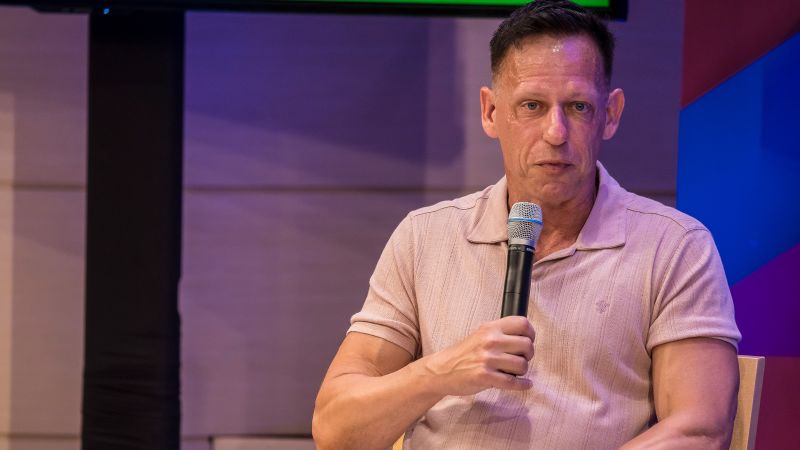
Peter Thiel in Aspen: The Pope Accused of Working for the Chinese Communists
Peter Thiel in Aspen – At the Aspen Ideas Festival in Colorado, tech magnate and investor Peter Thiel launched a series of bold assertions about the trajectory of artificial intelligence and the future of Western democracies. Central to his remarks was a sharp critique of Pope Leo XIV, whom he claimed is “working for the Chinese Communists” by promoting AI regulation. This accusation came during a non-recorded panel, where Thiel engaged in dialogue with political theorist Francis Fukuyama, marking a significant shift in their intellectual exchange from previous years.
Thiel’s Vision of a Global AI Race
Thiel, a co-founder of Palantir and PayPal, has long been a vocal figure in the tech world, advocating for innovation and market-driven solutions. During the festival, he argued that the Vatican’s push for stricter international oversight of AI could slow down the United States in its competition with China. His point was rooted in the belief that the Pope’s encyclical, “Magnifica Humanitas” (“Magnificent Humanity”), released in May, called for disarming AI technology. Thiel contended this message would resonate with Americans but fall on deaf ears in China, thereby tipping the balance of the global race in favor of Beijing.
“The weird ways that politics has gone haywire is telling me something very deep.”
Thiel’s claim that the Pope is an “agent” for the Chinese Communist Party stems from his view that the encyclical could inadvertently aid China’s efforts to dominate AI development. This idea echoes his broader skepticism of institutions that, in his opinion, hinder technological progress. While the Pope’s message is framed as a moral call for AI governance, Thiel suggests it serves a strategic purpose for Beijing, aligning with the Pope’s own geopolitical interests.
A History of Tension with the Vatican
Thiel’s relationship with the Vatican has been marked by recurring clashes. Earlier this year, he hosted an exclusive lecture series in Rome on the concept of the Antichrist, just a short distance from the Holy See. The event, which focused on the idea of a world government led by elites to combat existential threats like AI or climate change, reportedly unsettled Vatican officials. Two Catholic universities even distanced themselves from the event, stating they were not involved in its organization.
Thiel’s critique of the Vatican isn’t new. In March, he gave a talk in Rome where he theorized that the Antichrist could emerge as a global authority, not an individual, to manage crises threatening humanity. This perspective ties into his broader argument that democratic institutions have become obsolete in the face of technological challenges. His recent comments at Aspen suggest a similar line of thought, framing the Pope’s actions as part of a larger pattern of institutional subversion.
Democratic Socialists and the Future of U.S. Politics
Thiel’s remarks at Aspen extended beyond the Vatican, targeting the Democratic Party as a potential ground for a “democratic-socialist takeover.” He emphasized that while the Republican Party remains less influential, the Democratic Party’s transformation could spell the end of American democracy. “When the Democratic Party goes, this country is over,” he declared, citing the recent rise of self-identified democratic socialists within the party.
Thiel highlighted the growing presence of democratic socialist candidates in key races, such as the mayoral and congressional primaries, as evidence of this shift. He warned that the party’s leftward drift could lead to a new era of governance dominated by far-left ideologies. This view contrasts with Fukuyama’s, who argued during the panel that maintaining democratic institutions is critical to preserving the system’s stability.
“I think there’s going to be a democratic-socialist takeover of the Democratic Party.”
Fukuyama, known for his “End of History” thesis, posited that liberal democracy represents the final form of government. However, he acknowledged that the current political climate poses a threat to this model. Thiel, on the other hand, argued that existing institutions have become barriers to progress, creating a gridlock that stifles innovation and growth. “The weird ways that politics has gone haywire is telling me something very deep,” he said, suggesting that the breakdown of traditional democratic norms signals a deeper existential crisis.
Contrasting Debates: From Stagnation to Democracy’s Fate
Thiel and Fukuyama’s discussion at Aspen marked a notable departure from their 2012 debate, which centered on technological stagnation. At that time, they explored issues like income inequality, the failure of clean energy initiatives, and the delays in U.S. infrastructure projects such as high-speed rail. The current conversation, however, is framed around the survival of Western democracy, with Thiel warning of a looming threat from left-wing forces.
Fukuyama countered Thiel’s argument by stressing the resilience of liberal democracy despite its challenges. He noted that, even in the face of extremism, democratic systems remain humanity’s most viable political framework. Thiel, though, dismissed this as overly optimistic, claiming that the Democratic Party’s evolution toward democratic socialism could lead to a concentration of power in the hands of a technocratic elite. This, he argued, would mirror the authoritarian models he once criticized in the 20th century.
The Road Ahead for Western Democracy
Thiel’s remarks at Aspen have sparked debate about the future of governance in the West. Critics argue that his disdain for democratic institutions borders on “techno-authoritarianism,” a term used to describe his preference for elite-led solutions to complex problems. Supporters, however, see his vision as a necessary adaptation to the challenges of the modern era, where rapid technological change demands new political structures.
The Pope’s role in this discourse highlights the intersection of religion and geopolitics. As the first pope from the United States, Leo XIV’s encyclical has been interpreted as a bridge between Catholic moral authority and Chinese strategic interests. This interpretation, though controversial, underscores the growing influence of global powers on international institutions. Thiel’s claim that the Pope is aligned with Beijing’s goals has been met with skepticism, but the audience at Aspen seemed to find his remarks provocative and entertaining.
The Vatican has not yet commented on Thiel’s accusations, leaving room for further debate. Meanwhile, the discussion continues to reflect a broader tension between innovation and tradition, between market forces and state control, and between the West’s political ideals and the realities of global competition. As the 250th anniversary of the United States’ adoption of the Declaration of Independence approaches, Thiel’s remarks serve as a reminder of the evolving challenges facing democratic governance in the 21st century.