
July 4, 1776: The day Thomas Jefferson went shopping
July 4, 1776: The day Thomas Jefferson went shopping
July 4 1776 – On the morning of July 4, 1776, Philadelphia experienced a mild start to the day, with temperatures hovering around 68 degrees. By midday, the mercury had risen to 72.25 degrees, reaching a comfortable 76 by 1 p.m. The weather would later drop to 73.5 degrees as the sun set, but these observations were not mere trivia. They were documented by Thomas Jefferson himself, who took the time to measure the ambient heat on what is now considered a pivotal moment in American history. The day marked the formal adoption of the Declaration of Independence by the Continental Congress, a decision that would sever the United States from British rule and ignite a revolution that would reshape global politics.
A Day of Weather and Work
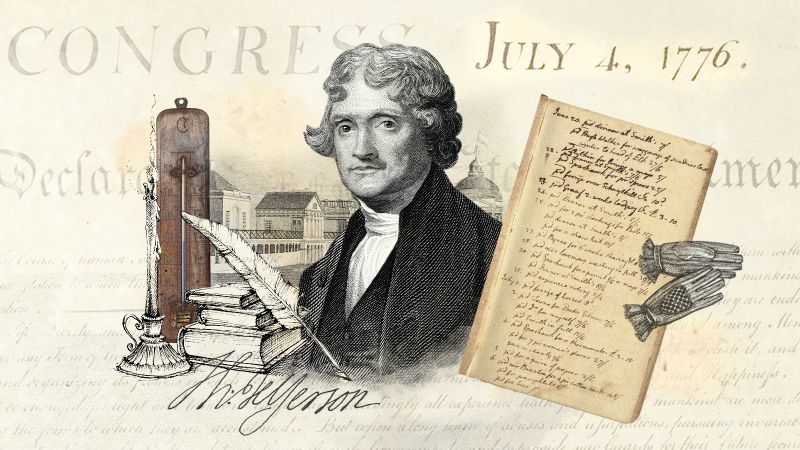
Jefferson’s meticulous nature extended beyond politics and philosophy. His personal ledger, a collection of detailed financial records, reveals that on July 4, he made a small but notable purchase: a thermometer from John Sparhawk, a local apothecary and bookseller. The instrument, acquired for three pounds and 15 shillings, was likely part of a broader interest in meteorological tools, given Sparhawk’s reputation for selling such items on Second Street. This transaction, however, was not an isolated event. Jefferson also spent 17 shillings on seven pairs of women’s gloves, suggesting a mix of practicality and perhaps a touch of domesticity in his routine.
Jefferson’s ability to multitask on this day has sparked debate among historians. While he was busy with the monumental task of drafting the Declaration of Independence, he managed to complete these mundane purchases. The question arises: how did Jefferson balance such seemingly routine activities with the gravity of the day? Did he simply prioritize personal needs, or was this evidence of a broader trend in the lives of revolutionary leaders?
The Fabric of Civic Life
Andrew Davenport, vice president of research at Monticello, Jefferson’s estate, offered a perspective that underscores the everyday realities of revolutionaries. “It’s a mundane day, except it’s a revolutionary one,” he noted. “It reminds us that even during the most intense periods of history, routine tasks remain essential. These everyday duties form the backbone of civic life, which in turn builds the foundation of the nation.” Davenport’s observation highlights how the Declaration’s adoption was not a singular, dramatic event but the culmination of months of debate, drafting, and collaboration. For many, the July 4 festivities symbolize a grand national moment, yet the records show that for Jefferson, the day was as much about practicality as it was about principle.
Cara Rogers Stevens, a Jeffersonian scholar at Ashland University, proposed an alternative interpretation. She suggested that Jefferson’s apparent focus on household matters might reflect his lighter workload compared to other Congress members. “The fact that he could manage errands on the same day as the Declaration’s adoption may indicate he wasn’t involved in as many committees as figures like John Adams,” Stevens explained. This theory invites further inquiry into the distribution of responsibilities among the Founding Fathers, questioning whether Jefferson’s role was less demanding or simply more efficiently managed.
The Genesis of a National Holiday
James P. McClure, general editor of the Papers of Thomas Jefferson project and a historian at Princeton University, provided context for why July 4 became the celebrated date of independence. He noted that while the Continental Congress officially approved the Declaration on July 2, the final wording was adopted on July 4, making it the day the document was formally finalized. This distinction, though subtle, played a role in the day’s eventual recognition as a national holiday. John Adams, in a letter to his wife Abigail on July 3, had already predicted that the Second of July would be commemorated as a “great anniversary Festival,” envisioning parades, bonfires, and public celebrations that would endure for generations.
Jefferson’s role in the Second Continental Congress was both critical and intricate. He arrived in Philadelphia in May 1776, accompanied by Robert Hemmings, an enslaved teenager who served as his personal attendant. On June 11, the Congress appointed a five-member committee to draft the Declaration, with Jefferson as the primary author. McClure emphasized that Jefferson’s work on the document was not done in isolation. “He juggling between drafting the Declaration and attending to other obligations,” McClure said. The committee submitted the draft to Congress on June 28, and by July 4, the process of finalizing the text was largely complete. Historical records suggest that the Congress may have approved the Declaration in the morning, leaving the afternoon and evening open for Jefferson’s shopping excursions.
Revisiting the Legacy of a Revolutionary Day
July 4, 1776, was not the dramatic dawn of a new era but a culmination of months of tireless effort. The Continental Congress had spent over a year deliberating on the issue of independence, navigating complex debates and balancing military strategies with political aspirations. For the people in and around the Pennsylvania State House, the day was part of a continuous process, not a sudden breakthrough. Yet, it was this day that would later be immortalized as the birth of a nation.
Jefferson’s actions on July 4, while seemingly trivial, offer a fascinating glimpse into the lives of those who shaped history. The act of purchasing a thermometer and gloves might appear inconsequential, but it reflects a man who was deeply attuned to the details of his environment. His meticulous logging of temperatures and expenses demonstrates a commitment to precision that mirrored his work on the Declaration. This blend of practicality and passion for intellectual pursuits was a hallmark of Jefferson’s character.
The day’s significance also lies in its role as a bridge between the formal adoption of the Declaration and the public’s eventual embrace of it. While July 2 was the moment of decision, July 4 became the day of proclamation. The two-day gap allowed for the necessary steps to finalize the document, and by the time the Congress approved it on the fourth, the framework for a new nation was in place. This historical nuance invites a reevaluation of how we commemorate such pivotal moments. Perhaps, McClure argued, the July 4 celebrations are not just about the Declaration but also about the everyday persistence required to build a nation.
Jefferson’s shopping on July 4 serves as a reminder that revolutionaries were not immune to the mundane. Their ability to attend to both grand political visions and the practicalities of daily life was essential to the success of the American cause. As Davenport pointed out, the fabric of civic life is woven from such everyday tasks, and Jefferson’s actions exemplify how these small details contribute to the larger narrative of history. In a world often defined by monumental events, the simple act of buying gloves and a thermometer becomes a symbol of the human element behind the revolution.
Reflections on a Historical Moment
The story of Jefferson’s shopping on July 4, 1776, is more than a quirky footnote. It underscores the complexity of historical figures and the multifaceted nature of their contributions. While the Declaration of Independence is celebrated as a bold declaration of freedom, the day it was finalized was also a time for personal reflection and routine. This duality captures the essence of the American Revolution: a blend of idealism and practicality, of grand ideals and the day-to-day labor that brought them to life.
As we reflect on this day, it is worth considering the broader implications of Jefferson’s actions. The fact that he could balance such significant responsibilities with personal errands suggests a man of exceptional efficiency. Yet, it also raises questions about the division of labor among the Founding Fathers. Were some figures more centrally involved in the revolutionary process, while others handled the logistical aspects? Jefferson’s account of July 4 offers a unique window into this question, revealing that even the most consequential days were marked by moments of ordinary activity.
Ultimately, July 4, 1776, was a day that combined the extraordinary with the everyday. Jefferson’s decision to purchase a thermometer and gloves may seem minor, but it highlights the human side of history. In an age that often romanticizes the past, these small details remind us that the people who shaped our nation were not just visionaries but individuals with diverse interests and routines. As we celebrate the Declaration of Independence, we might also take a moment to appreciate the quiet moments that accompanied its creation.