China postpones launch of unprecedented water-hunting moon mission amid space race

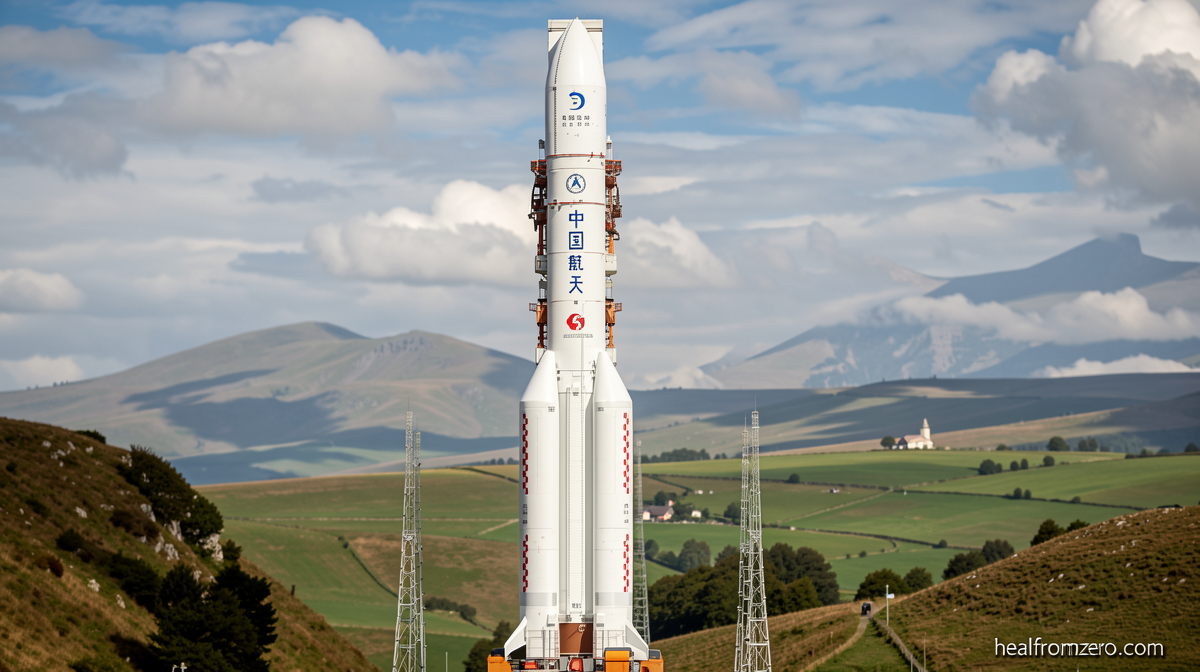
China Delays Chang’e-7 Lunar Water Mission
Healfromzero.com – China postpones launch of unprecedented lunar science operations after Beijing confirmed that the Chang’e-7 spacecraft will not fly within its originally planned window later this year. The China Manned Space Engineering Office released a terse statement through state media, declaring the mission “cannot take place during the planned window this year.” The probe had been staged for liftoff as early as Sunday evening or Monday morning Beijing time, turning the cancellation into a sudden disruption of an already crowded launch calendar.
No technical rationale accompanied the announcement. State outlets offered only that the “lunar probe does not meet launch conditions” and that the call reflected an “assessment conducted following the principle of prudence, reliability and absolute mission success.” Neither the duration of the hold nor the specific anomaly behind it was disclosed at the time of reporting.
What Chang’e-7 Was Designed to Achieve
The spacecraft’s core objective is to descend onto permanently shadowed terrain near the Moon’s south pole and perform the first direct, in-situ chemical analysis of water ice on the lunar surface. No prior mission has drilled into or spectroscopically characterized frozen water at that location. Orbital remote sensing has mapped spectral signatures consistent with ice deposits and estimated their approximate volume, yet ground-truth measurement has always remained the missing element.
Chang’e-7 carries instruments engineered to confirm whether ice exists in usable quantities, characterize its depth and lateral distribution, and gather data that would inform future mining or in-situ resource utilization operations. In practical terms, the probe was meant to convert a decades-old hypothesis into an engineering fact.
The Competitive Landscape
The delay arrives at a moment when the United States is accelerating its own push toward the same lunar region. Within roughly the next twelve months, multiple American spacecraft are slated to target the south-pole terrain that Chang’e-7 was built to investigate.
Astrobotic Technologies, headquartered in Pittsburgh, has been preparing its Griffin lander for a south-pole insertion as early as late 2026. Separately, Jeff Bezos’s Blue Origin has outlined plans to deliver up to two robotic landers to the Moon next year; one of those vehicles may carry the VIPER rover, a NASA-built prospecting robot engineered to traverse shadowed craters, sample regolith, and confirm the presence and accessibility of water ice and other volatiles.
Competitive stakes were already visible in 2025, when Intuitive Machines, a Texas-based firm, dispatched a water-hunting drill to the south pole. The spacecraft tripped during its descent onto the notoriously rugged, low-visibility terrain and was unable to complete its science objectives. That failure underscored how unforgiving the target environment remains, even for experienced landers.
US officials have publicly framed the standoff with China over lunar resources as a “space race,” and the Chang’e-7 hold temporarily narrows the gap between the two programs’ timelines. Whether the pause lasts days or weeks will determine whether Beijing retains its first-mover advantage in direct ice characterization.
Why the South Pole Matters
The lunar south pole is the single most strategically contested region in current space exploration because of its expected water-ice reserves. Frozen water, if present in sufficient concentration, can be split into oxygen and hydrogen — yielding breathable air, drinking water, and rocket propellant. Those three products together would dramatically lower the cost of sustained lunar habitation and serve as a staging point for deeper-space missions toward Mars and beyond.
Whether the ice deposits are thick enough, accessible enough, and distributed widely enough to support those applications remains an open question. Confirming the answer is precisely what Chang’e-7 was tasked with doing, and what VIPER would attempt from the American side of the equation.
Expert Perspective
Yuqi Qian, a lunar geologist at the University of Hong Kong, told CNN that the mission’s outcome would carry weight far beyond a single data set. He noted that Chang’e-7 could help make “important progress on this question, sharpening and focusing experiments for further exploration and testing.”
Qian added that the probe represents a qualitative shift in China’s lunar architecture: “shifting from an exploration program to a resource utilization program.” That framing — from discovery to exploitation — mirrors the trajectory the United States is attempting to follow with its own south-pole landers.
Frequently Asked Questions
When was Chang’e-7 originally scheduled to launch? The spacecraft was poised for liftoff as early as Sunday evening or Monday morning Beijing time within the planned window later this year. The exact date was not publicly fixed before the postponement was announced.
Why was the launch delayed? State media stated only that the probe “does not meet launch conditions” and that the decision followed a principle of “prudence, reliability and absolute mission success.” No specific technical fault or anomaly was named.
How long will the delay last? The duration was unspecified at the time of reporting. Officials did not indicate whether the pause would span days, weeks, or a full launch-season reset.
What makes the lunar south pole strategically important? Permanently shadowed craters near the south pole are expected to harbor water ice. If confirmed in sufficient quantity, that ice can be processed into oxygen, water, and hydrogen propellant — resources essential for long-duration lunar presence and as a staging point for Mars missions.
How does this delay affect the US-China space race? Multiple American south-pole missions, including Astrobotic’s Griffin lander and Blue Origin’s VIPER-carrying vehicles, are targeted within roughly the next twelve months. A brief pause narrows the gap between the two programs’ timelines; a longer one could hand the United States a first-mover window in direct ice characterization.