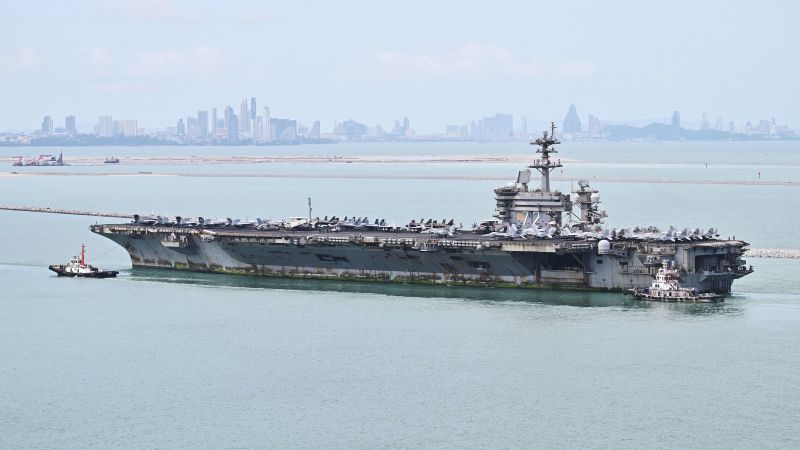
Aircraft carrier USS Abraham Lincoln arrives in Thailand after months of combat in Middle East

Daftar Isi
Aircraft Carrier USS Abraham Lincoln Docks in Thailand
Healfromzero.com – The aircraft carrier USS Abraham Lincoln glided into Laem Chabang port on Wednesday, ending a run of continuous Middle East operations that had stretched far past any standard deployment window. The 100,000-ton vessel had not entered a friendly harbor since leaving San Diego last November, and its eventual return to Southern California later this year will rank among the longest sustained assignments in U.S. Navy history.
Capt. Dan Keeler, who commands the ship, described the arrival as a moment of collective relief:
“We are all very excited to make Thailand the first port visit on our historic deployment.”
Months of saltwater exposure without dry-dock access left visible corrosion streaks across the superstructure. For the roughly 5,000 sailors aboard, the stop represented far more than a logistical pause — it was a psychological lifeline after an unbroken combat and blockade rotation against Iran.
Congressional Scrutiny Over Conditions Aboard
The sheer length of the assignment drew pointed questions from Capitol Hill. Sen. Richard Blumenthal, a Connecticut Democrat on the Armed Services Committee, sent a letter last month to Defense Secretary Pete Hegseth and the acting secretary of the Navy, voicing what he termed “serious concern” over escalating deployment durations and demanding specifics about life below decks.
“There have been widespread reports of shortages of basic supplies, water contamination, plumbing issues, deteriorating mental health, deck safety concerns,” the senator wrote, noting that “disruptions in the mail system” had caused care packages to be lost in transit for months.
Blumenthal also referenced at least one possible suicide attempt among the crew, a detail that highlighted the psychological toll of sustained operations without shore leave. Hegseth replied by declaring conditions on the vessel had been “completely misrepresented,” though he offered no itemized rebuttal to the specific complaints catalogued in the letter. President Donald Trump, pressed on deployment length, waved the concern aside, remarking that the period at sea was “not nearly long enough.”
Strategic Trade-Offs: Two Carriers, One Gap
Within days of the aboard-ship problems surfacing publicly, the Pentagon shifted the Japan-based USS George Washington into the Middle East theater to relieve the Lincoln. The George Washington has since taken up station alongside the USS George H.W. Bush, preserving a two-carrier posture while hostilities with Iran continue.
That rotation carried a cost in the Pacific. Analysts and defense critics noted that pulling the George Washington out of East Asia stripped the Navy of one of its largest surface combatants from the region where it traditionally signals alliance commitment and deters adversaries such as China and North Korea. The episode, they argued, exposed a structural shortfall: the service simply lacks enough large-deck carriers to sustain simultaneous high-tempo operations in two theaters without creating a visible gap elsewhere.
Adm. Daryle Caudle, Chief of Naval Operations, addressed the strain directly while speaking to reporters in Virginia last week. He acknowledged that extended deployments exact a heavy price on sailors and their families, and said the Navy would strive to introduce greater predictability into rotation schedules — while conceding that active combat makes rigid planning difficult.
“I would prefer, you know, seven-month deployments. I typically am not a big fan of extensions, and I push back hard on that. But the enemy gets a vote,” Caudle told USNI News.
A Pattaya Port Call Echoing Vietnam-Era Rest Stops
The choice of Laem Chabang — a commercial port less than an hour’s drive from the beach town of Pattaya — carries a long lineage in American military culture. Since the Vietnam War, Pattaya has served as a rest-and-relaxation destination for U.S. servicemembers rotating out of combat zones, a tradition rooted in the proximity of U-Tapao airbase, where dozens of B-52 Stratofortress bombers were based during the conflict.
From U-Tapao, the eight-engine bombers could reach targets in North Vietnam in roughly three to four hours, a significant time and fuel saving compared with the alternative of launching from the continental United States. That same geographic shortcut now underpins a quieter mission: giving 5,000 sailors a few days of shore leave, fresh water, and the psychological reset that only a friendly port can provide.
Frequently Asked Questions
How long had the carrier been deployed before arriving in Thailand? Approximately eight months, from its departure out of San Diego last November through the Laem Chabang port call in September 2026.
Why was Thailand selected as the first friendly port? Laem Chabang sits near Pattaya, a long-standing rest-and-relaxation area for U.S. forces in the region dating back to the Vietnam era. Its proximity to U-Tapao airbase and established logistics infrastructure made it a practical choice for a mid-deployment pause.
What happened to the carrier’s Pacific coverage after the rotation? The USS George Washington, previously stationed in Japan, was redirected to the Middle East to relieve the Lincoln. This left the Navy with fewer large-deck carriers in East Asia, a gap analysts say underscores the service’s limited carrier inventory.
What did congressional critics say about conditions on board? Sen. Blumenthal cited reports of supply shortages, water contamination, plumbing failures, mental-health deterioration, and mail-system disruptions. The Pentagon’s response characterized the account as “completely misrepresented” without itemizing specific rebuttals.