A mysterious ‘cold blob’ in the ocean has puzzled scientists. A new study says it’s an ominous sign

A Mysterious Cold Blob in the Atlantic: A Climate Warning Signal
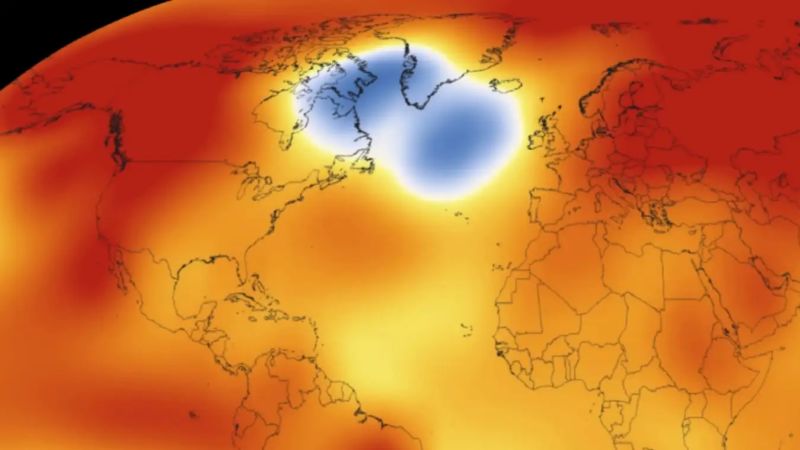
A mysterious cold blob in the ocean – The discovery of a mysterious cold blob in the North Atlantic has sparked significant scientific debate. This region, south of Greenland and Iceland, has cooled sharply over the past century, despite global warming trends in surrounding waters. A recent study published in *Nature Climate Change* proposes that this anomaly may signal a critical shift in Earth’s climate systems. The cold blob, which has dropped nearly 1 degree Celsius (1.8 Fahrenheit) since 1900, could be an early indicator of broader oceanic and atmospheric changes.
The Cold Blob and the AMOC’s Role in Cooling the North Atlantic
Researchers have long sought to understand the cause of this unusual cooling. The Atlantic Meridional Overturning Circulation (AMOC), often described as the ocean’s “conveyor belt,” is central to this discussion. This current system moves warm tropical waters northward, where they cool, sink, and return southward, influencing global weather patterns. However, recent data suggests the AMOC may be weakening, potentially explaining the cold blob’s formation. The study indicates that the anomaly aligns with this disruption, raising concerns about the system’s future stability.
Contrary to earlier hypotheses that linked the cold blob to atmospheric factors like wind patterns or cloud cover, the research highlights its connection to ocean currents. The cooling extends deep into the water, a pattern not easily explained by surface-level changes alone. Scientists argue that this finding reinforces the AMOC’s role in maintaining climate balance and underscores its vulnerability to freshwater inputs from melting ice sheets and glaciers.
Global Impacts of the AMOC’s Decline
If the AMOC continues to weaken, the implications could be far-reaching. A potential collapse might lead to accelerated sea level rise along the US East Coast, as the current’s ability to redistribute water diminishes. Europe could face colder winters and more unpredictable weather, while African monsoon systems might shift, causing droughts in some areas and heavy rainfall in others. These effects demonstrate how the cold blob is more than a local anomaly—it could signal a tipping point in global climate dynamics.
Historical records show that the AMOC’s current weakening rate is among the fastest in 1,000 years. This rapid decline, driven by freshwater influx from melting ice, disrupts the density-driven circulation that powers the system. The study’s lead author, Stefan Rahmstorf of Potsdam University, noted that the cold blob’s persistence may reflect this slowdown. “The cold blob is a fingerprint of the AMOC’s instability,” he stated, emphasizing its significance as a climate warning.
Methodology and Supporting Evidence
To confirm the cold blob’s link to the AMOC, the study combined ocean heat measurements with climate models. Data from Argo floats and satellite observations revealed a consistent pattern: the cooling in the region correlates strongly with the AMOC’s weakening. This integration of real-world data and simulations strengthens the argument that the anomaly is a direct consequence of oceanic changes rather than atmospheric variability alone.
René van Westen, a researcher at Utrecht University, echoed this conclusion. He noted that while atmospheric factors can create localized cooling, the study’s cross-validation across datasets supports the AMOC’s role. “The cold blob’s formation is likely tied to the AMOC’s decline,” he said, stressing the need for further research. This consensus among experts highlights the cold blob’s potential as a key climate marker.
“The cold blob is a fingerprint of the AMOC’s instability,” said Stefan Rahmstorf, a physics and oceans professor at Potsdam University, Germany.
Future Research and Climate Outlook
Despite the study’s findings, uncertainties remain. Scientists continue to analyze the cold blob’s long-term trajectory and its interaction with other climate factors. Additional research, including more detailed sediment core analysis and improved climate models, could provide further clarity. The cold blob’s persistence may also be influenced by natural variability, so its role as a definitive climate signal is still under investigation.
As the AMOC weakens, the cold blob could serve as an early warning of larger climate shifts. Its presence in the North Atlantic, where the current delivers critical heat, suggests that the system’s decline may have cascading effects. By monitoring the cold blob and its relationship to the AMOC, researchers hope to better predict future climate scenarios and prepare for potential changes in weather and sea levels worldwide.