The world’s most delicious pancakes

A Global History Written in Batter and Dough
Healfromzero.com – For thousands of years, nearly every civilization has found a way to flatten a mixture of grain, liquid, and fat into a disc or triangle and cook it on a hot surface. The result — whether drenched in syrup, folded around melted cheese, or dusted with cracked pepper — has become one of humanity’s most universal comfort foods. From the wheat fields of Europe to the rice paddies of East Asia, from the copper pans of Mediterranean street corners to the wood-fired ovens of Italian hill towns, the pancake in its countless guises has outlasted empires, survived dietary revolutions, and earned a permanent seat at both the weekday breakfast table and the holiday feast.
Because traditional batters lean heavily on butter and eggs, pancakes historically carried a quasi-sacred role: they were the last rich meal eaten before a period of fasting. That association persists in many cultures, where a week of pancake-heavy celebration marks the threshold before Lent or other observances. Today, however, the primary draw is simpler — a weekend indulgence, a guilty-pleasure stack, a reason to linger over coffee a little longer.
French Crêpes: Brittany’s Thin-Layer Legacy
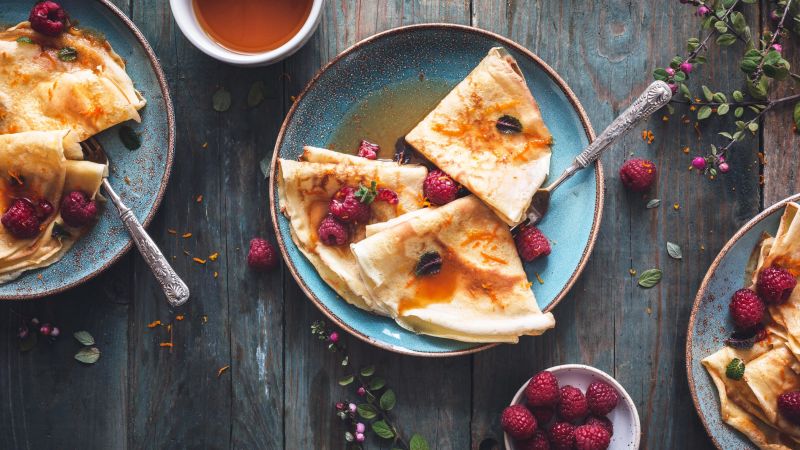
If a hall of fame existed for flat, cooked discs, the Breton crêpe would occupy the center plaque. These paper-thin pancakes trace their origin to the 13th century in the rugged northwest corner of France, where buckwheat and wheat flours met iron pans and centuries of refinement. The modern crêpe splits cleanly into two camps. The sweet version arrives laden with fruit preserves, ribbons of chocolate, or a generous pour of syrup. The savory classic — crêpe au jambon et fromage — layers ham and cheese until the cheese melts into a glossy, unctuous sheet. Watching a skilled cook coax the batter to its correct viscosity, then flick the pan so the thin film folds over itself in a single fluid motion, remains one of gastronomy’s most theatrical moments.
Socca and Farinata: The Chickpea Disc of the Riviera
Along the French-Italian border, a different pancake tradition takes root. In Nice and the Ligurian coast, a mixture of chickpea flour, water, olive oil, and simple seasoning is spread into large copper pans set inside wood-fired ovens. The result — called socca in Nice, farinata in Liguria — is a golden, custardy disc with a crisp-edged exterior. It functions as a naturally gluten-free alternative to pizza and has long served as a cheap, filling street snack. Vendors in Nice still hand out slices folded into paper cones, finished with a crack of black pepper. The dish’s simplicity and its deep regional identity make it a fixture of local identity far beyond any single restaurant.
Blinis: Buckwheat, Yeast, and the Russian Lenten Table
Across Slavic Europe, the pancake tradition takes a distinctly different shape. Blinis are thin, round, and leavened with yeast, their batter built on buckwheat flour rather than wheat. In home kitchens and village taverns they appear in generous, rustic sizes; in fine-dining settings they shrink to delicate rounds crowned with caviar or a curl of smoked salmon. Their cultural calendar role is unmistakable: the week of Maslenitsa, the final feast before the Christian fast of Lent, is essentially a week of blini. The prospect of pancakes every day for seven consecutive days remains, for many, the most appealing sentence in the Russian culinary calendar.
Hemp Protein Pancakes at Grand Resort Bad Ragaz
Dietary constraints and modern nutrition science have spawned a wave of alternative-ingredient pancakes, but few match the ambition of Michelin-starred chef Sven Wassmer at Verve by Sven, housed within Switzerland’s Grand Resort Bad Ragaz. Wassmer’s creation replaces wheat flour entirely with hemp protein, yielding a gluten-free disc that still delivers the structural integrity a pancake demands. Toppings range from sliced banana and toasted almonds to a drizzle of maple syrup and, optionally, a small quenelle of whipped cream. In a country already associated with health-conscious breakfast culture, the dish reads as both a technical showcase and a nod to Swiss culinary precision.
Japanese Hotcakes: Soufflé Physics on a Plate
The Japanese name for this towering treat — “hottokeki,” a phonetic rendering of the English word “hotcakes” — tells you exactly what you are looking at. What makes the Japanese version visually and texturally distinct is its construction: egg whites are whipped into a meringue and folded into the batter, producing a soufflé-like interior that rises well above the rim of the pan. The result is an extra-tall, impossibly fluffy disc with a cloud-soft crumb. Toppings are essentially unlimited — berries, fresh cream, maple syrup, even strips of bacon — but the one non-negotiable ritual is photographing the stack before the first bite. Social media has turned these towering creations into a genre of their own.
Crispy Dough Triangles: The Wok-Fried Alternative
Not every flatbread-adjacent pancake begins as a liquid batter. A family of fragrant, crispy triangles — made from rolled and cut dough rather than poured batter — delivers a texture that is simultaneously flaky, chewy, and shatteringly crisp. They are straightforward enough to prepare at home, and many diners dip them in sauces built on soy or chili. Yet their most celebrated form is unadorned: straight from the pan or wok, still warm, carrying the sharp, green note of scallions baked into the dough. Regional variations push the richness further; the Shanghai iteration incorporates pork fat into the dough itself, adding a layer of savory decadence that transforms the snack into something closer to a pastry.
American Pancakes: Buttermilk, Bacon, and a 229-Year-Old Recipe
Thick, pillowy, and drenched in maple syrup with a contrast of salty, crispy bacon, the classic American pancake stack occupies a singular place in Western breakfast culture. The lineage stretches back to 1796, when Amelia Simmons published American Cookery, which included a recipe she called “Indian Slapjacks,” made from cornmeal. Those early cornmeal versions have largely faded from memory, but the wheat-and-buttermilk iteration that followed became the standard. Buttermilk’s mild acidity reacts with baking soda to produce a finer crumb, greater loft, and a faint tang that distinguishes a proper American pancake from its flatter, sweeter continental cousins. The unwritten rule of presentation is simple: pile them high.
Latkes: The Potato’s Place in Ashkenazi Tradition
Among the most celebrated pancakes in Ashkenazi Jewish cuisine, latkes introduce an ingredient rarely associated with the category: the potato. Grated, drained, and bound with egg, the potato forms a golden, crisp disc traditionally served with applesauce or sour cream. The potato’s dominance in the recipe is a relatively recent development; earlier versions of the dish relied on other starches before the spud became ubiquitous in Eastern European kitchens. Today, latkes are inseparable from Hanukkah, when the oil-fried tradition aligns with the holiday’s theme of light and abundance.
The pancake, in its global multiplicity, resists any single definition. What unites every version — from the 13th-century Breton crêpe to a modern hemp-protein disc in a Swiss spa — is the ancient, universal act of spreading a mixture thin, applying heat, and sharing the result at a table.
Related Reading
Frequently Asked Questions
What is The world s most delicious pancakes?
The world s most delicious pancakes is the main topic of this guide. The article explains the context, practical details, and next steps readers should understand.
Why does The world s most delicious pancakes matter?
The world s most delicious pancakes matters because readers are looking for a useful answer, not just a short summary. Good content should match search intent and help them decide what to do next.