
The new tastemakers are cutlery designers
The New Tastemakers Are Cutlery Designers
The new tastemakers are cutlery designers – When Dung Ngo, a design writer and collector, began amassing cutlery over two decades ago, he never imagined it would evolve into a major project. The journey started when Ngo, then 30, realized that the utensils he purchased in his early years from Target no longer aligned with his personal identity. A chance discovery in a vintage shop—a 40-piece set priced at $400—led him to a Finnish design classic, Composition by Tapio Wirkkala. Today, a complete set from this renowned designer can command prices exceeding $3,600, yet Ngo’s initial spark was rooted in a simple, emotional connection.
A Passion for Precision and History
Ngo’s obsession with cutlery design grew from a desire to uncover stories hidden in everyday objects. He spent weeks combing through old design journals, piecing together clues from faded photographs in mid-20th-century magazines. The result was a collection of over 10,000 pieces, now housed in storage outside his New York apartment. This vast assemblage forms the foundation of his upcoming book, Knife Fork Spoon: Modernist Cutlery 1900–2025, set to release in August. The 600-page work is complemented by an exhibition at the Denver Art Museum, featuring over 150 designs organized chronologically around themes like travel, children, and aviation.
“I became hooked,” Ngo said, reflecting on how cutlery became a central focus of his life. “It’s among the most intimate objects in daily life.” The exhibition and book trace 125 years of flatware evolution, but Ngo felt the narrative was incomplete. “There is also a future to this category,” he explained, “and maybe I can actually participate in that future in a real, physical way rather than just writing about it.” His vision extends beyond preserving the past—it aims to redefine the present and shape the next era of design.
Challenges in the Craft
Ngo’s research uncovered a critical issue in contemporary cutlery production. “Modern cutlery has barely changed in 150 years,” he noted. “We start with a flat sheet of metal, bend it, and it can get quite three-dimensional, but never highly sculptural.” This limitation stems from a fading craftsmanship tradition. While exploring Solingen, Germany—the historic heart of cutlery manufacturing—he found only a few remaining producers. Similarly, in England, a visit to David Mellor’s workshop near Sheffield, dubbed the “Steel City” for its industrial heritage, revealed a similar decline. “It’s nearly all gone,” Ngo said, describing the emotional weight of this realization. “That was heartbreaking.”
These findings underscored a need for innovation. Inspired by a 3D-printed metal set designed by architect Greg Lynn for Alessi in 2007, Ngo envisioned a way to revive the craft. At the time, the experiment cost $10,000 to $20,000 per set, with only a few ever produced. “I called Greg and said, ‘Can I take your design and put it back into production?’ He said, ‘Absolutely. Now is the time—twenty years later is perfect,’” Ngo recalled. This collaboration marked the beginning of a broader initiative to reimagine cutlery through modern techniques.
Reimagining the Future
To bridge the gap between tradition and innovation, Ngo invited eleven international artists to contribute to a new project. The brief was simple yet ambitious: create designs that were personal, cultural, and exclusively achievable via 3D printing on sintered steel—a material formed from compressed steel powder. Functionality was secondary. “You can buy that stuff from anywhere for fifty bucks,” he told the designers. The goal was to explore the expressive potential of cutlery, pushing beyond its utilitarian roots.
The outcome was the exhibition Knife, Fork, Spoon 3.0, curated by Ngo and presented by the Los Angeles gallery Marta during the recent 3 Days of Design in Copenhagen. This event showcased a diverse array of works, each reflecting the creator’s unique perspective. Ngo made a deliberate effort to highlight underrepresented voices, particularly female designers, and emphasized cultural relevance. For example, Korean designer Minjae Kim crafted a set that combined Western utensils with chopsticks, blending traditions in a single design. Nigerian artist Nifemi Marcus-Bello, on the other hand, introduced a resin bowl alongside his graphically shaped cutlery, inspired by local dining customs.
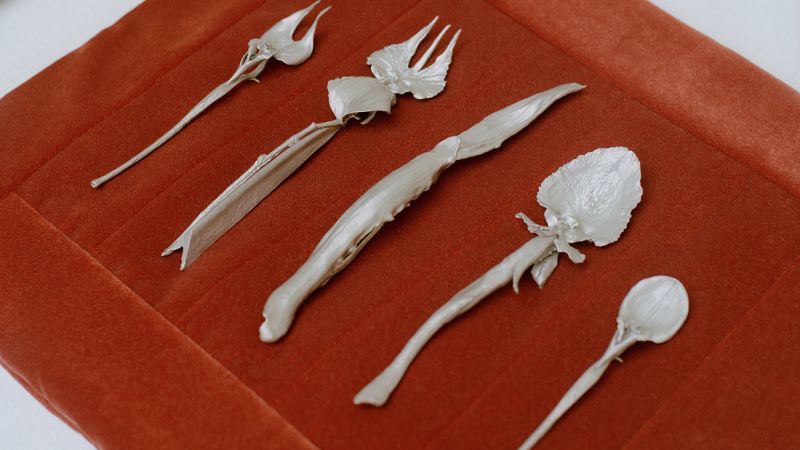
“He explained that in Nigeria, when you go out to eat, you’re asked if you want to use a fork and spoon or eat with your hands,” Marcus-Bello shared. “If you choose hands, you’re served a bowl of water to clean them—a ritual that’s deeply embedded in the culture.” This insight exemplifies how the project seeks to honor cultural practices while redefining cutlery’s role in global design. Ngo also praised Polish designer Marcin Rusak’s work, which he described as pushing the brief to its limits. Rusak’s inspiration came from his childhood, where his grandfather’s expertise in orchid breeding shaped his visual language. The resulting set evokes organic forms, merging natural aesthetics with cutting-edge technology.
Legacy and Innovation
As Ngo’s work gains traction, it challenges the notion that cutlery is merely a functional object. By blending historical reverence with futuristic possibilities, he invites a reevaluation of how we interact with the tools we use daily. The Denver exhibition and his book serve as both a tribute to past design excellence and a call to action for future creators. “This isn’t just about collecting,” he said. “It’s about rebuilding a narrative that’s been overlooked for too long.”
His project also highlights the potential of 3D printing to transform the industry. Sintered steel allows for intricate shapes and textures that traditional methods struggle to achieve, opening new avenues for creativity. For Ngo, this technology represents a way to reconnect with the tactile and visual aspects of cutlery, which he believes are often lost in mass production. “There’s a richness in the material that you can’t replicate with standard techniques,” he noted, emphasizing the tactile experience of using handcrafted utensils.
Through his efforts, Ngo hopes to inspire a new generation of designers to think beyond convention. The collaboration with artists like Kim and Marcus-Bello demonstrates how cultural contexts can influence design, making cutlery more than just a tool but a reflection of identity. As the exhibition and book prepare to debut, they symbolize a turning point in the history of flatware, proving that even the smallest objects can carry profound meaning. “Cutlery is more than metal and curves,” Ngo said. “It’s a conversation between past and future, tradition and innovation.”
In a world increasingly dominated by digital aesthetics, Ngo’s work reminds us of the value of physical craftsmanship and the stories embedded in each piece. His journey from a single vintage set to a global movement underscores how design can evolve through personal passion and collective creativity. As the industry stands on the brink of a new era, the legacy of figures like Wirkkala and the vision of emerging designers like Rusak and Kim will shape what comes next. For Ngo, this is not just a collection of spoons and forks—it’s a celebration of the enduring power of design to connect, inspire, and transform.