Amy Sherald finds her people

Amy Sherald finds her people
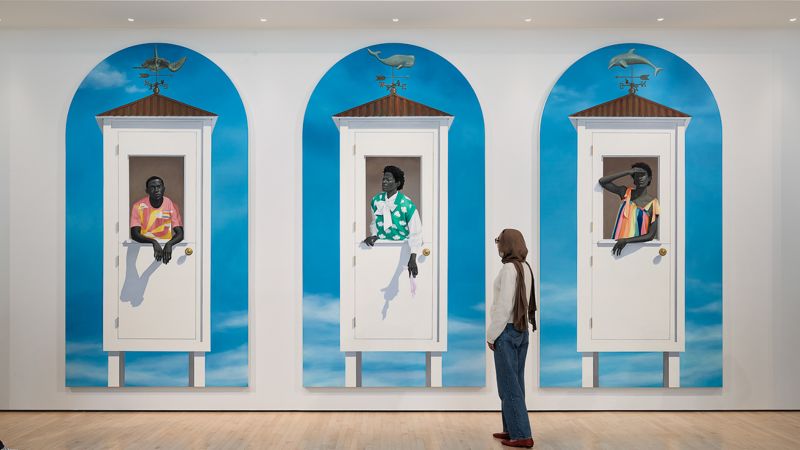
Amy Sherald finds her people – On the opening day of the “Amy Sherald: American Sublime” exhibit at Atlanta’s High Museum of Art, Robyn Palmore-Amos sat in front of one of the artist’s paintings, reflecting on the profound connection it evoked. “It felt like the subjects could be my aunt, my uncle, or even my kids,” she said, her voice carrying a mix of nostalgia and admiration. The exhibit, which has been touring the country for 17 months, has now reached its final stop in the city, drawing attention to Sherald’s ability to reframe American identity through her bold, unflinching portraits.
The Michelle Obama Portrait and Its Cultural Impact
Diana Beasley, a young admirer of Sherald’s work, had a memorable experience on her 12th birthday, when she spent the day at the High Museum surrounded by the artist’s paintings. She had learned about Sherald in school, intrigued by the way her art blends realism with a playful, almost cartoonish quality. Her favorite piece was the official portrait of former First Lady Michelle Obama, a work that captures the former president’s gaze with striking intensity. In Sherald’s style, Obama’s skin is rendered in shades of gray, contrasting with the vibrant black-and-white dress she wears, adorned with multicolored geometric patterns. The soft baby blue background adds a serene backdrop to the image, which emphasizes Obama’s determination. “She looks serious about her job,” Diana remarked, highlighting the portrait’s power to convey both strength and humanity.
The Obama painting, displayed prominently in the Atlanta exhibit, became a centerpiece of the national tour. When it first debuted at the Smithsonian’s National Portrait Gallery in 2018, it was paired with Kehinde Wiley’s portrait of President Barack Obama, marking a significant moment for Black representation in the arts. At the time, the exhibit was seen as a celebration of diverse narratives, with Sherald’s work fitting seamlessly into the nation’s cultural canon. But eight years later, the political landscape has shifted, and the same portrait now serves as a reminder of the tension between artistic expression and institutional alignment.
From the Smithsonian to the Baltimore Museum of Art
The “American Sublime” exhibit was originally slated to return to the National Portrait Gallery, following its earlier stop at the Whitney Museum in New York. However, Sherald’s decision to withdraw the entire show came after she learned the Smithsonian had plans to feature her painting “Trans Forming Liberty” alongside a video documenting public reactions. The work depicts a Black transgender woman standing in the iconic pose of the Statue of Liberty, symbolizing freedom and resilience. “To contextualize the piece,” the Smithsonian explained, but Sherald saw it as a move that compromised her artistic vision.
Instead, she redirected the exhibit to the Baltimore Museum of Art, where it was met with overwhelming enthusiasm. The BMA reported that the show attracted more than 80,000 visitors, surpassing the attendance of its previous most popular exhibition, the 2016-2017 “Matisse/Diebenkorn” display, which drew 46,000 people. Sherald’s ability to highlight the everyday lives of Black individuals has become a powerful counterpoint to the federal government’s portrayal of America. Her work, which often features ordinary people in moments of quiet dignity, challenges the dominant narratives promoted by institutions like the Smithsonian during the Trump administration.
“American Sublime” was curated by Sarah Roberts, who noted that the exhibit initially felt celebratory. Two years prior, when the show was hosted in San Francisco, the museum acquired Sherald’s “For Love, and for Country,” a painting that reimagines Alfred Eisenstaedt’s iconic “V-J Day in Times Square” photograph. In Sherald’s version, two Black men embrace, wearing sailor hats, while holding each other in a gesture of love and solidarity. “It was a nod to the LGBTQ community’s role in San Francisco,” Roberts explained, underscoring the exhibit’s original intent to honor diverse identities.
But as federal and state governments implemented policies restricting LGBTQ rights, the act of representation became more than an artistic choice—it transformed into a political statement. “It feels like more of a commitment,” Roberts said. “Like a reassertion of no, actually this is the America that exists in this museum, in this city, and we are not letting that go.” The withdrawal of the exhibit from the Smithsonian, and its relocation to Baltimore, underscored this tension. The Trump administration criticized “Trans Forming Liberty” for “fundamentally straying from the mission and spirit of our national museums,” a critique that Sherald’s team viewed as an attack on the freedom of artistic expression.
The Crisis of Representation and Sherald’s Vision
During his second term, President Donald Trump’s policies included racist social media posts, the dismantling of minority-focused programs, and the welcoming of white South African refugees while excluding African and Central/South American asylum seekers. Health care reforms and anti-trans legislation further marginalized communities of color, creating a cultural divide between the government’s vision of America and the realities captured by artists like Sherald.
“American Sublime” has since become a mirror to this ideological conflict. Sherald’s work, which centers on Black subjects in their authentic, unpolished state, challenges the federal government’s narrow depiction of national identity. Her portraits, with their vivid colors and intricate details, celebrate the everyday lives of Black Americans, from the poised elegance of Michelle Obama to the quiet resilience of a Black transgender woman. “The viewpoint at trial, both politically and in Sherald’s art, is whose history and whose lives get to be considered American,” Palmore-Amos observed, emphasizing the exhibit’s role in questioning who gets to define the nation’s story.
Sherald’s popularity is not just a reflection of her artistic talent but also of a broader cultural shift. Her ability to render Black subjects with both grace and unflinching honesty has resonated with audiences across the country, making her work a symbol of resistance and representation. In Atlanta, where the exhibit is currently housed, visitors have praised its ability to bring historical and contemporary Black experiences to the forefront. “It’s like looking into a mirror,” one attendee said, “only the reflection is more beautiful than I ever imagined.”
As the “American Sublime” tour concludes in Atlanta, it leaves behind a legacy of reimagining America’s image. Sherald’s mid-career retrospective, which has traversed the nation’s cultural landscape, now stands as a testament to the evolving relationship between art and politics. Her work, once seen as a celebration, has become a statement of defiance. By capturing the essence of Black life in its most authentic form, Sherald ensures that the stories of her people are not only seen but also remembered as part of the American narrative. The exhibit’s success in Baltimore and its resonance in Atlanta signal a growing recognition of the power of art to shape and redefine national identity.
Ultimately, “American Sublime” is more than a collection of paintings—it is a dialogue between the past and present, a challenge to institutions, and a celebration of the Black experience. As Sherald’s work continues to travel, it carries with it the hope that America’s story will one day include everyone, not just the privileged few who have traditionally shaped it. In a world where representation is often contested, her art serves as a reminder that the true essence of the nation lies in its people, their struggles, and their triumphs.