The Chinese mavericks looking to buck the trends in American college basketball

Daftar Isi
A New Lane to the NBA: Chinese Prospects Rethink the College Route
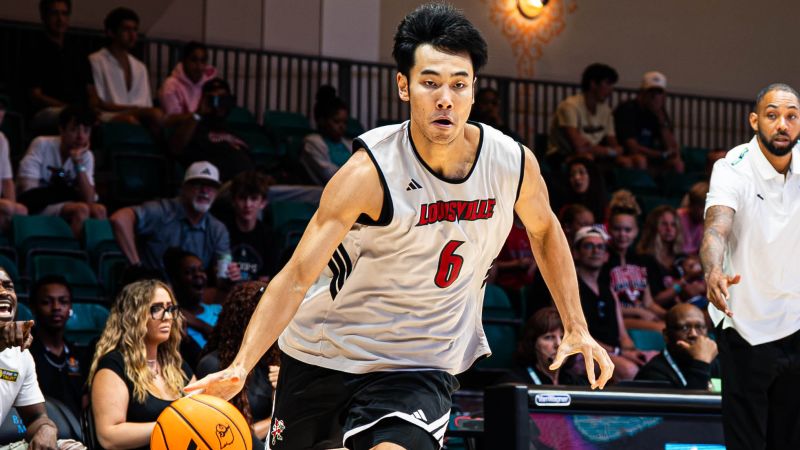
Healfromzero.com – The first Friday of the fall semester at the University of Louisville carries a particular weight for Zhang Boyuan. Inside the Cardinals’ training complex, a weighted sled sits at center court while strength coach Eli Foy climbs aboard to add extra load. The 19-year-old forward from northeast China grips the handles and drives the sled the full length of the floor, surrounded by teammates and coaches chanting his name in unison. It is the closing ritual of every weekly strength block, and for Zhang it marks the threshold of something far larger than a single workout.
He is weeks away from suiting up for his first NCAA Division I season. He is also part of a cohort that now numbers more than ten Chinese players enrolled across American college programs — a small but unmistakable shift in how the next generation of Chinese talent envisions its path to professional basketball.
The Old Road and the New One
For decades, the pipeline from Chinese courts to the NBA ran through the domestic league. Yao Ming, Yi Jianlian, and most recently Yang Hansen — drafted 16th overall by the Portland Trail Blazers last summer — all spent multiple seasons in China’s professional circuit before crossing the Pacific. The domestic league was the assumed proving ground, the only realistic on-ramp to global competition.
That calculus changed in 2021 when the NCAA adopted Name, Image and Likeness rules, permitting student-athletes to earn compensation from endorsements, appearances, and personal-brand deals while still in school. Jonathan Givony, an NBA and NCAA draft analyst, framed the shift plainly: the NIL framework turned American college basketball into a financially viable development platform for international players who previously had no reason to consider it.
“So, seeing Chinese players come over and playing high school basketball and then college basketball, that’s another extension of this same trend.”
The implication is structural. A prospect who once had to wait years in a domestic league before attracting NBA scouts can now enter a high-level American environment at 17 or 18, earn a NIL income, and build a two- or three-year résumé that mirrors the profile of a domestic draft candidate.
Changchun, Curry, and a Dream on Television
Zhang grew up in Changchun, a northeastern industrial city whose Mandarin name translates to “long spring” and whose winters bite far harder than anything Louisville has to offer. Basketball entered his life through the television set in his family’s living room, where his father — a devoted fan — tuned in to NBA broadcasts. Since American games first appeared on Chinese television in 1986, the league’s star power has shaped the aspirations of successive generations of young players across the country.
For Zhang, the era of the Golden State Warriors and Stephen Curry defined his formative years. The Warriors became his team; Curry became his player. Yet as veteran basketball journalist Jia Lei, who has covered Chinese hoops for two decades, observed, the NBA remained a goal that Chinese kids could picture vividly but rarely imagined as attainable.
“For every kid who hoops in China, playing in the NBA is a dream that can be seen, but never reached.”
Zhang’s domestic competition, meanwhile, offered little resistance. Jia described him as the best player in his age group across the country. Representing a top-tier high school program in Changchun, he helped his team finish third at a national tournament. At the 2024 FIBA U17 World Cup and the U18 Asian Cup, he averaged more than 17 points per game in both events, combining a quick first step with the ability to finish at the rim and knock down catch-and-shoot or pull-up three-pointers.
One Game in Portland
The turning point arrived not in a Chinese gymnasium but on a Portland arena floor last April, during the Nike Hoop Summit. Zhang was named to the World Team, a global showcase squad assembled from the sport’s most promising young talents. Across the court stood the United States team, loaded with some of the country’s most heralded prospects.
He scored six points in the opening quarter, then watched from the bench as AJ Dybantsa and Cam Boozer seized control for the Americans. The World Team fell 124-114. The experience of American speed, physicality, and decision-making at that level hit Zhang with a force no domestic game had ever delivered.
“Before that game, I never thought about moving to America. My plan was to go to a good college in China. But just that single game changed everything.”
Back in Changchun, he spent weeks convincing his parents to let him cross the Pacific. They agreed. He enrolled at Veritas Academy in California for a full academic year, where he averaged 20.2 points per game against high-level high-school competition. College scouts took notice. ESPN placed him at No. 56 in the 2026 recruiting class, and Louisville extended its invitation.
What Comes Next
Zhang’s story is no longer an outlier. With more than ten Chinese players now navigating American college programs, the question for Chinese basketball’s development apparatus is no longer whether the college route works, but how many more prospects will choose it each year. The NIL framework removed the financial disincentive; the competitive gap between American college basketball and China’s domestic circuit removed the developmental one. What remains is the question every young player in Changchun, Guangzhou, or Beijing now asks at the dinner table: if the dream is visible, why not walk toward it sooner?
“If I didn’t have a dream or a plan to play higher level basketball, I would not have come to the US.”
For Zhang, the answer was settled in a single quarter in Portland. For the next wave of Chinese prospects, the door is already open.
Related Reading
Frequently Asked Questions
What is The Chinese mavericks looking to buck?
The Chinese mavericks looking to buck is the main topic of this guide. The article explains the context, practical details, and next steps readers should understand.
Why does The Chinese mavericks looking to buck matter?
The Chinese mavericks looking to buck matters because readers are looking for a useful answer, not just a short summary. Good content should match search intent and help them decide what to do next.