This Iowa Democrat is stirring hopes of a red state comeback by charting his own path

Daftar Isi
Iowa’s Most Watched Race: How a State Auditor Is Betting on a Post-Partisan Playbook
Healfromzero.com – Iowa has not sent a Democrat to the governor’s mansion since 2006, a drought that made the state a reliable blue dot on Republican maps for nearly two decades. Yet the 2026 cycle has turned the Hawkeye State into one of the most scrutinized battlegrounds in the country, and at the center of that transformation sits Rob Sand, the 44-year-old state auditor who has staked his campaign on an almost radical premise: that voters are exhausted by the machinery of two entrenched parties and hungry for something else entirely.
Sand’s approach is as theatrical as it is ideological. At each of his campaign stops, he opens by asking Republicans and independents in the room to raise their hands, then offers a polite round of applause before turning to the Democrats, who typically fill the majority of the crowd. The ritual is designed to signal that his audience is not a monolith. Later, often near the end of an evening, he invites everyone to stand and sing the opening verse of “America the Beautiful,” stepping aside to join the chorus rather than leading it from a podium.
“Shouldn’t politics always be like that? Bring a bunch of people into a room, acknowledge first that you disagree and then say, you know what? Left-wing, right-wing – one bird! We’re all still in this together, so let’s work together.”
A Hundred Towns, One Message
The campaign’s physical architecture is as deliberate as its symbolism. Sand pledged over the summer to hold 100 town hall meetings, touching every county in the state. That commitment made stops like Independence, the Buchanan County seat nestled along the Wapsipinicon River in eastern Iowa, non-negotiable on his schedule. The town’s name, he acknowledged to a tightly packed audience inside the Sanity Room, a crowded watering hole in downtown Independence, carried an unintended resonance with his message.
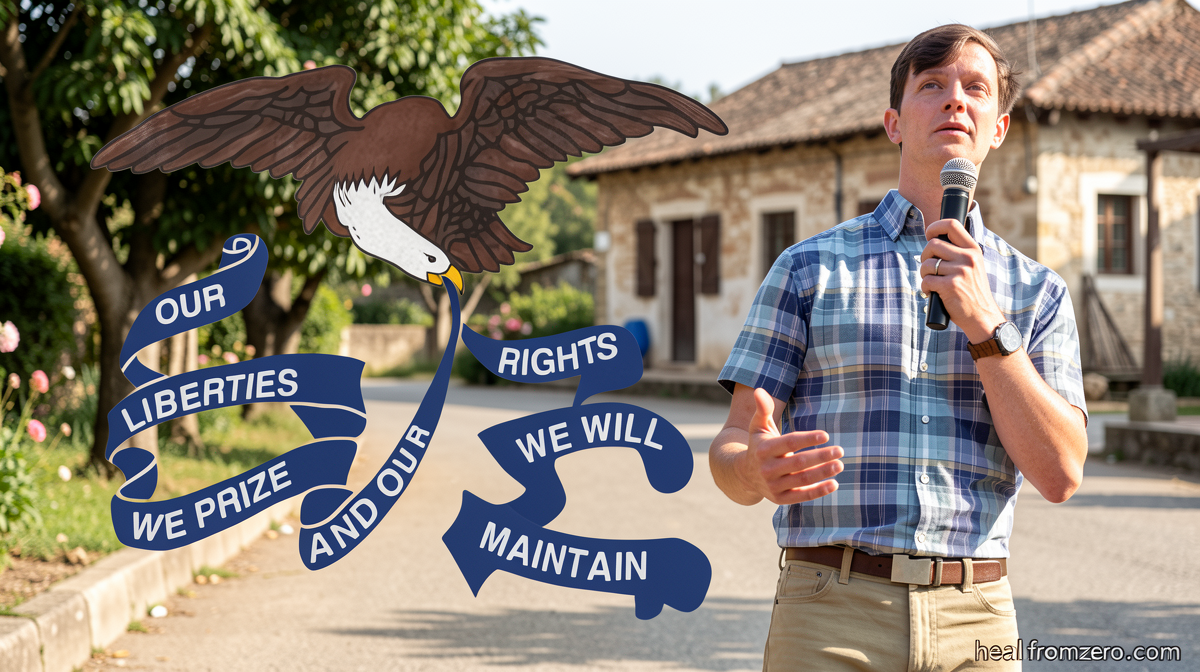
He does not lead with party labels. Audiences quickly learn that the man in the plaid shirt is also a bow hunter, a father of two, and someone who quotes scripture without apparent irony. He frames the red-blue split as something pathological rather than natural.
“I think our political system is broken. Mostly because it’s run by two private clubs and they’re more interested in beating up on each other than they are in solving our problems.”
The critique extends to ballot mechanics. Sand questions why independent voters are structurally disadvantaged in a system that forces a binary choice.
“Why do we have to only pick from the lesser of two evils? Why do we make independent voters less equal?”
The Electoral Arithmetic
For all the warmth in his delivery, the numbers are unforgiving. Registered Republicans outnumber Democrats in Iowa by more than 180,000 voters. Sand’s path to victory therefore depends not on mobilizing a base that already votes his way, but on converting or persuading a substantial slice of the party that has dominated state government for years. He frames this not as a partisan project but as a civic one.
“There’s a lot of people out there who are happy to do politics to gin up anger and to make people full of hatred for their neighbors and their friends. I’m trying to do the opposite.”
His opponent, Zach Lahn, is a GOP businessman and farmer who stunned party leadership in the June primary by unseating Rep. Randy Feenstra, the candidate President Donald Trump had personally endorsed. Lahn’s upset win signaled that even within the Republican coalition, the old loyalty structures are fraying. Sand, by contrast, is the only Democrat currently holding statewide office in Iowa, a distinction that gives him institutional credibility even as it underscores how thin the party’s footprint has become.
The governor’s race does not exist in isolation. A wide-open contest for the state’s U.S. Senate seat and three fiercely competitive congressional districts have layered additional stakes onto the November ballot. For the national Democratic Party, Iowa represents one of its most consequential tests of whether the brand can still compete in a state where it has been effectively locked out of executive power for nearly twenty years.
What Voters Actually Hear
The singing, the hand-raises, the plaid shirt—these elements risk reading as performance unless they land with people who have no reason to like a Democrat. John Fish, a Republican who attended a Sand town hall in Allamakee County, said he had heard about the “America the Beautiful” routine beforehand and expected it to feel forced. He found himself singing “from sea to shining sea” along with the room.
“I thought it would seem cheesy, but at the time it was not. Politicians all kind of say the same thing, ‘We’ve got to come together, we’ve got to do this thing,’ but for some reason he seems”
Fish walked away with what he described as a favorable impression, a small but telling data point in a campaign whose entire strategy rests on whether sincerity can outpace skepticism in a state where the opposing party has held the governor’s chair since 2007. Sand’s bet is that the exhaustion with partisan combat runs deeper than the loyalty to either club, and that a candidate willing to step aside and sing along might, improbably, find enough Iowans willing to sing back.
Related Reading
Frequently Asked Questions
What is This Iowa Democrat is stirring hopes?
This Iowa Democrat is stirring hopes is the main topic of this guide. The article explains the context, practical details, and next steps readers should understand.
Why does This Iowa Democrat is stirring hopes matter?
This Iowa Democrat is stirring hopes matters because readers are looking for a useful answer, not just a short summary. Good content should match search intent and help them decide what to do next.