‘Residual algae’ coats part of newly opened Reflecting Pool

Algae Lingers in Reflecting Pool Despite Trump Administration’s Renovation Claims
Residual algae coats part of newly – Days after the Lincoln Memorial Reflecting Pool was officially reopened following extensive renovations, a noticeable issue has emerged: algae has begun to appear in parts of the water. While the Trump administration has emphasized the project’s success, highlighting the president’s role in revitalizing the iconic landmark, the algae’s presence has sparked questions about the long-term effectiveness of the work.
Residual Algae Identified as Part of the Renovation Process
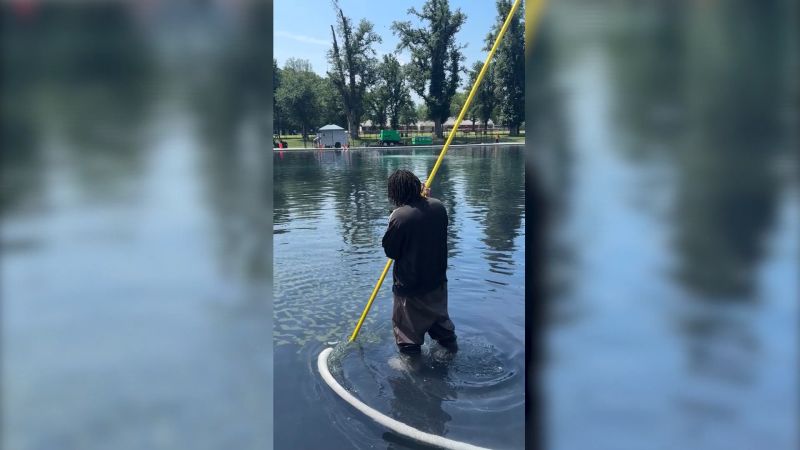
Shortly after the pool was filled, CNN observed algae accumulating near the water’s edge, prompting a response from the Interior Department. A spokesperson for the agency explained that the algae is “residual,” stemming from the supply lines that were inactive during the eight-week construction period. This explanation was given following the release of videos showing workers actively removing the algae from the pool’s bottom.
“What you are seeing is residual algae from the supply lines, which have been sitting dormant for eight weeks while construction has been taking place. It’s part of the normal startup process. We are removing the algae, and the nanobubblers will maintain the pool and keep it algae free,” said Kate Martin, the Interior Department’s communications director, in a statement.
Martin also took the opportunity to compare the current renovations to past efforts, stating that President Donald J. Trump’s project is “an expert builder who has fixed the Reflecting Pool for good,” unlike the “failed and extremely costly” attempt under the Obama and Biden administrations. The National Park Service has invested in an advanced ozone nanobubbler filtration system, which is designed to prevent future algae growth.
Cost Escalations and Public Promotions
The Trump administration has consistently highlighted the Reflecting Pool project as a flagship initiative, with the president frequently referencing it in recent public appearances. In remarks to farmers in Wisconsin and during Oval Office events, he praised the $14.2 million renovation as a transformative effort that has “made Washington, DC, look better than ever.” However, the project’s budget has seen significant increases since its initial announcement.
Originally estimated at $1.8 million, the cost of the renovations climbed to $13.1 million before settling at $14.2 million. Trump acknowledged the rising expenses in an interview, noting that the project had expanded beyond a simple base repair. “I originally thought I’d do it for $2 or $3 million,” he said, “but now we are fixing up the exterior of it so we will probably be in it for less than $20 million.”
The Interior Department’s statement came in response to CNN’s footage of the algae. Initially, the agency’s representative hesitated, stating the Fish and Wildlife Service wasn’t certain the substance was algae before confirming it was indeed residual. A department official added that they would provide a clearer timeline for its removal the following day, citing rain as a factor that complicated earlier predictions.
Mixed Public Reactions to the Renovations
Residents and visitors near the Reflecting Pool on Wednesday offered varied opinions about the changes. Some praised the effort, while others questioned its necessity. For instance, Lara Harvey, a New Zealander who has resided in Bethesda for a decade, expressed surprise at the pool’s appearance. “I needed to come down to see if it was actually reflecting, and it wasn’t bright blue. And I’m impressed, to be honest. It reflects beautifully,” she said.
Harvey noted that the “American flag blue” paint on the pool’s bottom had exceeded her expectations. “I was expecting a swimming pool. I was expecting swimming pool blue, but I’m really surprised,” she added, reflecting on the visual transformation. In contrast, Marcus Tate, a local resident from Alexandria, criticized the spending, arguing the funds could have been better allocated to address homelessness.
“DC is already a beautiful place,” Tate remarked. “I’m not sure the money was spent on something as minor as upkeep, and I’d have preferred to see more impactful investments.”
Kyra Brown, a Washington, DC, resident, also voiced skepticism about the renovations’ value. Observing the pool from the steps adjacent to it, she said, “It doesn’t look that much different, honestly, to me.” Her comment suggests that while the administration has promoted the project as a major overhaul, some citizens remain unconvinced of its tangible benefits.
Despite the algae issue, the White House social media account celebrated the pool’s reopening last week, declaring, “The water is ON, the Reflecting Pool is reflecting, and D.C. is looking better than ever.” This statement preceded the pool’s full filling, indicating optimism from the administration. Yet, the algae’s presence has raised concerns about the project’s immediate results.
Historical Context and Future Outlook
The Reflecting Pool has been a symbol of Washington, DC, for decades, and its upkeep has long been a point of contention. Under the Obama administration, a contract for similar renovations cost $35.3 million, a figure that Trump’s team has sought to surpass in terms of efficiency and cost-effectiveness. However, the current budget increase has led to speculation about whether the project is truly a success or a continuation of previous inefficiencies.
As the algae is addressed, the focus will shift to whether the nanobubbler system can sustain the pool’s clarity. The spokesperson emphasized that this technology represents a modern approach to water maintenance, but its effectiveness remains to be seen. Residents like Harvey, who have a personal connection to the pool, continue to offer their perspectives, blending admiration for the aesthetic improvements with curiosity about the practical outcomes.
While the administration’s efforts to showcase the pool’s rejuvenation are clear, the algae’s appearance serves as a reminder that even well-planned projects can face unexpected challenges. The upcoming timeline for its removal and the broader implications of the renovation’s cost will likely shape public perception in the coming weeks. For now, the pool stands as a testament to both the promise and the pitfalls of large-scale infrastructure projects in the nation’s capital.
Contributing to this report was CNN’s Abigail Roedersheimer, who documented the algae issue and the mixed reactions from the community. As the pool’s future unfolds, its role as a gathering place and a historical landmark will remain central to the discussion surrounding its transformation.