Italian foreign minister cancels trip to US over Trump’s comments about Meloni

Italian Foreign Minister Cancels Trip to U.S. Over Trump’s Remarks on Meloni
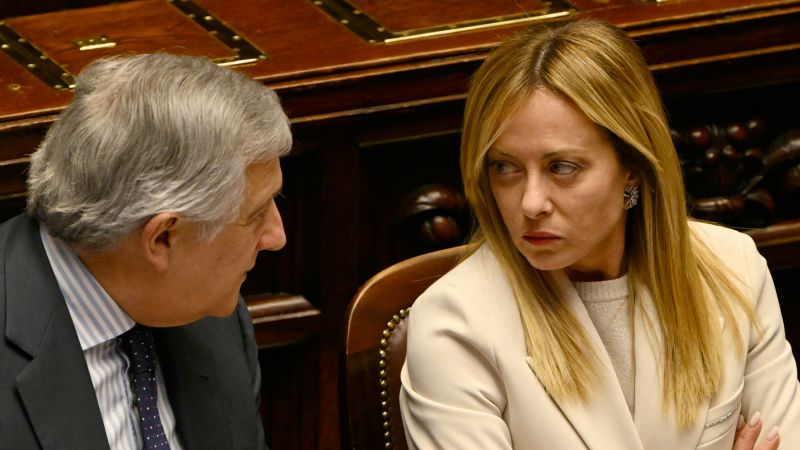
Italian foreign minister cancels trip to US – Relations between Italy and the United States have taken a notable turn following recent remarks by former President Donald Trump about Prime Minister Giorgia Meloni, prompting Italian Foreign Minister Antonio Tajani to cancel an upcoming diplomatic visit. The decision, announced on Friday, marks a new development in the strained ties between the two nations, which have been steadily worsening since Trump’s re-election. Tajani’s absence from the U.S. was set to include a meeting with Secretary of State Marco Rubio, a key figure in shaping U.S. foreign policy, to discuss economic cooperation and critical minerals. The canceled trip underscores growing tensions over Trump’s public criticism of Meloni, a leader who has long been seen as a staunch ally of the United States in Europe.
Trump’s Comments Spark Controversy
According to a dubbed Italian translation of an interview with La7 TV, Trump claimed that Meloni had “begged” him for a photograph during the recent G7 summit in France. He elaborated, “She begged me to take a picture with her. She wanted a photo with me so badly. I wouldn’t have done it, but I felt sorry for her.” The statement, shared by the media outlet, has been interpreted as a personal jab at Meloni, implying that her request for a photo was an act of desperation. While Trump framed his comments as a gesture of goodwill, Italian officials viewed them as disrespectful and undermining.
“Donald Trump’s statements are completely fabricated. I’m frankly shocked. I don’t know why the president of the United States behaves this way towards his own allies, and it’s not the first time it’s happened,” Meloni said in a video posted on X. “I can only say that it’s a shame he doesn’t have the same determination with the enemies of the West, with the enemies of the United States, with leaderships with which he instead appears much more accommodating,” she continued.
Italian Foreign Minister Tajani echoed Meloni’s frustration, labeling Trump’s remarks “offensive.” In a statement released earlier in the week, Tajani emphasized that the comments were not just a minor disagreement but a direct challenge to Italy’s national dignity. The incident comes as the U.S. and its European partners work to mend diplomatic rifts following the G7 summit, where collaborative efforts were highlighted. Yet, Trump’s remarks seem to have exacerbated divisions, signaling a shift in his approach toward Italy compared to other European allies.
Historical Context of the Strained Relationship
The current spat between Trump and Meloni is not an isolated event. Earlier this year, Meloni had criticized Trump’s comments about Pope Leo XIV, specifically his stance on the Iran war, calling the remarks “unacceptable.” In response, Trump accused Italy of failing to support the U.S. in the conflict, a criticism that resonated with some of his base but alienated Meloni and her government. This back-and-forth reflects a broader ideological divide: while Meloni advocates for strong national sovereignty and conservative policies, Trump’s administration has often prioritized pragmatic alliances over shared values.
Despite these tensions, Meloni has remained a pivotal figure in Trump’s foreign policy agenda. She was the only European leader to attend his second inauguration, a gesture that underscored her importance in the U.S. political landscape. Their shared views on strict immigration controls and economic self-reliance have kept them aligned on certain issues, yet Trump’s recent personal attacks have exposed vulnerabilities in their relationship. The Italian government’s reaction highlights how deeply the remarks have affected their diplomatic standing, even as Meloni continues to champion her nation’s interests on the global stage.
Impact on U.S.-Italy Bilateral Cooperation
The canceled trip to the U.S. was part of a larger initiative to strengthen economic ties, particularly in the realm of critical minerals and security partnerships. The Italy-US Business, Investment, Science and Innovation Forum, originally scheduled for early next week in Miami, was abruptly called off following Trump’s remarks. A State Department statement noted that the meeting with Tajani was intended to “advance U.S.-Italy bilateral cooperation on economic security and critical minerals,” a move that now appears to have been undermined by the political fallout.
Trump’s criticism of Meloni has also been tied to her refusal to join the U.S. in military operations during the Iran war. In an interview with NBC News later on Friday, he reiterated his dissatisfaction, stating, “I don’t want her as a fan because she was not there – along with the NATO group – having to do with the Strait.” This reference to the Strait likely alludes to a specific geopolitical issue, possibly involving naval or strategic maneuvers. The comments suggest Trump is viewing Meloni’s stance as a betrayal of NATO unity, a sentiment that has further strained the relationship.
Meanwhile, Meloni has continued to defend her position, framing Trump’s remarks as a reflection of his inconsistent approach to European allies. She argued that while the U.S. leader has been harsh in his criticism of adversaries, he extends undue leniency to those he perceives as allies. This dichotomy has become a focal point of her public messaging, as she seeks to position herself as a resilient leader capable of standing firm against external pressures. The incident has also been leveraged by her domestic supporters to bolster her image as a strong, independent leader.
Broader Implications for U.S. Foreign Policy
Trump’s comments on Meloni have reignited debates about the U.S. approach to its European partners. While his administration has historically emphasized pragmatic alliances, recent actions suggest a more personalized and occasionally confrontational strategy. This shift has raised concerns among European leaders, who worry about the consistency of U.S. support in global affairs. Meloni’s criticism of Trump’s behavior aligns with broader European skepticism of his unpredictable leadership style, particularly in matters of defense and international cooperation.
The incident also highlights the role of media in shaping diplomatic narratives. The dubbed Italian translation of Trump’s interview has amplified the controversy, providing a platform for Meloni to respond with sharp rhetoric. Her video statement, which combined personal and political critique, was widely shared across Italian social media, reinforcing public sentiment against Trump’s remarks. This use of digital platforms to counter U.S. criticism reflects a growing trend in modern diplomacy, where leaders can quickly mobilize support and challenge perceptions in real time.
As the U.S. and Italy navigate this new chapter in their relationship, the implications for future cooperation remain unclear. While the canceled trip may be a temporary setback, it has exposed deeper fractures in their alliance, particularly around issues of national sovereignty and strategic alignment. The coming weeks will be critical in determining whether this incident leads to a lasting rift or serves as a minor blip in an otherwise solid partnership. For now, the focus remains on the fallout from Trump’s words and the political capital Meloni is able to reclaim through her response.
CNN has contacted the White House and the U.S. State Department for additional comments on the matter. In the meantime, the episode has reignited discussions about the role of personal dynamics in international relations and the challenges of maintaining unity among Western allies. As Trump continues to take a hard line with European partners, Meloni’s ability to defend her country’s position will be a key test of her leadership in the region.