
How an Oscar became a symbol of grief and hope for one Texas family
How an Oscar Became a Symbol of Grief and Hope for One Texas Family
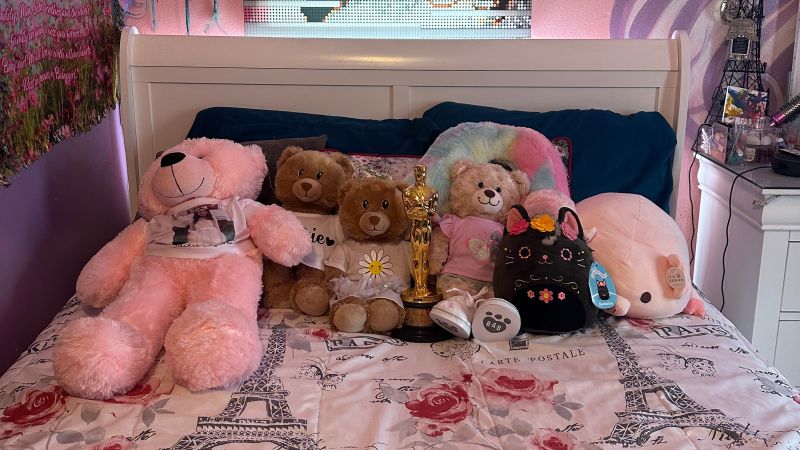
How an Oscar became a symbol – Jackie Cazares’ bedroom remains a frozen time capsule, untouched since the tragic day she was taken from the world. Among the familiar items on her bed — a row of teddy bears — rests a gleaming Oscar statuette, a unique artifact that has transformed into a beacon of both sorrow and solace for her parents. This golden trophy, awarded for the documentary “All the Empty Rooms,” has taken on a new meaning, not just as a cinematic honor but as a powerful reminder of the life Jackie once filled with joy.
A Memorial in the Spotlight
The Oscar’s presence in the room is a poignant juxtaposition of Hollywood glamour and the raw reality of loss. It shares space with everyday mementos of Jackie’s short life: a Ferrero Rocher candy on the dresser, a brush tangled with her dark hair, and a unicorn mural that once adorned the walls. These objects, left behind four years after her death, are now part of a larger narrative that the film aims to capture.
Conall Jones, a producer of the documentary, visited the Cazares family in Texas this spring as part of the film’s promotional tour. During his stay, the Oscar was placed in the family’s home as a tribute to Jackie. The statuette’s journey through the rooms of the Cazares family became a moving display, capturing their deep connection to the girl who is no longer with them. Photos shared with CNN reveal the Oscar in various settings — beside her gravestone, in the presence of her mural, and cradled by her godfather, Manuel Rizo, as he held it to his heart.
“It was overwhelming,” Gloria Cazares said, reflecting on that week in April. “My first thought was this belonged to all of those children who left their empty bedrooms behind, not just Jackie. It wasn’t just an award — it was so much more.”
For Gloria, the Oscar represented more than a trophy. It felt like a memorial, a symbol of the ongoing grief that lingers in the spaces where Jackie once played. The family’s emotional response to the award was deeply personal, as they grappled with the weight of its significance. “Far from Hollywood, the statuette felt more like a memorial than a trophy,” Gloria explained, emphasizing how the moment was a bittersweet tribute to their daughter.
A Voice at the Academy Awards
Earlier that month, Jackie’s story found its way to the Dolby Theatre, where the Academy Awards ceremony honored the film. Gloria Cazares stood among the crowd, delivering a heartfelt tribute to her daughter as she accepted the Oscar with director Joshua Seftel. “Jackie is more than just a headline,” she told the audience, her voice trembling with emotion. “She is our light and our life.”
“Gun violence is now the number one cause of death in kids and teens,” Gloria added. “We believe if the world could see their empty bedrooms, we’d be a different America.”
For the Cazares family, the Oscar was both an opportunity and a burden. It allowed Jackie’s story to reach millions, but it also reminded them of the void she left behind. “I kept thinking, ‘I shouldn’t be doing this. There’s no reason for me to hold an Oscar,’” Gloria said, her words carrying the weight of her daughter’s absence. “But my biggest fear is her being forgotten, and we knew we had to be there to represent her.”
Javier Cazares, Jackie’s father, echoed his wife’s sentiment. “People were asking, ‘did you see any movie stars?’” he recalled, laughing through tears. “And I was like, ‘I’m not here for that. I could care less if I see somebody. I’m here for Jackie.’” Their shared determination to honor Jackie’s memory became a central theme of the night, a testament to the family’s resilience in the face of unimaginable loss.
The Day That Changed Everything
The journey to the Oscars began with a day the Cazares family wished had never happened. On May 24, 2022, Gloria was at her daughter’s school for an award ceremony when a co-worker’s text changed everything: “Shooting at Robb Elementary.” Gloria, a home health nurse, sprang into action, rushing to the scene behind a convoy of emergency vehicles. Her husband, Javier, followed, their lives forever altered by the chaos that unfolded.
The school, once a place of celebration, became a site of horror. Jackie and her cousin, Annabell, were in the same classroom when the shooting began. Parents, panicking, surged behind police tape, desperate to locate their children. For hours, the Cazares family waited in uncertainty, only to learn that Jackie was among the 19 students and two teachers who lost their lives that day. An additional 18 were injured, but Jackie’s fate was sealed in a matter of minutes.
“It was chaotic. Nobody knew exactly what was going on,” Gloria said, recalling the events. “It took us a few hours before we knew what happened.”
Relatives waiting at a nearby hospital later spotted an ambulance arriving with Jackie on a stretcher. A chaplain guided Gloria and Javier to a private room, where they identified their daughter. The sight of her, still breathing, was both a comfort and a crushing reminder of the tragedy that had just begun. “The hardest thing was knowing our daughter was never coming home,” Javier admitted, his voice steady but filled with grief.
Since the shooting, the Cazares family has been unable to touch Jackie’s room. The space, carefully arranged by her weeks before her death, now holds a fragile peace. The purple wall paint and unicorn mural, once vibrant, have become symbols of a life cut short. Yet, through the Oscar and the documentary, they have found a way to keep her story alive, ensuring that her voice echoes beyond the silence of an empty room.