
Hamas says it will dissolve Gaza government as US-brokered ceasefire plan stalls
Hamas says it will dissolve Gaza government as US-brokered ceasefire plan stalls
Hamas says it will dissolve Gaza – On Monday, Hamas declared its intention to dissolve the government in Gaza, a move that analysts view as a calculated strategy to shift the dynamics of the ongoing conflict. The militant group’s decision comes amid stalled progress in the US-backed ceasefire agreement, which has left the enclave in a state of prolonged tension. The announcement, made by Ismail al-Thwabta, head of Hamas’ Government Media Office (GMO), signals a potential realignment of power structures, with Hamas proposing to transfer governance to the Palestinian technocratic committee established under the peace deal.
Symbolic Shift and Strategic Maneuvering
While the dissolution of Gaza’s government does not immediately alter the practical control Hamas holds over the territory, it carries significant symbolic weight. Al-Thwabta emphasized that the group is prepared to hand over administrative responsibilities to the technocratic committee, which is meant to govern Gaza as part of the ceasefire framework. This transition, however, hinges on the committee’s ability to establish itself effectively. The statement does not explicitly address disarmament, a crucial requirement of the second phase of the agreement that Hamas has consistently resisted.
“We call on all concerned and relevant parties to immediately accelerate the steps for the National Committee for the Administration of Gaza (NCAG) to enter quickly and assume its national and administrative duties and responsibilities, in order to strengthen the steadfastness of our noble Palestinian people and heal their wounds,” al-Thwabta said in a statement at Al-Aqsa Martyr’s Hospital in Gaza City.
The move is seen as an effort to redirect attention from Hamas’ refusal to disarm toward the broader goal of establishing a recognized Palestinian administration. By emphasizing its willingness to cede governance, Hamas aims to counter Israel’s narrative that the group is unwilling to relinquish power. This strategy aligns with the group’s longstanding tactics of leveraging international support to pressure Israeli authorities.
Stalemate in the Ceasefire Negotiations
The US-brokered ceasefire plan, which was designed to halt hostilities and establish a framework for governance in Gaza, has faced repeated setbacks. The agreement, conceived in October, outlined 20 key elements, including the creation of the NCAG. However, the committee has remained in Cairo, unable to enter Gaza or assert authority there. The Board of Peace, a body tasked with advancing the deal, acknowledged Hamas’ announcement but stressed that it would require tangible actions rather than mere promises.
“The core principle remains one authority, one law and one weapon,” the Board of Peace said on X, urging Hamas to disarm and fulfill its commitments under the ceasefire deal.
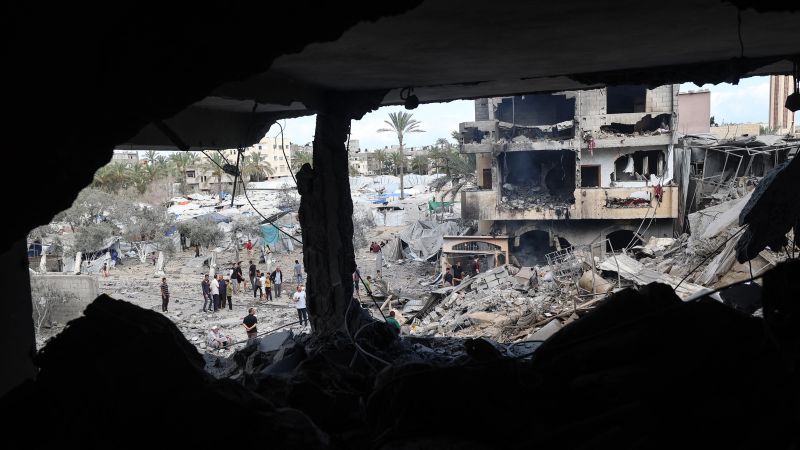
Meanwhile, the situation on the ground continues to deteriorate. With the ceasefire plan unfulfilled, Gaza remains under a state of uncertainty. Bodies lie unclaimed in streets, and rats scuttle through abandoned homes, a stark reminder of the humanitarian crisis that has persisted for months. The delay in implementing the agreement has exacerbated tensions, leaving both sides in a deadlock.
International Pressure and Domestic Politics
President Donald Trump has been a central figure in the ceasefire negotiations, pushing for a resolution that could reshape the political landscape in Gaza. His advocacy has placed pressure on Israeli Prime Minister Benjamin Netanyahu, who has resisted elements of the plan, particularly the handover of governance to the technocratic committee. Hamas, by dissolving its government, seeks to appeal to Trump’s influence and portray itself as a pragmatic actor willing to cooperate.
According to Muhammad Shehada, a Gaza expert at the European Council on Foreign Relations, Hamas’ statement is an attempt to bypass Netanyahu’s resistance and secure Trump’s backing. “Hamas has clearly said that the move was intended to pave the way for a breakthrough,” Shehada explained to CNN. “The Israelis are saying that Hamas is refusing to leave government and particularly security, so what they tried to emphasize in this statement is that they’re willing to give up everything vis-a-vis governance from A to Z.”
“Even if that bet pays off – even if Trump is convinced, and even if everything goes according to plan – Israel still has ultimate control over everything in Gaza,” Shehada added. “Israel would still foil NCAG.”
The NCAG, envisioned as a neutral governing body, represents Hamas’ hope for international recognition without reservations. Shehada called the group’s maneuver a “savvy move,” though he noted its timing may be critical. “The committee has been waiting for months, and now Hamas is trying to fast-track its entry. But without Israel’s cooperation, the plan will remain a mirage,” he said.
Mediators and the Path Forward
The key mediators in the ceasefire negotiations—Qatar, Turkey, and Egypt—have been striving to present a unified front to Trump. Their efforts aim to demonstrate that the agreement is progressing, even as the timeline for implementation remains unclear. Michael Milshtein, head of the Palestinian Studies Forum at Tel Aviv University, described Hamas’ announcement as a strategic move rather than a sudden shift. “This is not a surprise. Hamas and its allies have been working to change the formula, ensuring that the NCAG becomes a central piece of the peace process,” Milshtein told CNN.
Despite the symbolic gestures, the practical challenges persist. The NCAG requires Israeli consent to operate, and the militant group’s continued dominance over security and administrative functions complicates the transition. Al-Thwabta claimed that “full reassurance” has been given that all preparations are in place for the handover, including the status of approximately 60,000 government employees who will be recognized as state workers under the new system. However, the reality of Gaza’s situation suggests that these assurances may not be enough to overcome the deep-seated mistrust between Hamas and Israel.
Broader Implications and Unanswered Questions
The stalled ceasefire has raised concerns about the future of Gaza. With the technocratic committee unable to enter the enclave, the balance of power remains tilted in favor of Hamas. Analysts warn that without a clear timeline or agreed-upon conditions for the NCAG’s activation, the ceasefire could collapse entirely. The recent meetings in Cyprus, hailed as “highly productive” by the Board of Peace, have done little to resolve these fundamental issues.
As the conflict drags on, the humanitarian and political stakes grow higher. The dissolution of Hamas’ government is a step toward institutionalizing a new administration, but it does not guarantee peace. The international community now faces the challenge of convincing Israel to cede control, while Hamas must prove its commitment to the plan’s terms. The next phase of the agreement, which includes the establishment of pilot areas for the NCAG, remains a fragile hope in a landscape of uncertainty.
In the end, the success of the ceasefire hinges on the ability of all parties to reconcile their differences. Hamas’ symbolic gesture is a critical piece of the puzzle, but without sustained diplomatic efforts and a willingness to compromise, the dream of a unified Palestinian government in Gaza may remain out of reach. The world watches closely as the balance of power continues to shift, with the fate of the ceasefire hanging in the delicate hands of negotiators and leaders on both sides.