Tensions flare at court hearing on Trump’s golf course renovation after president says construction will begin ‘immediately’

Daftar Isi
Trump’s East Potomac Golf Course Plan Draws Sharp Courtroom Scrutiny
Healfromzero.com – A dispute over the future of the East Potomac Golf Course in Washington, DC, escalated Monday as President Donald Trump insisted that renovation work would start immediately while a federal judge continued to examine limits on the administration’s authority to alter the public site.
The conflict has developed into a closely watched test of how the Trump administration communicates and carries out plans involving federally managed public land. Preservation advocates and golfers have challenged the proposed changes to the course, arguing that the public park should not be transformed without proper legal review.
Trump renewed his position early Monday in a social-media post, saying the government did not require approval before moving forward. His statement came despite an order from US District Judge Ana C. Reyes requiring at least three days’ advance notice before any work that could permanently change the course.
“Work is scheduled to begin IMMEDIATELY! The finished product will be World Class, and bring income and great prestige back to D.C.”
Late Monday, Trump again criticized the condition of the property and the litigation surrounding it. He described the golf course as “Trash Island” and said it had been neglected for decades, calling it an unsafe and unworkable project in its current form.
“’Trash Island,’ Washington, D.C., the nickname for the broken and dilapidated Golf Course that is the subject of frivolous litigation in the United States Court System, before a judge that seems not to want Greatness for our Capital or our Nation (but who knows?), has been badly managed for so many decades that it is a completely nonviable and unsafe Project.”
Trump said his proposed overhaul would remake the location into “an Island of Beauty and Success.”
Questions over the administration’s plans
The hearing before Reyes lasted for hours and exposed a significant gap between Trump’s public declarations and the government’s courtroom position. Justice Department lawyers sought to distinguish the president’s social-media posts from statements made by officials responsible for managing the course.
Reyes pressed the administration for a clear account of whether a final renovation proposal existed. At the start of the hearing, she expressed frustration with what she viewed as inconsistent explanations.
“I don’t know what to do, when I keep getting different stories,”
Later, Reyes returned to the apparent contradiction between Trump’s assertions and testimony offered by administration witnesses. She said the president had told the public there was a final plan, while lawyers and witnesses had indicated otherwise.
“I have, on the one hand the president of the United States saying to the American people … there is a final plan,”
“I have you all telling me, witnesses saying what they’re saying, there is no final plan … which is it?”
Robert Stander, a Justice Department attorney presenting much of the government’s argument, had difficulty offering a direct answer. Reyes rejected comparisons between Trump’s posts and an executive order that merely launches agency work rather than establishes a completed decision.
Associate Attorney General Stan Woodward, the Justice Department’s third-highest-ranking official, later told the judge that there was no plan to close the course in the ordinary meaning of those words. He also argued that it placed Stander in an uncomfortable situation to expect a lower-level lawyer, who was not Senate-confirmed, to contradict the president publicly.
Tree removal remains central to the case
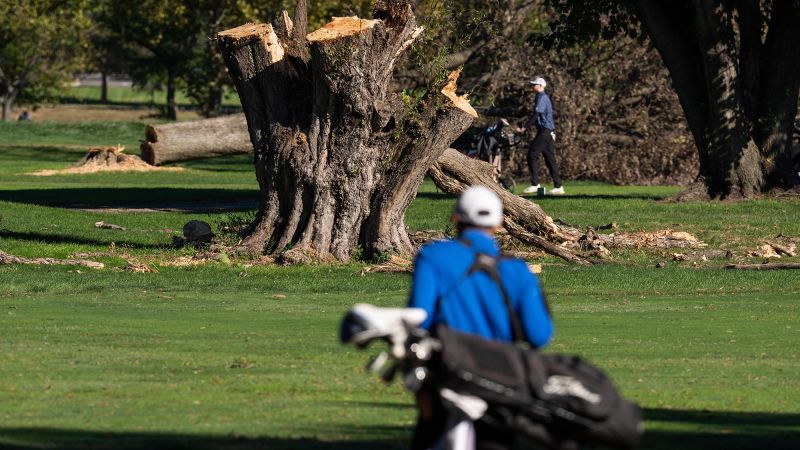
Although the broader challenge concerns the possible renovation of the golf course, much of the immediate legal dispute has centered on the removal of more than 400 trees from the park earlier in October. The administration carried out that work with less than a day’s notice to the court.
Government lawyers have maintained that the tree removal was routine maintenance and was not tied to a plan to renovate the course. Reyes has questioned that explanation, particularly given the timing and the scope of the work.
Last week, the judge said she was “furious” that hundreds of trees had been removed without the notice she believed was required. She ordered the government to stop cutting down additional trees through October 26.
Her more recent order requires the administration to provide three days’ notice before making an “irreparable modification” at the golf course. That condition is intended to give the court and the parties challenging the project an opportunity to respond before changes occur that cannot easily be undone.
Reyes is now weighing whether a longer-lasting order should restrict further activity at the property, including any additional tree cutting. Such an order could shape the administration’s ability to advance construction plans while the underlying case continues.
A local land dispute with wider legal stakes
The case concerns a single public golf course, but it has drawn substantial attention from senior Justice Department officials. It also illustrates a recurring issue in litigation involving the executive branch: whether courtroom representations from agencies and government lawyers align with public statements made by the president.
For residents, golfers and park users, the outcome could determine how quickly the East Potomac site changes and whether the public has a meaningful opportunity to challenge those changes before they occur. For the administration, the case raises questions about the procedures required before federally managed recreational land can be significantly altered.
The Justice Department has also sought Reyes’ removal from the case. In a Friday filing, the department accused the judge of having a “disdain for the” administration, though the filing’s full allegation was not included in the material available here.
As the legal battle proceeds, the central issue remains unresolved: whether the administration has a settled plan for the course, and whether it can begin transforming the property before the court decides what restrictions should apply.
Related Reading
Frequently Asked Questions
What is Tensions flare at court hearing on Trump?
Tensions flare at court hearing on Trump is the main topic of this guide. The article explains the context, practical details, and next steps readers should understand.
Why does Tensions flare at court hearing on Trump matter?
Tensions flare at court hearing on Trump matters because readers are looking for a useful answer, not just a short summary. Good content should match search intent and help them decide what to do next.